As Katherine Sheen rested on the banks of Hensham river on 3 August 2005, her gaze fell upon a small, dirt-covered object amongst a tangle of tree roots. Cleaning away the soil, she realised it was a leather pouch. It fell apart as Katherine opened it, and the items inside fell to the ground. Although her university degree had merely touched on the Roman occupation of ancient Britain, providing a very general overview of everyday activities, once she'd rubbed off some of the dirt, Katherine immediately identified the coins in her hand as coming from that era. Despite their discoloration, Katherine had no doubt they were historically significant. As soon as she got home, she informed the police of her find.
That might have been the end of the story - except for the fact that the farmer who owned the adjacent field then mentioned the lines of large stones his plough kept running into. By mid-August, with the farmer's permission, a team of archaeologists, led by Professor Kevin Durrand, were camped out in the field. Durrand had previously worked on other projects where pieces of ancient pottery and the discovery of an old sword had led archaeologists to unearth sizeable Roman settlements. He was keen to start excavations at Hensham, and had got funding for a three-month dig. What his team eventually discovered, three weeks into excavations, were the remains of the outer walls of a Roman villa. As many Romans in Britain simply lived in wooden houses with thatched roofs, the family that occupied the villa must have been very wealthy. As the team continued their work, they looked for evidence that might indicate whether the villa had been attacked and purposely demolished, or fallen into such a poor state that it eventually collapsed. Looking at the way a set of slate roof tiles had fallen to the ground, they decided on the latter. What caused the noble Roman family and their servants to abandon the villa remains open to speculation. Another find was six blue beads, crafted from glass, which the archaeologists speculated were part of a necklace. Durrand has previously found gold bracelets on other sites, but for him the beads are no less significant. 'Every find contributes to the story,' he says.
On the outer western wall, the archaeologists uncovered a number of foundation stones. On one is carved what the archaeologists made out to be a Latin inscription. But as the stone itself has endured centuries of erosion, the team has yet to work out what it says. Another find was a section of traditional Roman mosaic. Although incomplete, enough pieces remain to show a geometrical pattern and stylised fish. From this, Durrand assumes that a bath house would have been a feature of the villa. While his team have so far not found any hard proof of this, Durrand is confident it will turn out to be the case.
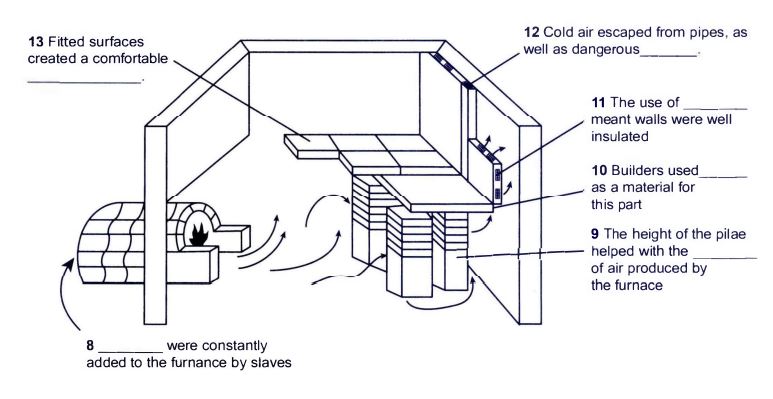
Something that the team are particularly excited about is evidence of a heating system, which would have served the Roman family and their visitors well in winter months. Although much of the system has long since crumbled at Hensham, Durrand and his team believe it would have been based on a typical Roman hypocaust; they have created a model for visitors to see. The furnace that produced the hot air needed to be kept burning all the time, a task that would have fallen to the villa's slaves. As large branches would have taken too long to produce the heat required, it is more likely that twigs would have been gathered from surrounding woodland instead. Another fuel source used in some Roman hypocausts was charcoal, but evidence for this at Hensham has not presented itself. The underfloor space was made by setting the floor on top of piles of square stones. Known as pilae, these stones stood approximately two feet high. The gap this created meant that the hot air coming out of the furnace was not trapped and restricted. Instead its distribution around the pilae and under the floor was free flowing. Floor tiles were not placed directly onto the pilae but separated by a layer of concrete, or at least a primitive version of it. This would have made the whole structure more solid, and helped reduce the risk of fire spreading to upper levels. The walls of the rooms above the heating system were made of bricks, but the key point here is that they were hollow, in order to allow heat to rise around the rooms and provide insulation. Some have been recovered from the Hensham villa and are now undergoing preservation treatment.
Another feature of the heating system that archaeologists have identified at Hensham was its clay pipes. These were cleverly built into the wall so as not to take up space. The principal reason for including the pipes was to let out air through a vent in the roof once it had cooled down. What the Romans may not have realised, however, was that gas produced by the burning fuel was expelled in this way too. In high doses, it could have been lethal if it had leaked into the upper levels. Inside the rooms in the villa, a layer of plaster would have been applied to the walls and painted in rich colours. Sadly, none of the original plaster at Hensham still exists. However, some of the tiles that the family would have walked on have survived. They would certainly have felt warm underfoot and helped generate an indoor climate that the family could relax in. In its day, the Hensham hypocaust would have been a remarkable piece of engineering.