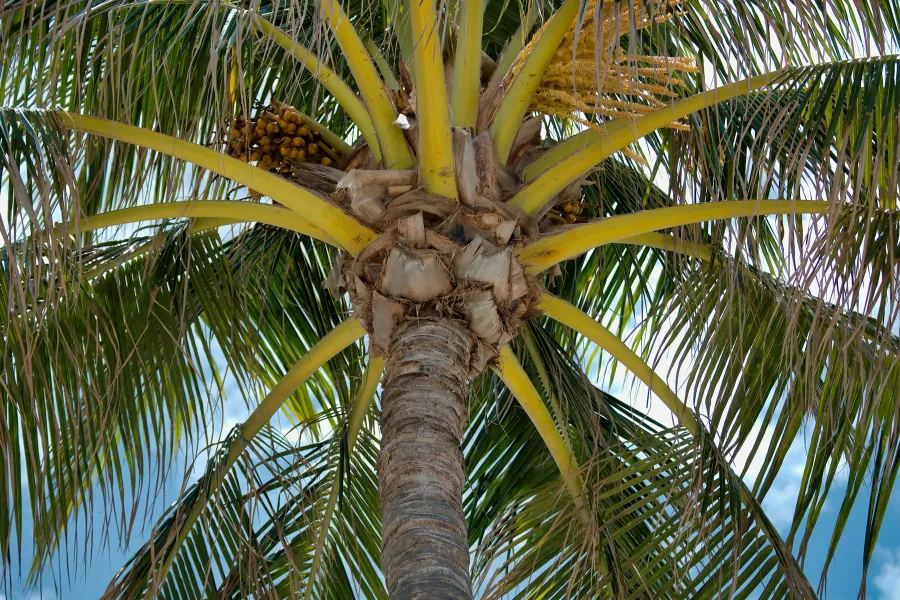
As part of this semester's geography project, I'm going to talk about a tall palm tree called the lontar, which mainly grows on the island of Roti in the south of the Indonesian archipelago.
Now, the lontar is a truly amazing example of how one tree can sustain human life.
The locals call it the tree of life, and with good reason, because the tree provides them with virtually everything they need in the way of food, drink, utensils, and shelter.
The lontar juice is the most amazingly refreshing juice you'll ever taste.
The juice is collected from high in the tree in a process known as tapping.
Basically, a slice is cut into part of the tree, and the sap flows slowly from it into a container.
It's then collected twice daily.
Male and female lontar trees are different.
Male lontars can be tapped all their lives, so they are preferred.
If the female tree is left untapped, a large fruit develops, like a coconut in appearance.
The watery interior of the fruit can be drunk, but these fruits are often left to fall to the ground as animal feed.
Men and older boys climb to the tops of the trees to do the tapping.
They don't use safety equipment, but make things easier for themselves by tying stones to the trunk.
What is amazing is that so much of the equipment they use in the tapping process is actually made from the tree itself.
The men attach all the tools they need to a belt that they wear when climbing the tree.
In most cases, climbers own particular trees within their family.
Ownership involves not only care of the trees themselves, but also a share in the maintenance of the fence, which belongs to the local community.
Anyway, more about this incredible juice.
Tapping reaches a peak at the end of the dry season, which runs from September to October, as villagers work frantically to get their harvest in before the rains come and it gets too wet and windy to climb.
Whatever juice isn't drunk immediately has to be processed as quickly as possible, as it turns sour very rapidly.
In the rainy season, when no fresh juice is available, the locals drink a concentrated form with water added.
The locals also use this rainy season version of the drink in other ways.
For example, it can be used to make biscuits of brown sugar.
But the lontar palm supplies much more than sustenance for the Rotinis.
The broad lontar leaves are woven into a huge number of things, containers for watering the garden and bags for transporting chickens to market.
People also use them to cover the roofs of their homes.
When the leaves are replaced every five years or so, the old ones are burned on the garden as a fertilizer.
So you see, the leaves are never wasted.
The Rotinis also make a distinctive hat out of the leaf.
Design-wise, they were inspired by 16th century Portuguese helmets.
There are many for different occasions, ranging from simple ones for everyday use to larger and more elaborate hats used for a celebration, which are painted in bright colors.
The lontar leaf even provides the Rotinis people with a unique musical instrument known as the sassando.
The leaf is made into a sounding board and has strings attached, which are plucked in the manner of a harp, and the sound produced is also similar.
The stalks of the lontar leaves can also be used.
They are really strong and grow up to 1.5 meters long, and local people produce ropes from them.
Even when a lontar tree becomes old and unproductive and no longer can be used for tapping, the whole tree is cut down and the thick trunk is utilized for building houses.
Their immense strength means that they are highly valued for this purpose.