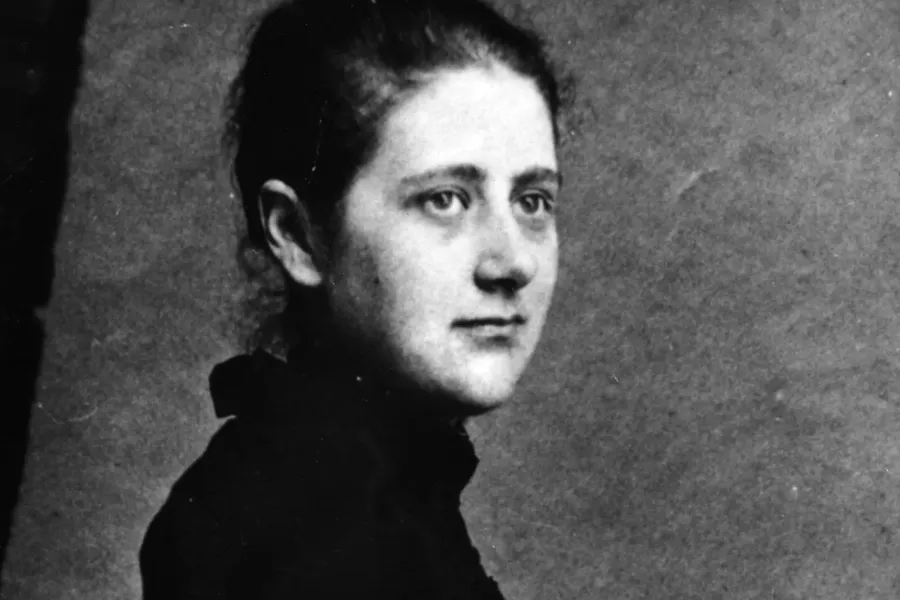
Beatrix Potter is one of the best-selling children's authors of all time. Her popular series of books that includes The Tale of Peter Rabbit was first published over one hundred years ago, and has never been out of print. Generations of children have enjoyed her many stories and illustrations, all of which celebrate the English lifestyle and rural landscape through the adventures of animals.
Born to a comfortable middle-class family in London in 1866, Potter spent much of her early life in her own company. She was educated in her parents' house by a governess and rarely saw her brother Bertram, who was sent to boarding school. Having little social contact with children of her own age, Potter began to be drawn into her own world of writing. When Beatrix was 15, she began to keep a diary written in a secret code of her own invention. Even Beatrix herself, when she read back over it in later life, found it difficult to understand. It was not until 15 years after her death that the code was cracked. To the outside world Beatrix appeared a shy and reserved person, but in her diary she was able to express herself openly, and she was critical of the paintings of a number of artists of the day.
Potter was a naturally gifted artist, and with the aid of some art lessons she also learnt the technical side of drawing. During her childhood, she looked after many animals, such as rabbits, frogs, and even bats. She drew these animals throughout her childhood, gradually improving the standard of her work by sketching in museums. She was also interested in natural history. She would spend many hours drawing wildlife such as fungi and flowers, and at one time she had an ambition to develop this scientific interest. An uncle tried to help her become a student at the Royal Botanic Gardens at Kew in London, but she was rejected because of her gender. Nevertheless, she achieved a measure of respect from the scientific establishment for her illustrations and contribution to mycology, the study of fungi.
When Potter was in her early 20s, her parents tried to arrange a partner for her to marry. Many likely suitors were found; however, Potter turned them all down. She was a fiercely independent woman, and she disliked the idea of being tied down to a domestic life that, at that time, consisted mostly of staying at home and bringing up children. Thus, unusually for British women of those times, she remained single and lived in her parents' home.
For several years, Potter tried to get her first children's book, The Tale of Peter Rabbit, published. Her initial attempts proved unsuccessful, but she persevered and eventually the book was accepted for publication by Frederick Warne & Company. The book finally came out in 1902, when Potter was 36, but the publishers did not expect it would sell many copies. In fact, the project was given to the youngest brother in the family company, Norman Warne, for his first project as a kind of test. Luckily, he proved to be a good choice as he warmed to both the book and Potter. He was determined to make a success of the book and developed a good working relationship with Potter as they pored over the individual details of the book. It was Norman who insisted that each drawing would be in colour. Potter insisted that the book remain small so that it would be easy for children to hold, and by the end of the year, 28,000 copies were in print.
The relationship between Warne and Potter blossomed, and eventually they became engaged. However, Potter's parents were unhappy about this because of his occupation. They eventually relented, but insisted the couple live apart for six months to give Potter time to change her mind. Tragically, before the wedding could take place, Warne developed pernicious anaemia, a blood disease, and passed away. Potter was devastated and she wrote in a letter to his sister, Millie, 'He did not live long, but he fulfilled a useful, happy life. I must try to make a fresh beginning next year.'
After Warne's death, Potter moved to the Lake District in northern England. In 1905 she bought a small farm there, and for the next eight years she busied herself writing more books, some of which were based in or around the area. She lived there for the remainder of her life, but due to failing eyesight she was forced to stop writing children's books. Instead, she devoted her time to the breeding of sheep and helping with the conservation of farms in the district. Using proceeds from her very successful books and later her inheritance, Potter was able to buy many working farms. On her death, she left over 4,000 acres to the National Trust, an organisation which protects historical buildings and areas of countryside in England. It has meant that her beloved countryside is now accessible to many visitors.