Choose the correct heading for paragraph A-G from the list below.
Write the correct number, i-xi on your answer sheet.
NB There are more headings than paragraphs, so you will not use them
List of Headings
I
The famous moai
II
The status represented symbols of combined purposes
III
The ancient spots that indicates scientific application
IV
The story of the name
V
Early immigrants, rise and prosperity
VI
The geology of Easter Island
VII
The countering explanation to the misconceptions politically manipulated
VIII
Damage done by the Europeans
IX
Symbols of authority and power
X
The Navel of the World
XI
The Norwegian Invaders' legacy
1
Paragraph A
2
Paragraph B
3
Paragraph C
4
Paragraph D
5
Paragraph E
6
Paragraph F
7
Paragraph G
Question 8 - 11
Do the following statements agree with the information given in Reading Passage?
In following statements below, choose
TRUE if the statement agrees with the information
FALSE if the statement contradicts the information
NOT GIVEN if it is impossible to say what the writer thinks about this
8
The first inhabitants of Easter Island were Polynesians, from the Marquesas or Society islands.
9
Most archeologists recognized the religious and astronomical functions for an ancient society
10
The structures on Easter Island work as an astronomical outpost for extraterrestrial visitors.
11
The theory that depleted natural resources led to the fail of Easter Island actually has a distorted perspective
Question 12 - 14
Complete the following summary of the paragraphs of Reading Passage, using NO MORE THAN THREE WORDS from the Reading Passage for each answer. Write your answers on your answer sheet.
Many theories speculated that Easter Island fall around the era of the initial European contact. Some say the resources are depleted by a; The erroneous theories began with a root of the racist assumptions advanced by some scholars. Early writers did not have adequate understandings to comprehend the true nature of events on the island. The social devastation was in fact a direct result of of the first European settlers.
DOL IELTS Đình Lực
📖 Bài đọc (reading passage)
Mystery in Easter Island!
A
A. One of the world's most famous yet least visited archaeological sites, Easter Island is a small, hilly, now treeless island of volcanic origin. Located in the Pacific Ocean at 27 degrees south of the equator and some 2200 miles (3600 kilometers) off the coast of Chile, it is considered to be the world's most remote inhabited island. The island is, technically speaking, a single massive volcano rising over ten thousand feet from the Pacific Ocean floor. The island received its most well-known current name, Easter Island, from the Dutch sea captain Jacob Roggeveen who became the first European to visit Easter Sunday, April 5, 1722.
B
"In the early 1950s, the Norwegian explorer Thor Heyerdahl popularized the idea that the island had been originally settled by advanced societies of Indians from the coast of South America. Extensive archaeological, ethnographic, and linguistic research has conclusively shown this hypothesis to be inaccurate. It is now recognized that the original inhabitants of Easter Island are of Polynesian) stock (DNA extracts from skeletons have confirmed this), that they most probably came from the Marquesas or Society islands, and that they arrived as early as 318 AD (carbon dating of reeds from a grave confirms this). At the time of their arrival, much of the island was forested, was teeming with land birds, and was perhaps the most productive breeding site for seabirds in the Polynesia region. Because of the plentiful bird, fish, and plant food sources, the human population grew and gave rise to a rich religious and artistic culture.
C
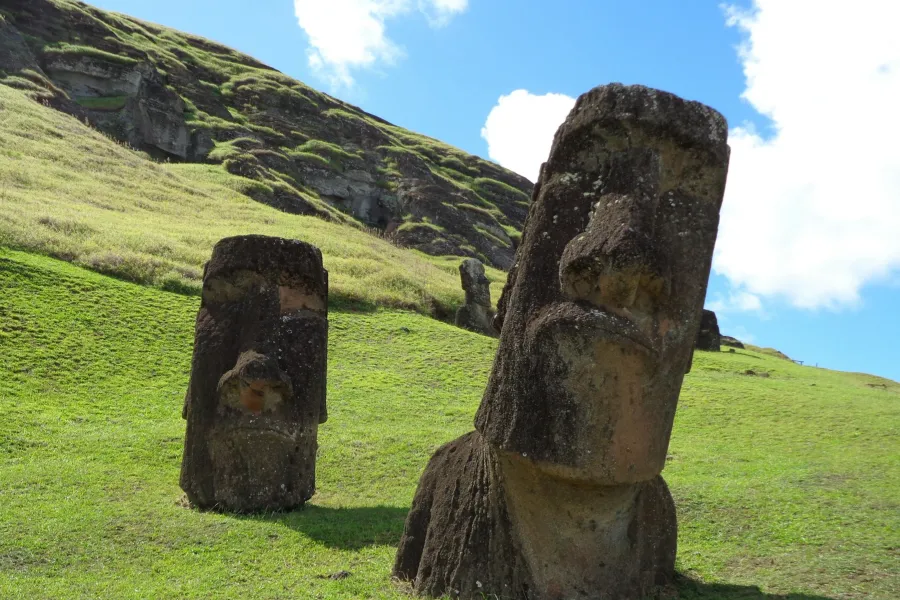
That culture's most famous features are its enormous stone statues called moai, at least 288 of which once stood upon massive stone platforms called ahu. There are some 250 of these ahu platforms spaced approximately one-half mile apart creating an almost unbroken line around the perimeter of the island. Another 600 moai statues, in various stages of completion, are scattered around the island, either in quarries or along ancient roads between the quarries and the coastal areas where the statues were most often erected. Nearly all the moai are carved from the tough stone of the Rano Raraku volcano. The average statue is 14 feet and 6 inches tall and weighs 14 tons. Some moai were as large as 33 feet and weighed more than 80 tons. Depending upon the size of the statues, it has been estimated that between 50 and 150 people were needed to drag them across the countryside on sleds and rollers made from the island's trees.
D
Scholars are unable to definitively explain the function and use of the moai statues. It is assumed that their carving and erection derived from an idea rooted in similar practices found elsewhere in Polynesia but which evolved in a unique way on Easter Island. Archaeological and iconographic analysis indicates that the statue cult was based on an ideology of male, lineage-based authority incorporating anthropomorphic symbolism. The statues were thus symbols of authority and power, both religious and political. But they were not only symbols. To the people who erected and used them, they were actual repositories of sacred spirit. Carved stone and wooden objects in ancient Polynesian religions, when properly fashioned and ritually prepared, were believed to be charged by a magical spiritual essence called mana. The ahu platforms of Easter Island were the sanctuaries of the people, and the moai statues were the ritually charged sacred objects of those sanctuaries.
E
Besides its more well-known name, Easter Island is also known as Te-Pito-O-Te-Henua, meaning 'The Navel of the World', and as Mata-Ki-Te-Rani, meaning 'Eyes Looking at Heaven'. These ancient names and a host of mythological details ignored by mainstream archaeologists point to the possibility that the remote island may once have been a geodetic marker and the site of an astronomical observatory of a long-forgotten civilization.
In his book, Heaven's Mirror, Graham Hancock suggests that Easter Island may once have been a significant scientific outpost of this antediluvian civilization and that its location had extreme importance in a planet-spanning, mathematically precise grid of sacred sites. Two other alternative scholars, Christopher Knight and Robert Lomas, have extensively studied the location and possible function of these geodetic markers. In their fascinating book, Uriel's Machine, they suggest that one purpose of the geodetic markers was as part of the global network of sophisticated astronomical observatories dedicated to predicting and preparing for future commentary impacts and crystal displacement cataclysms.
F
In the latter years of the 20th century and the first years of the 21st century, various writers and scientists have advanced theories regarding the rapid decline of Easter Island's magnificent civilization around the time of the first European contact. Principal among these theories, and now shown to be inaccurate, is that postulated by Jared Diamond in his book Collapse: How Societies Choose to Fail or Survive. Basically, these theories state that a few centuries after Easter Island's initial colonization the resource needs of the growing population had begun to outpace the island's capacity to renew itself ecologically. By the 1400s the forests had been entirely cut, the rich ground cover had eroded away, the springs had dried up, and the vast flocks of birds coming to roost on the island had disappeared. With no logs to build canoes for offshore fishing, depleted bird and wildlife food sources, and with declining crop yields because of the erosion of good soil, the nutritional intake of the people plummeted. First famine, then cannibalism (MT), set it. Because the island could no longer feed the chiets, bureaucrats and priests who kept the complex society running, the resulting chaos triggered a social and cultural collapse. By 1700 the population dropped to between one-quarter and one-tenth of its former number, and many of the statues were toppled during supposed "clan wars" of the 1600s and 1700s.
G
The faulty notions presented in these theories began with the racist assumptions of Thor Heyerdahl and have been perpetuated by writers, such as Jared Diamond, who do not have sufficient archaeological and historical understanding of the actual events that occurred on Easter Island. The real truth regarding the tremendous social devastation which occurred on Easter Island is that it was a direct consequence of the inhumane behavior of many of the first European visitors, particularly the slavers who raped and murdered the islanders, introduced small pox and other diseases, and brutally removed the natives to mainland South America.
🔥 Answer key (đáp án và giải thích)
1
IV
Giải thích chi tiết
☺️ Ứng dụng Linearthinking để giải quyết dạng bài Matching Headings
Step 01: Read to understand main idea
Dựa vào phần Simplify & Connection ở trên, ta có thể rút ra main idea như sau:
Phần đầu đoạn văn cung cấp thông tin nền về Easter Island: vị trí biệt lập, địa hình núi lửa, đặc điểm không còn cây cối.
Phía sau giới thiệu nguồn gốc tên gọi “Easter Island” – một sự kiện lịch sử cụ thể: đảo được đặt tên bởi nhà thám hiểm Hà Lan Jacob Roggeveen vào đúng ngày lễ Phục Sinh.
⇒ Nội dung đoạn tập trung vào việc cung cấp bối cảnh địa lý và lịch sử tên gọi của đảo.
------------------------
Step 02: Compare meaning with meaning
Đại ý của đoạn: Mô tả vị trí địa lý, nguồn gốc núi lửa và lý do đảo có tên là “Easter Island”.
So sánh với các tiêu đề: Đáp án D. The story of the name là lựa chọn chính xác vì khớp hoàn toàn với nội dung câu 5 – chi tiết then chốt tạo nên chủ đề của cả đoạn.
B. "In the early 1950s, the Norwegian explorer Thor Heyerdahl popularized the idea that the island had been originally settled by advanced societies of Indians from the coast of South America. Extensive archaeological, ethnographic, and linguistic research has conclusively shown this hypothesis to be inaccurate. It is now recognized that the original inhabitants of Easter Island are of Polynesian) stock (DNA extracts from skeletons have confirmed this), that they most probably came from the Marquesas or Society islands, and that they arrived as early as 318 AD (carbon dating of reeds from a grave confirms this). At the time of their arrival, much of the island was forested, was teeming with land birds, and was perhaps the most productive breeding site for seabirds in the Polynesia region. Because of the plentiful bird, fish, and plant food sources, the human population grew and gave rise to a rich religious and artistic culture.
C. That culture's most famous features are its enormous stone statues called moai, at least 288 of which once stood upon massive stone platforms called ahu. There are some 250 of these ahu platforms spaced approximately one-half mile apart creating an almost unbroken line around the perimeter of the island. Another 600 moai statues, in various stages of completion, are scattered around the island, either in quarries or along ancient roads between the quarries and the coastal areas where the statues were most often erected. Nearly all the moai are carved from the tough stone of the Rano Raraku volcano. The average statue is 14 feet and 6 inches tall and weighs 14 tons. Some moai were as large as 33 feet and weighed more than 80 tons. Depending upon the size of the statues, it has been estimated that between 50 and 150 people were needed to drag them across the countryside on sleds and rollers made from the island's trees.
D. Scholars are unable to definitively explain the function and use of the moai statues. It is assumed that their carving and erection derived from an idea rooted in similar practices found elsewhere in Polynesia but which evolved in a unique way on Easter Island. Archaeological and iconographic analysis indicates that the statue cult was based on an ideology of male, lineage-based authority incorporating anthropomorphic symbolism. The statues were thus symbols of authority and power, both religious and political. But they were not only symbols. To the people who erected and used them, they were actual repositories of sacred spirit. Carved stone and wooden objects in ancient Polynesian religions, when properly fashioned and ritually prepared, were believed to be charged by a magical spiritual essence called mana. The ahu platforms of Easter Island were the sanctuaries of the people, and the moai statues were the ritually charged sacred objects of those sanctuaries.
E. Besides its more well-known name, Easter Island is also known as Te-Pito-O-Te-Henua, meaning 'The Navel of the World', and as Mata-Ki-Te-Rani, meaning 'Eyes Looking at Heaven'. These ancient names and a host of mythological details ignored by mainstream archaeologists point to the possibility that the remote island may once have been a geodetic marker and the site of an astronomical observatory of a long-forgotten civilization.
In his book, Heaven's Mirror, Graham Hancock suggests that Easter Island may once have been a significant scientific outpost of this antediluvian civilization and that its location had extreme importance in a planet-spanning, mathematically precise grid of sacred sites. Two other alternative scholars, Christopher Knight and Robert Lomas, have extensively studied the location and possible function of these geodetic markers. In their fascinating book, Uriel's Machine, they suggest that one purpose of the geodetic markers was as part of the global network of sophisticated astronomical observatories dedicated to predicting and preparing for future commentary impacts and crystal displacement cataclysms.
F. In the latter years of the 20th century and the first years of the 21st century, various writers and scientists have advanced theories regarding the rapid decline of Easter Island's magnificent civilization around the time of the first European contact. Principal among these theories, and now shown to be inaccurate, is that postulated by Jared Diamond in his book Collapse: How Societies Choose to Fail or Survive. Basically, these theories state that a few centuries after Easter Island's initial colonization the resource needs of the growing population had begun to outpace the island's capacity to renew itself ecologically. By the 1400s the forests had been entirely cut, the rich ground cover had eroded away, the springs had dried up, and the vast flocks of birds coming to roost on the island had disappeared. With no logs to build canoes for offshore fishing, depleted bird and wildlife food sources, and with declining crop yields because of the erosion of good soil, the nutritional intake of the people plummeted. First famine, then cannibalism (MT), set it. Because the island could no longer feed the chiets, bureaucrats and priests who kept the complex society running, the resulting chaos triggered a social and cultural collapse. By 1700 the population dropped to between one-quarter and one-tenth of its former number, and many of the statues were toppled during supposed "clan wars" of the 1600s and 1700s.
G. The faulty notions presented in these theories began with the racist assumptions of Thor Heyerdahl and have been perpetuated by writers, such as Jared Diamond, who do not have sufficient archaeological and historical understanding of the actual events that occurred on Easter Island. The real truth regarding the tremendous social devastation which occurred on Easter Island is that it was a direct consequence of the inhumane behavior of many of the first European visitors, particularly the slavers who raped and murdered the islanders, introduced small pox and other diseases, and brutally removed the natives to mainland South America.