Patrick:
Good morning, ladies and gentlemen.
Patrick:
We're very happy to welcome you to the Museum of Natural History today.
Patrick:
My name is Patrick and I'll be your guide for today's tour.
Patrick:
Before we get started, I'll first go over a few of the museum's highlights.
Patrick:
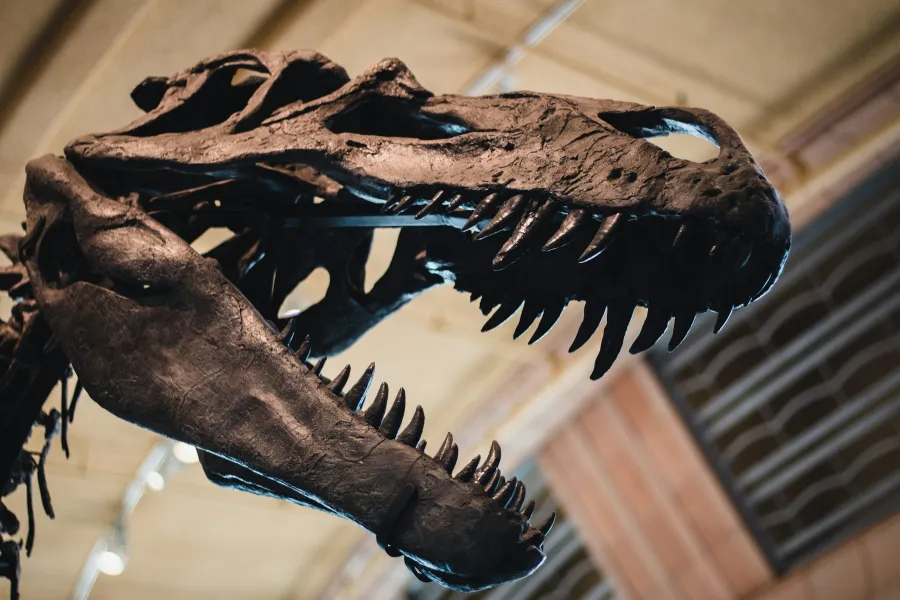
To start with, our dinosaur exhibits are some of the most popular in the museum.
Patrick:
These include actual skeletons and remains from these prehistoric animals.
Patrick:
There are also numerous interactive displays which share information about the different dinosaur species.
Patrick:
And be sure not to miss the life-size replica models of the colossal Tyrannosaurus and Brontosaurus on exhibit just beyond the prehistoric timeline display in the main foyer.
Patrick:
We have a few amazing displays about ocean life as well.
Patrick:
Our life-size model of a blue whale is in the main courtyard and we have a spectacular under the sea room which includes lots of models of fish and mammals.
Patrick:
Our dolphin display is possibly our most famous.
Patrick:
It draws loads of people to see actual size models of the creatures and learn about how they swim.
Patrick:
We also have a display about fish evolution which is especially interesting as it shows how they started as simple organisms and developed into complex species.
Patrick:
And we have a very interesting display focusing on the life cycle of sharks.
Patrick:
It shows how they develop from an embryo in an egg until they are fully grown and features models of infant sharks, adolescents and fearsome adult hunters.
Patrick:
And then there is our plant life exhibit which is contained in the museum's indoor botanical garden.
Patrick:
Colorful and rare species of plants, trees and shrubs have been imported and put on display for you to view including specimens from the Amazon rainforest and the tundra of Greenland.
Patrick:
We are proud to house the country's rarest assortment of wildflowers many of which you can grow yourself with seeds from our shop.
Patrick:
One special area of note is our activity zone which has several interactive displays and activities.
Patrick:
You can watch a short film on the evolution of our human ancestors showing how we evolved through time.
Patrick:
And also check out our stage area which hosts a variety of interesting presentations demonstrations and talks throughout the day.
Patrick:
In addition, visit our 3D planetarium where you can view incredible images of the stars and universe.
Alice:
Professor Brown, I'm hoping to participate in the national car technology competition.
Professor Brown:
Certainly, Alice.
Professor Brown:
The idea submission deadline is next Thursday though.
Professor Brown:
Do you already have an idea in mind?
Alice:
Oh, I have a couple of ideas.
Alice:
One is for a biometric access system.
Alice:
This would allow only particular users to unlock, start and drive the vehicle by using sensors.
Professor Brown:
Interesting idea.
Professor Brown:
How would that work exactly?
Alice:
Well, it would require the use of a scanner to access the vehicle and interior sensors to scan the eyes of drivers for retinal confirmation.
Alice:
Drivers would place a thumb on the outdoor scanner to unlock the vehicle and the retinal sensor would allow them to turn on the ignition.
Professor Brown:
That might be complicated.
Professor Brown:
Do you have any ideas on how that sensor might work?
Alice:
I was thinking about embedding it in the rear-view mirror.
Alice:
The driver would simply look into the mirror and the sensor would scan their retina.
Alice:
If the person is authorized to use the vehicle, the ignition would automatically turn on.
Professor Brown:
Sounds impressive.
Professor Brown:
I think you should go ahead with that idea.
Professor Brown:
Is there anything else you need help with?
Alice:
Well, actually, the entrance fee is higher than I expected.
Professor Brown:
Oh, there actually is a sponsorship from the university that you may be eligible for and as far as I know, you'll be able to do that.
Professor Brown:
Then the cost of $200 for entering the competition would be lifted.
Professor Brown:
And of course, you'd be able to use materials for the project at our lab facilities.
Professor Brown:
You can pick up a form to apply for the sponsorship at the academic office.
Alice:
And what is required for the application?
Professor Brown:
You'll first need to submit a proposal, no longer than one page, to the Dean of the Engineering College by this Wednesday.
Professor Brown:
If he thinks your idea is intriguing enough, then he'll meet with you in person to discuss some additional details about it.
Alice:
I suppose I ought to get started on typing my proposal then.
Professor Brown:
Oh, and for your reference, the proposal must include a rough design or sketch of your idea.
Professor Brown:
Otherwise, the Dean won't accept it.
Professor Brown:
It's a very particular requirement, but it's because he prefers to look at papers with graphical information.
Professor Brown:
The proposal can be structured as you like and in any file format.
Professor Brown:
And you can list references any way you want as well.
Alice:
That's exactly what I was going to inquire about next.
Alice:
Actually, would you have some time to meet either today or Tuesday to provide me with some guidance on how to draft the proposal?
Professor Brown:
Certainly.
Professor Brown:
I'll be available at my office after 4 p.m. this Tuesday.
Alice:
I'll come by your office at 4.30 on Tuesday.