Making documentary films - IELTS Reading with Practice Test, Answers And Explanation
Luyện tập đề IELTS Reading Practice với passage Making documentary films được lấy từ cuốn sách IELTS Practice A - Book 2 - Test 1 - Passage 2 với trải nghiệm thi IELTS trên máy và giải thích đáp án chi tiết bằng Linearthinking, kèm list từ vựng IELTS cần học trong bài đọc.
Making documentary films - IELTS Reading with Practice Test, Answers And Explanation
❓ Câu hỏi (questions)
Question 1 - 3
Choose the correct letter, A, B, C or D.
Write the correct letter in boxes on your answer sheet.
1
The main idea of the third paragraph is that environmental damage
A
requires political action if it is to be stopped
B
is the result of ignorance on the part of the public.
C
could be prevented by the action of ordinary people.
D
can only be stopped by educating business leaders.
2
In the fourth paragraph, the writer describes ways in which the public can
A
reduce their own individual impact on the environment.
B
learn more about the impact of business of the environment.
C
raise awareness of the effects of specific environmental disasters.
D
influence the environmental policies of businesses and governments
3
What pressure was exerted by big business in the case of the disease BSE?
A
Meat packers stopped supplying hamburgers to fast-food chains
B
A fast-food company forced their meat suppliers to follow the law.
C
Meat packers persuaded the government to reduce their expenses.
D
A fast-food company encouraged the government to introduce legislation.
Question 4 - 5
Choose TWO letters, A-F.
The list below includes factors contributing to classroom noise. Which TWO are mentioned by the writer of the passage?
A
current teaching methods
B
echoing corridors
C
cooling systems
D
large class sizes
E
loud-voiced teachers
F
playground games
Question 6 - 10
Do the following statements agree with the information given in Reading Passage?
In following statements below, choose
YES if the statement agrees with the information
NO if the statement contradicts the information
NOT GIVEN if it is impossible to say what the writer thinks about this
6
The public should be prepared to fund good environmental practices
7
There is a contrast between the moral principles of different businesses.
8
It is important to make a clear distinction between acceptable and unacceptable behaviour.
9
The public have successfully influenced businesses in the past.
10
In the future, businesses will show more concern for the environment.
Question 11 - 15
Do the following statements agree with the information given in the Reading Passage?
TRUE if the statement agrees with the information
FALSE if the statement contradicts the information
NOT GIVEN if it is impossible to say what the writer thinks about this
11
Novices and experts use the same system to classify objects.
12
A novice’s training is focused on memory skills.
13
Experts have higher efficiency than novices when solving problems in their own field.
14
When facing a problem, a novices always tries to solve it straight away.
15
Experts are better at recognising their own mistakes and limits.
Question 16 - 19
Answer the questions below.
Choose NO MORE THAN TWO WORDS AND/OR A NUMBER from the passage for each answer.
16
For what period of time has hearing loss in schoolchildren been studied in New Zealand?
17
In addition to machinery noise, what other type of noise can upset children with autism?
18
What term is used to describe the hearing problems of schoolchildren which have not been diagnosed?
19
What part of the New Zealand Disability Strategy aims to give schoolchildren equal opportunity?
Question 20 - 22
Complete the sentences below.
Choose NO MORE THAN TWO WORDS AND/OR A NUMBER from the passage for each answer.
Write your answers in boxes 1-3 on your answer sheet.
20
Vertical tubes are used to grow strawberries,
and herbs.
21
There will eventually be a daily harvest of as much as
in weight of fruit and vegetables.
22
It may be possible that the farm's produce will account for as much as 10% of the city's
overall.
Question 23 - 29
Complete the notes below.
Choose ONE WORD ONLY from the passage for each answer.
Britain's Industrial Revolution
Steam power
Newcomen’s steam engine was used in mines to remove water.
In Watt and Boulton’s steam engine, the movement of the
23.
was linked to a gear system.
A greater supply of
24.
was required to power steam engines.
Textile industry
Before the Industrial Revolution, spinners and weavers worked at home and in
25.
.
Not as much
26.
was needed to produce cloth once the spinning jenny and power loom were invented.
Iron Industry
Smelting of iron ore with coke resulted in material that was better
27.
.
Demand for iron increased with the growth of the
28.
.
Communications
Cooke and Wheatstone patented the first telegraphy system.
The telegraphy system was used to prevent locomotives colliding.
Urbanisation
Small towns turned into cities very quickly.
The new cities were dirty, crowded and lacked sufficient
29.
.
Question 30 - 33
Complete the form below.
Write ONE WORD AND/OR A NUMBER for each answer.
PACKHAM'S SHIPPING AGENCY - customer quotation form
- Name: Jacob
30.
- Address to be collected from:
31.
College, Downlands Rd
- Town: Bristol
- Postcode:
32.
- Contents: clothes
33.
Question 34 - 36
Choose NO MORE THAN TWO WORDS from the passage for each answer.
Though experts are quite effective at solving problems in their own domains, their strengths can also be turned against them. Studies have shown that experts are less at making predictions than statistical models. Some researchers theorise it is because experts can also be inconsistent like all others. Yet some believe it is due to , but there isn’t a great deal of as to its cause and manifestation.
Question 37 - 41
Complete the summary using the list of words, A-J, below.
Write the correct letter, A-J, in boxes on your answer sheet.
<b>Big businesses</b>
Many big businesses today are prepared to harm people and the environment in order to make money, and they appear to have no Lack of by governments and lack of public can lead to environmental problems such as or the destruction of .
A
funding
B
trees
C
rare species
D
moral standards
E
control
F
involvement
G
flooding
H
overfishing
I
worker support
Question 42 - 48
Answer the question below.
GEO-ENGINEERING PROJECTS
Procedure
Aim
put a large number of tiny spacecraft into orbit far above Earth
to create a
42
that would reduce the amount of light reaching Earth
place
43
in the sea
to encourage
44
to form
release aerosol sprays into the stratosphere
to create
45
that would reduce the amount of light reaching Earth
fix strong
46
to Greenland ice sheets
to prevent icebergs moving into the sea
plant trees in Russian Arctic that would lose their leaves in winter
to allow the
47
to reflect radiation
change the direction of
48
to bring more cold water into ice-forming areas
Question 49 - 55
The Reading Passage has seven paragraphs A-G.
From the list of headings below choose the most suitable heading for each paragraph.
Write the appropriate numbers i-x
List of Headings
I
The long-term impact
II
A celebrated achievement
III
Early brilliance passes unrecognised
IV
Outdated methods retain popularity
V
The basis of a new design is born
VI
Frustration at never getting the design right
VII
Further refinements meet persistent objections
VIII
Different in all respects
IX
Bridge-makers look elsewhere
X
Transport developments spark a major change
49
Paragraph A
50
Paragraph B
51
Paragraph C
52
Paragraph D
53
Paragraph E
54
Paragraph F
Question 56 - 59
Look at the following statements and the list of scientists below.
Match each statement with the correct scientist, A-D.
Write the correct letter, A-D.
List of Findings
A
Roger Angel
B
Phil Rasch
C
Dan Hunt
D
Martin Sommerkorn
56
The effects of geo-engineering may not be long-lasting
57
Geo-engineering is a topic worth exploring
58
It may be necessary to limit the effectiveness of geo-engineering projects.
59
Research into non-fossil-based fuels cannot be replaced by geo engineering.
Question 60 - 63
Complete each of the following statements with the best ending A-G from the box below.
List of Endings
A
prove that local people were wrong.
B
find work in Switzerland.
C
win more building commissions.
D
reduce the amount of raw material required.
E
recognise his technical skills.
F
capitalise on the spectacular terrain.
G
improve the appearance of his bridges.
Maillart designed the hollow-box arch in order to
60
Following the construction of the Tavanasa Bridge, Maillart failed to
61
The transverse walls of the Flienglibach Bridge allowed Maillart to
62
Of all his bridges, the Salginatobel enabled Maillart to
63
Question 64 - 66
Reading Passage has eight paragraphs A-H
Which paragraph contains the following information?
Write the correct letter, A-H
64
mention of a geo-engineering project based on an earlier natural phenomenon
65
an example of a successful use of geo-engineering
66
a common definition of geo-engineering
Question 67 - 69
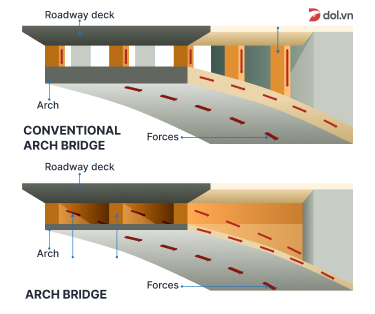
Complete the labels on the diagrams below using ONE or TWO WORDS from the reading passage.
Question 70 - 72
Choose NO MORE THAN ONE WORD from the passage for each answer.
Question 73 - 77
Complete the flow-chart below.
Choose NO MORE THAN THREE WORDS from the passage for each answer.
STEP 01
Novice: needs and to performa given task; exposed to specific cases; guided by a through learning
STEP 02
Journeyman: starts to identify within and between cases; often exposed to cases; contacts a mentor when facing difficult problems
STEP 03
Expert: creates predictions and new ; performs task independently without the help of a mentor
Question 78 - 81
Complete the flow-chart below
Write NO MORE THAN TWO WORDS for each answer
Peter Falkingham's computer model
STEP 1
Mud is simulated with attention to is texture and thickness and how much it contains.
STEP 2
A virtual foot produces a footprint in the mud.
STEP 3
The footprint is dissected and examined from all angles.
STEP 4
Levels of are measured with the footprint.
STEP 5
Multiple simulations relate footprints to different types of
STEP 6
More accurate interpretation of is possible
Question 82 - 87
Complete the flow chart below.
Write NO MORE THAN TWO WORDS for each answer.
STEP 01
Choose area of city to study
STEP 02
Did a survery of in city centre to compare with old maps
STEP 03
was assessed in five key locations
STEP 04
Measured twice a day
STEP 05
Research during one afternoon
STEP 06
Looked at official figures
STEP 07
Measured in several
STEP 08
Measured twice a day
Question 88 - 93
Complete the flow chart below.
Write NO MORE THAN TWO WORDS for each answer.
STEP1
Choose area of city to study
STEP2
Did a survery of in city centre to compare with old maps
STEP3
was assessed in five key locations
STEP4
Measured twice a day
STEP 05
Research during one afternoon
STEP 06
Looked at official figures
STEP 07
Measured in several
STEP 08
Measured twice a day
DOL IELTS Đình Lực
📖 Bài đọc (reading passage)
Making Documentary Films
A
A. For much of the twentieth century, documentary films were overshadowed by their more successful Hollywood counterparts. For a number of reasons, documentaries were frequently ignored by critics and film studies courses at universities. Firstly, the very idea of a documentary film made some people suspicious. As the critic Dr Helmut Fischer put it, 'Documentary makers might have ambitions to tell the "truth" and show only "facts" but there is no such thing as a non-fiction film. That's because, as soon as you record an incident on camera, you are altering its reality in a fundamental way'. Secondly, even supporters of documentaries could not agree on a precise definition, which did little to improve the reputation of the genre. Lastly, there were also concerns about the ethics of filming subjects without their consent, which is a necessity in many documentary films.
B
None of this prevented documentaries from being produced, though exactly when the process started is open to question. It is often claimed that Nanook of the North was the first documentary. Made by the American filmmaker Robert J. Flaherty in 1922, the film depicts the hard, sometimes heroic lives of nat ve American peoples in the Canadian Arctic. Nanook of the North is said to have set off a trend that continued through the 1920s with the films of Dziga Vertov in the Soviet Union and works by other filmmakers around the world. However, that 1922 starting point has been disputed by supporters of an earlier date. Among this group is film historian Anthony Berwick, who argues that the genre can be traced back as early as 1895, when similar films started to appear, including newsreels, scientific films and accounts of journeys of exploration.
C
In the years following 1922, one particular style of documentary started to appear. These films adopted a serious tone while depicting the lives of actual people. Cameras were mounted on tripods and subjects rehearsed and repeated activities for the purposes of the film. British filmmaker John Grierson was an important member of this group. Grierson's career lasted nearly 40 years, beginning with Drifters (1929) and culminating with I Remember, I Remember (1968). However, by the 1960s Grierson's style of film was being rejected by the Direct Cinema movement, which wanted to produce more natural and authentic films: cameras were hand-held; no additional lighting or sound was used; and the subjects did not rehearse. According to film writer Paula Murphy, the principles and methods of Direct Cinema brought documentaries to the attention of universities and film historians as never before. Documentaries started to be recognised as a distinct genre worthy of serious scholarly analysis.
D
Starting in the 1980s, the widespread availability of first video and then digital cameras transformed filmmaking. The flexibility and low cost of these devices meant that anyone could now be a filmmaker. Amateurs working from home could compete with professionals in ways never possible before. The appearance of online film-sharing platforms in the early 2000s only increased the new possibilities for amateur filmmakers. Nonetheless, while countless amateur documentaries were being made, perhaps the most popular documentary of 2006 was still the professionally made An Inconvenient Truth. New cameras and digital platforms revolutionised the making of films. But as critic Maria Fiala has pointed out, ‘The argument sometimes put forward that these innovations immediately transformed what the public expected to see in a documentary isn't entirely accurate’.
E
However, a new generation of documentary filmmakers then emerged, and with them came a new philosophy of the genre. These filmmakers moved away from highlighting political themes or urgent social issues. Instead the focus moved inwards, exploring personal lives, relationships and emotions. It could be argued that Catfish (2010) was a perfect example of this new trend. The film chronicles the everyday lives and interactions of the social media generation and was both a commercial and critical success. Filmmaker Josh Camberwell maintains that Catfish embodies a new realisation that documentaries are inherently subjective and that this should be celebrated. Says Camberwell, ‘It is a requirement for documentary makers to express a particular viewpoint and give personal responses to the material they are recording’.
F
The popularity and variety of documentaries today is illustrated by the large number of film festivals focusing on the genre around the world. The biggest of all must be the Hot Docs Festival in Canada, which over the years has showcased hundreds of documentaries from more than 50 different countries. Even older is the Hamburg International Short Film Festival. As its name suggests, Hamburg specialises in short films, but one category takes this to its limits - entries may not exceed three minutes in duration. The Short and Sweet Festival is a slightly smaller event held in Utah, USA. The small size of the festival means that for first timers this is the ideal venue to try to get some recognition for their films. Then there is the Atlanta Shortsfest, which is a great event for a wide variety of filmmakers. Atlanta welcomes all established types of documentaries and recognises the growing popularity of animations, with a category specifically for films of this type. These are just a few of the scores of film festivals on offer, and there are more being established every year. All in all, it has never been easier for documentary makers to get their films in front of an audience.
67
68
69
67
68
69
70
71
72
Dinosaur's name comes from spines. One theory: they were necessary to hold up a
70
which helped control body heat.
Skull is
71
compared with rest of body.
72
made easier by wide tail and highly developed muscles in legs.
B. None of this prevented documentaries from being produced, though exactly when the process started is open to question. It is often claimed that Nanook of the North was the first documentary. Made by the American filmmaker Robert J. Flaherty in 1922, the film depicts the hard, sometimes heroic lives of nat ve American peoples in the Canadian Arctic. Nanook of the North is said to have set off a trend that continued through the 1920s with the films of Dziga Vertov in the Soviet Union and works by other filmmakers around the world. However, that 1922 starting point has been disputed by supporters of an earlier date. Among this group is film historian Anthony Berwick, who argues that the genre can be traced back as early as 1895, when similar films started to appear, including newsreels, scientific films and accounts of journeys of exploration.
C. In the years following 1922, one particular style of documentary started to appear. These films adopted a serious tone while depicting the lives of actual people. Cameras were mounted on tripods and subjects rehearsed and repeated activities for the purposes of the film. British filmmaker John Grierson was an important member of this group. Grierson's career lasted nearly 40 years, beginning with Drifters (1929) and culminating with I Remember, I Remember (1968). However, by the 1960s Grierson's style of film was being rejected by the Direct Cinema movement, which wanted to produce more natural and authentic films: cameras were hand-held; no additional lighting or sound was used; and the subjects did not rehearse. According to film writer Paula Murphy, the principles and methods of Direct Cinema brought documentaries to the attention of universities and film historians as never before. Documentaries started to be recognised as a distinct genre worthy of serious scholarly analysis.
D. Starting in the 1980s, the widespread availability of first video and then digital cameras transformed filmmaking. The flexibility and low cost of these devices meant that anyone could now be a filmmaker. Amateurs working from home could compete with professionals in ways never possible before. The appearance of online film-sharing platforms in the early 2000s only increased the new possibilities for amateur filmmakers. Nonetheless, while countless amateur documentaries were being made, perhaps the most popular documentary of 2006 was still the professionally made An Inconvenient Truth. New cameras and digital platforms revolutionised the making of films. But as critic Maria Fiala has pointed out, ‘The argument sometimes put forward that these innovations immediately transformed what the public expected to see in a documentary isn't entirely accurate’.
E. However, a new generation of documentary filmmakers then emerged, and with them came a new philosophy of the genre. These filmmakers moved away from highlighting political themes or urgent social issues. Instead the focus moved inwards, exploring personal lives, relationships and emotions. It could be argued that Catfish (2010) was a perfect example of this new trend. The film chronicles the everyday lives and interactions of the social media generation and was both a commercial and critical success. Filmmaker Josh Camberwell maintains that Catfish embodies a new realisation that documentaries are inherently subjective and that this should be celebrated. Says Camberwell, ‘It is a requirement for documentary makers to express a particular viewpoint and give personal responses to the material they are recording’.
F. The popularity and variety of documentaries today is illustrated by the large number of film festivals focusing on the genre around the world. The biggest of all must be the Hot Docs Festival in Canada, which over the years has showcased hundreds of documentaries from more than 50 different countries. Even older is the Hamburg International Short Film Festival. As its name suggests, Hamburg specialises in short films, but one category takes this to its limits - entries may not exceed three minutes in duration. The Short and Sweet Festival is a slightly smaller event held in Utah, USA. The small size of the festival means that for first timers this is the ideal venue to try to get some recognition for their films. Then there is the Atlanta Shortsfest, which is a great event for a wide variety of filmmakers. Atlanta welcomes all established types of documentaries and recognises the growing popularity of animations, with a category specifically for films of this type. These are just a few of the scores of film festivals on offer, and there are more being established every year. All in all, it has never been easier for documentary makers to get their films in front of an audience.