IELTS Real Reading Test 2025 - Q2 Test 5 with Practice Test, Answers And Explanation
Luyện tập đề IELTS Real Reading Test 2025 - Q2 Test 5 được lấy từ cuốn sách Real Test 2025 - Q2 với trải nghiệm thi IELTS trên máy và giải thích đáp án chi tiết bằng Linearthinking, kèm answer key và list từ vựng IELTS cần học trong bài đọc.
IELTS Real Reading Test 2025 - Q2 Test 5 with Practice Test, Answers And Explanation
Passage
❓ Câu hỏi passage 1
Question 1 - 6
Do the following statements agree with the information given in the Reading Passage?
TRUE if the statement agrees with the information
FALSE if the statement contradicts the information
NOT GIVEN if it is impossible to say what the writer thinks about this
1
Some physical evidence of Uruk still exists in Iraq.
2
The people of Uruk lived in large apartment buildings.
3
Builders in Uruk frequently experimented with new construction methods.
4
Urban settlements were unusual in Mesopotamia 4,500 years ago.
5
The Tigris and the Euphrates rivers were important for the interchange of ideas.
6
When there were food shortages, farmers relied mainly on the help of their relatives.
Question 7 - 13
Complete the notes below.
Choose ONE WORD ONLY from the passage for each answer.
Early changes in Mesopotamia
Changes in organisation of farming
Improved agricultural methods led to:
- a food
7.
being used as insurance
- a wider range of crops being grown
- the development of industry and consumerism
- increased specialisation amongst workers
- greater control by institutions
Temples
- were built in the shape of large
8.
- had large
9.
where produce was kept
- many needed
10.
to manage the farms
- acted as
11.
in hard economic periods
The development of writing
- people wrote on surfaces made of
12.
- written records remained undamaged after
13.
destroyed the archives they were kept in
Passage
❓ Câu hỏi passage 2
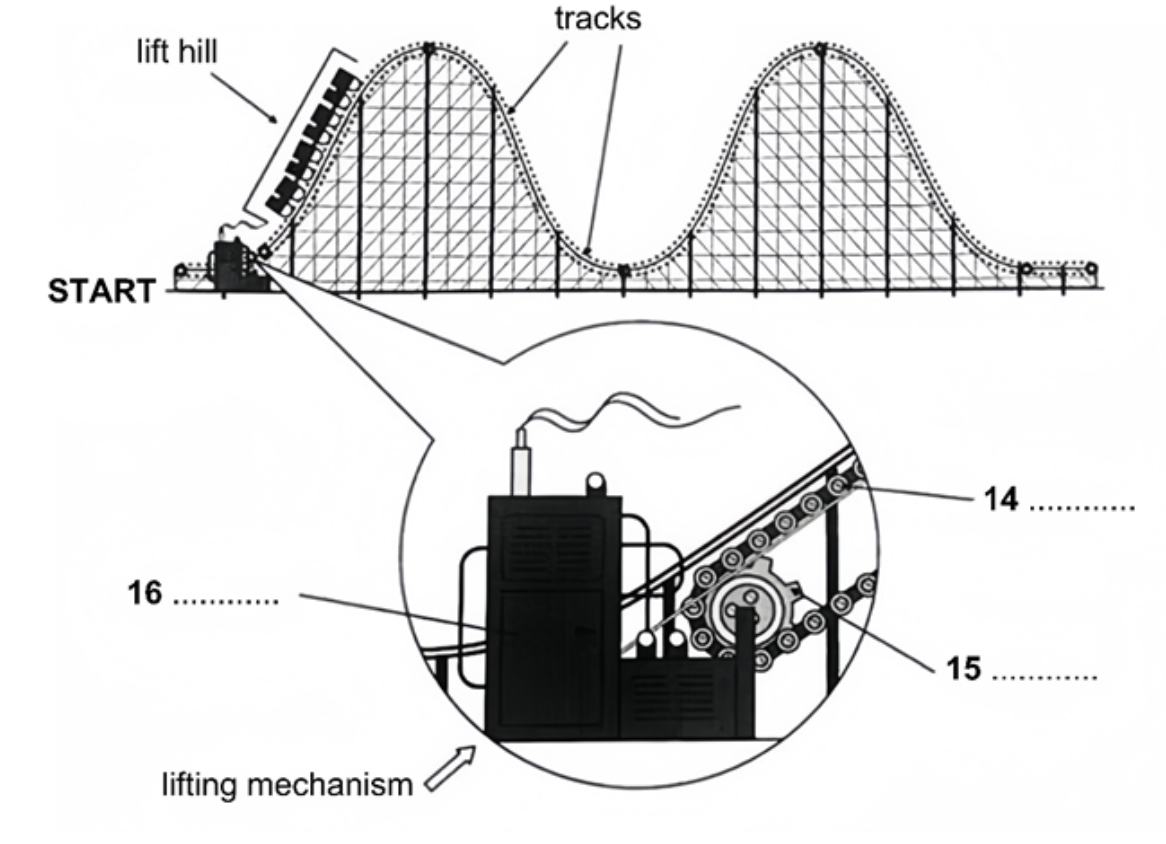
Question 14 - 16
Label the diagram below.
Write ONE WORD ONLY from the passage for each answer.
Question 17 - 21
Choose NO MORE THAN TWO WORDS from the passage for each answer.
History of roller coasters
Modern roller coasters are descended from 16th-century Russian slides with a surface of .
People climbed to the top, and travelled down in sleds. In France, because of the higher temperatures, the wooden surface on the slides was and were attached to the cars to ease the descent.
The first US roller coaster was used for transporting down a mountainside in carts. Initially, these were pulled by mules but in time power was produced by .
Question 22 - 26
Do the following statements agree with the information given in the Reading Passage?
TRUE if the statement agrees with the information
FALSE if the statement contradicts the information
NOT GIVEN if it is impossible to say what the writer thinks about this
22
The earliest modifications to the basic slide were made in France.
23
Roller coasters continued to increase in popularity throughout the 1920s and 1930s.
24
New roller coaster technology was introduced in the 1970s in response to public demand.
25
Roller coasters were less popular for most of the 1980s than in the 1970s and 1990s.
26
The design of roller-coaster rides became more varied in the 1990s.
Passage
❓ Câu hỏi passage 3
Question 27 - 31
The Reading Passage has six paragraphs A-F.
From the list of headings below choose the most suitable heading for each paragraph.
List of Headings
I
Disagreement about the reading process
II
The roots of the debate
III
A combined approach
IV
Methods of teaching reading
V
A controversial approach
VI
Inconclusive research
VII
Research with learners
VIII
Allowing teachers more control
IX
A debate amongst educators
27
Paragraph B
28
Paragraph C
29
Paragraph D
30
Paragraph E
31
Paragraph F
Question 32 - 36
Do the following statements agree with the information given in the Reading Passage?
TRUE if the statement agrees with the information
FALSE if the statement contradicts the information
NOT GIVEN if it is impossible to say what the writer thinks about this
32
The whole-language approach relates letters to sounds.
33
Many educators believe the whole-language approach to be the most interesting way to teach children to read.
34
Research supports the theory that we read without linking words to sounds.
35
Research has shown that the whole-word approach is less effective than the whole-language approach.
36
Research has shown that phonics is more successful than both the whole-word and whole-language approaches.
Question 37 - 40
Complete the summary using the list of words, A-G, below.
Write the correct letter, A-G, in boxes on your answer sheet.
In the teaching community, question the usefulness of research into methods of teaching reading. These critics believe that is incompatible with student-centred learning. In the future, teachers need to be aware of so that they understand the importance of phonics. They should not, however, ignore the ideas of which make reading enjoyable for learners.
A
the phonics method
B
the whole-word method
C
the whole-language method
D
traditionalists
E
progressives
F
linguistics
G
research studies
DOL IELTS Đình Lực
05/05/2026
📖 Bài đọc passage 1
The world's first cities
The creation of Mesopotamian cities
The inhabitants of Mesopotamia – which now forms part of eastern Syria, southeastern Turkey and Iraq - lived for thousands of years on individual farms and in small, isolated communities, working relentlessly just to meet their basic needs. But then, about 6,000 years ago something remarkable happened. The people left the security of their family homes and villages and came together with others to create something far more complex and difficult: the world's first city, called Uruk.
There is not much left now of Uruk, which is about 250 kilometres south of Iraq's capital Baghdad, but enough does remain to show that this initial experiment in urban living was extraordinarily successful. At its height, around 5,000 years ago, Uruk was home to more than 40,000 people. The outlines of the city walls indicate an enclosed area of about 600 hectares.
The archaeological record of Uruk reveals the intensive building and rebuilding which went on for four or five centuries after the city's initial establishment. In that period the people of Uruk built a dozen or so large public buildings. They would carefully level what had stood before, and then build another structure on top, often trying out a different building material or an innovative technique. They seemed to be searching for ways in which architecture could express the revolutionary new social structures that had come into being there.
Soon Uruk was not the only Mesopotamian city. People all across the flat plains of southern Mesopotamia were enjoying many of the benefits of city life. By about 4,500 years ago, 80 per cent of the Mesopotamian population lived in cities over 40 hectares in size, with populations of between 15,000 and 30,000 people. The emergence of these thriving communities, made up mostly of individuals and groups with no blood ties, was unprecedented in human history. Why did these extraordinary advances happen?
Reasons for the creation of cities in Mesopotamia
Smaller communities in Mesopotamia sometimes decided to come together to make it easier to defend themselves from their enemies. But the underlying reason for the creation of cities can be found in the harshness of this particular environment. The area was a place of extremes, where narrow strips of fertile river valleys were bounded by thousands of kilometres of desert and unproductive wetlands. As the small amount of rainfall in the region was incapable of sustaining anything but very limited agriculture, it was only through sophisticated irrigation that isolated pieces of land were kept fertile. The Tigris and the Euphrates rivers provided water for irrigation, and were also the basis of a communication system that led to the spread of the latest concepts in farming.
In such a region, the only way for humans to prosper was by forming groups that could work together. The threat of famine, which could be caused by a prolonged drought or the sudden change in the course of a river, forced people to look outside their families, and work with their neighbours to create an elaborate system of dams, channels and canals to manage water. These projects needed specific skills and labour from outside the farmer's family, and this established more firmly the patterns of dependence that are at the heart of civilisation.
Changes in the organisation of farming
The intensive farming that came about in Mesopotamia was more efficient and productive and therefore generated a surplus of food, allowing crops in years of good harvests to be stored as protection against future less successful years. It also allowed more land for the production of a wider range of crops. It created a world where there was a need for traders and for skilled craftsmen: in short, it was the beginning of industry and consumerism. The concept of specialisation emerged within the population – with increasing numbers of soldiers, builders, musicians, doctors, fortune tellers - all supported directly or indirectly by agriculture. At the same time, this increased the control that powerful institutions, gradually emerging in the early cities, had over the urban population. Although large numbers of people were freed from the struggle of subsistence farming, they were now totally dependent on the institutions that employed them for their daily sustenance.
The role of the temples
The earliest and most powerful of these institutions was centred on the religious temple. Ever more temple structures were erected in the form of massive pyramids which had enormous storerooms for the output from the farming estates. Over time, the temples acquired these farms for themselves, and appointed a large number of staff to administer them and to deal with the storage of produce. The temples' greatest advantage was that each citizen was expected to give up some time to work for the temples. This meant that temples could easily store huge amounts of agricultural produce which could be used to buy yet more land. In addition, the revenues generated allowed the temples to serve as primitive kinds of banks making loans to people in difficult economic times.
The emergence of writing
We know a surprising amount about these times thanks to the development of an important new technology: writing. In Mesopotamia basic records were inscribed in wet clay, unlike the fragile papyrus used in ancient Egypt and Greece. These first writings were largely lists of people and things, simple bookkeeping. But within several hundred years, writing systems had become more advanced capable of recording concepts as well as lists. The clay tablets used for writing were tough, and the fires that often burnt down the archives where they were stored usually merely baked them for future generations.
🔥 Đáp án & giải thích 1
1
True
Giải thích chi tiết
☺️ Ứng dụng Linearthinking để giải quyết dạng bài True / False / Not Given
Step 01: Read the question to understand (main idea + detail)
Simplified: some physical evidence of Uruk still exists in Iraq
Main idea: Hiện nay vẫn còn một số dấu tích vật chất của Uruk ở Iraq.
-------
Step 02: Locate relevant information
🔍 Từ khoá: “Uruk”, “ physical evidence”, “exists”, “Iraq”.
=> Dựa vào các từ khoá trên -> Tìm được trích dẫn ở đoạn 2.
-------
Step 03: Read relevant information to understand (main + detail)
📌 Trích dẫn: “There is not much left now of Uruk, which is about 250 kilometres south of Iraq's capital Baghdad, but enough does remain to show that this initial experiment in urban living was extraordinarily successful.”
Simplified: not much is left of Uruk but enough does remain
Main idea: Dù Uruk không còn nhiều, vẫn còn đủ dấu tích vật chất để chứng minh sự tồn tại và thành công của nó.
-------
Step 04: Compare meaning with meaning
Trong bài đọc: Uruk vẫn còn một phần dấu tích vật chất tồn tại đến ngày nay.
Trong câu hỏi: Vẫn còn một số bằng chứng vật chất của Uruk ở Iraq.
⇒ Hai ý tương đương về mặt ý nghĩa (“some evidence still exists” ≈ “enough does remain”).
✅ Chọn: TRUE
-------
Giải thích vì sao không phải FALSE / NOT GIVEN?
FALSE: nếu bài nói Uruk không còn bất kỳ dấu tích nào → bài nói ngược lại (“enough does remain”).
NOT GIVEN: nếu bài không đề cập hiện trạng Uruk → nhưng bài mô tả rất rõ mức độ còn lại.
How they move
A. Like a passenger train, a roller coaster consists of a series of connected cars that move on a track. But unlike a passenger train, it has no engine or power source of its own. For most of the ride, it is moved only by the forces of inertia and gravity. The only exertion of energy occurs at the very beginning of the ride when the coaster train is pulled up the lift hill.
B. The traditional lifting mechanism is a long length of chain running up the hill under the track. The chain is fastened in a loop, which is wound around a gear at the top of the hill and another one at the bottom of the hill. The gear at the bottom of the hill is turned by a motor. This turns the chain so that it continually moves up the hill like a long conveyor belt. The coaster cars grip onto the chain, which simply pulls them to the top of the hill. At the summit, the train is released and starts its descent.
C. The purpose of this initial ascent is to build up a sort of reservoir of potential energy, which simply means that as the coaster gets higher in the air, there is a greater distance gravity can pull it down.
D. As the train starts coasting down the hill, this potential energy is converted into kinetic energy (energy of motion), and the train speeds up. At the bottom of the hill, this has reached its maximum, and this propels the train up the second hill, again building up the potential energy level.
E. In this way, the course of the track is constantly converting energy from kinetic to potential and back again. This fluctuation in acceleration is what makes roller coasters so much fun. At its most basic level, this is all a roller coaster is – a machine that uses gravity and inertia to send a train along a winding track.
Coasting through history
F. Roller coasters have a long, fascinating history. Their direct ancestors were ice slides, popular in Russia in the 16th and 17th centuries. They consisted of a long, steep, wooden slide covered in ice. Riders walked up a ladder or set of stairs to the top of the slide, as high as 21 meters up. At the top, they climbed into sleds made out of wood or blocks of ice and shot down the slope. At the base of the slide, the sleds would crash-land in a sand pile.
G. It seems that the idea was then imported into France. For most of the year, the warmer climate would melt the ice, so the French started building waxed slides instead. To help the sleds move down these slides, they added wheels, and in 1817, for the first time, a train was attached to the track. The French continued to expand on this idea, coming up with more complex track layouts, with multiple cars and all sorts of twists and turns.
H. The first American roller coaster was built in the mountains of Pennsylvania in the mid-1800s originally to provide an easy way to send coal to the railway 29 km down to mountain. When the track was first built, a crew at the bottom of the mountain would attach the cart to a team of mules after emptying the load, and the mules would drag it back up to the top. They were eventually replaced with steam engines, to make the system more efficient.
I. Soon after these improvements were made, the railway company built a new tunnel that brought the freight trains much closer to the coal mine. Now no longer required for its original purpose, the roller coaster was configured as a 'scenic tour'. For one dollar, tourists got a leisurely ride up to the top of the mountain, followed by a wild, bumpy ride straight down. This was soon a resounding success, attracting thousands of tourists every year.
J. Scenic rides like this continued to thrive and were joined by wooden roller coasters similar to the ones we know today. These coasters were the main attraction at popular amusement parks throughout the United States, such as the many parks of Coney Island in New York. By the 1920s, roller coasters were in full swing, with some 2,000 rides in operation around the country. Following the Great Depression, a decline in roller coaster production began in the early 1930s but a second roller-coaster boom in the 1970s and the beginning of the 1980s revitalized the amusement park industry, and introduced a slew of innovative tubular steel coasters.
K. This was followed by a decline in interest for the rest of the decade, but since the early 1990s the amusement-park industry has experienced another coaster boom of sorts. New launching techniques and other technological developments have opened up a world of options for designers so in some rides you feel as if you are flying. In the next few years we can expect to see many faster, taller and more twisted rides popping up in amusement parks around the world.
14
15
16
14
15
16
🔥 Đáp án & giải thích 2
14
chain
Giải thích chi tiết
☺️ Ứng dụng Linearthinking để giải quyết dạng bài Gap Fill
Step 1: Read the question to understand (main idea + detail) + Predict Word Form + Meaning
Câu hỏi yêu cầu chọn đúng bộ phận (1) trong cơ cấu kéo (lifting mechanism) của tàu lượn.
Prediction: Từ cần điền là danh từ số ít(N) → chỉ một bộ phận cơ học dài, dùng để kéo/nâng tàu.
-------
Step 02: Locate relevant information
🔍 Từ khoá: “lifting mechanism” => Dựa vào từ khoá này -> Tìm được trích dẫn ở đoạn B.
-------
Step 03: Read relevant information to understand (main + detail)
📌 Trích dẫn: "The traditional lifting mechanism is a long length of chain running up the hill under the track."
Simplified: the traditional lifting mechanism is a long length of chain running up the hill under the track
-------
Step 04: Compare meaning with meaning
Trong bài đọc: Cơ chế nâng là một sợi xích dài dùng để kéo tàu lên dốc.
Trong câu hỏi: Cơ chế nâng cần một bộ phận cơ học dài, dùng để kéo/nâng tàu.
A. Learning to speak is automatic for almost all children, but learning to read requires elaborate instruction and conscious effort. Well aware of the difficulties, educators have given a great deal of thought to how they can best help children learn to read. No single method has triumphed. Indeed, heated arguments about the most appropriate form of reading instruction continue to polarize the teaching community.
B
B.
Three general approaches have been tried. In one, called whole-word instruction, children learn by rote how to recognise at a glance a vocabulary of 50 to 100 words. Then they gradually acquire other words, often through seeing them used over and over again in the context of a story.
Speakers of most languages learn the relationship between letters and the sounds associated with them (phonemes). That is, children are taught how to use their knowledge of the alphabet to sound out words. This procedure constitutes a second approach to teaching reading – phonics.
Many schools have adopted a different approach: the whole-language method. The strategy here relies on the child’s experience with the language. For example, students are offered engaging books and are encouraged to guess the words that they do not know by considering the context of the sentence or by looking for clues in the storyline and illustrations, rather than trying to sound them out.
Many teachers adopted the whole-language approach because of its intuitive appeal. Making reading fun promises to keep children motivated, and learning to read depends more on what the student does than on what the teacher does. The presumed benefits of whole-language instruction – and the contrast to the perceived dullness of phonics – led to its growing acceptance across American during the 1990s and a movement away from phonics.
C
However, many linguists and psychologists objected strongly to the abandonment of phonics in American schools. Why was this so? In short, because research had clearly demonstrated that understanding how letters related to the component sounds in words is critically important in reading. This conclusion rests, in part, on knowledge of how experienced readers make sense of words on a page. Advocates of whole-language instruction have argued forcefully that people often derive meanings directly from print without ever determining the sound of the word. Some psychologists today accept this view, but most believe that reading is typically a process of rapidly sounding out words mentally. Compelling evidence for this comes from experiments which show that subjects often confuse homophones (words that sound the same, such as Jrose and ‘rows’). This supports the idea that readers convert strings of letters to sounds.
D
In order to evaluate different approaches to teaching reading, a number of experiments have been carried out, firstly with college students, then with school pupils. Investigators trained English-speaking college students to read using unfamiliar symbols such as Arabic letters (the phonics approach), while another group learned entire words associated with certain strings of Arabic letters (whole-word). Then both groups were required to read a new set of words constructed from the original characters. In general, readers who were taught the rules of phonics could read many more new words than those trained with a whole-word procedure.
Classroom studies comparing phonics with either whole-word or whole-language instruction are also quite illuminating. One particularly persuasive study compared two programmes used in 20 first-grade classrooms. Half the students were offered traditional reading instruction, which included the use of phonics drills and applications. The other half were taught using an individualised method that drew from their experiences with languages; these children produce their own booklets of stories and developed sets of words to be recognised (common components of the whole-language approach). This study found that the first group scored higher at year’s end on tests of reading and comprehension.
E
If researchers are so convinced about the need for phonics instruction, why does the debate continue? Because the controversy is enmeshed in the philosophical differences between traditional and progressive (or new) approaches, differences that have divided educators for years. The progressive challenge the results of laboratory tests and classroom studies on the basis of a broad philosophical skepticism about the values of such research. They champion student-centred learned and teacher empowerment. Sadly, they fail to realise that these very admirable educational values are equally consistent with the teaching of phonics.
F
If schools of education insisted that would-be reading teachers learned something about the vast research in linguistics and psychology that bears on reading, their graduates would be more eager to use phonics and would be prepared to do so effectively. They could allow their pupils to apply the principles of phonics while reading for pleasure. Using whole-language activities to supplement phonics instruction certainly helps to make reading fun and meaningful for children, so no one would want to see such tools discarded. Indeed, recent work has indicated that the combination of literature-based instruction and phonics is more powerful than either method used alone.
Teachers need to strike a balance. But in doing so, we urge them to remember that reading must be grounded in a firm understanding of the connections between letters and sounds. Educators who deny this reality are neglecting decades of research. They are also neglecting the needs of their students.
🔥 Đáp án & giải thích 3
27
IV
Giải thích chi tiết
☺️ Ứng dụng Linearthinking để giải quyết dạng bài Matching Headings
Step 01: Read to understand main idea
→ Đại ý toàn đoạn: Đoạn B mô tả và so sánhcác phương pháp chính đã được sử dụng để dạy trẻ em học đọc, bao gồm whole-word instruction, phonics và whole-language.
-------
Step 02: Compare meaning with meaning
– Đại ý của đoạn:Trình bày các phương pháp dạy đọc khác nhau.
=> Chọn đáp án đúng:D. Methods of teaching reading
Giải thích:Heading D khớp hoàn toàn vì toàn bộ đoạn chỉ tập trung vào việc mô tả – giải thích – so sánh các cách dạy đọc, không tranh luận đúng sai mà giới thiệu hệ thống phương pháp.
The creation of Mesopotamian cities
The inhabitants of Mesopotamia – which now forms part of eastern Syria, southeastern Turkey and Iraq - lived for thousands of years on individual farms and in small, isolated communities, working relentlessly just to meet their basic needs. But then, about 6,000 years ago something remarkable happened. The people left the security of their family homes and villages and came together with others to create something far more complex and difficult: the world's first city, called Uruk.
There is not much left now of Uruk, which is about 250 kilometres south of Iraq's capital Baghdad, but enough does remain to show that this initial experiment in urban living was extraordinarily successful. At its height, around 5,000 years ago, Uruk was home to more than 40,000 people. The outlines of the city walls indicate an enclosed area of about 600 hectares.
The archaeological record of Uruk reveals the intensive building and rebuilding which went on for four or five centuries after the city's initial establishment. In that period the people of Uruk built a dozen or so large public buildings. They would carefully level what had stood before, and then build another structure on top, often trying out a different building material or an innovative technique. They seemed to be searching for ways in which architecture could express the revolutionary new social structures that had come into being there.
Soon Uruk was not the only Mesopotamian city. People all across the flat plains of southern Mesopotamia were enjoying many of the benefits of city life. By about 4,500 years ago, 80 per cent of the Mesopotamian population lived in cities over 40 hectares in size, with populations of between 15,000 and 30,000 people. The emergence of these thriving communities, made up mostly of individuals and groups with no blood ties, was unprecedented in human history. Why did these extraordinary advances happen?
Reasons for the creation of cities in Mesopotamia
Smaller communities in Mesopotamia sometimes decided to come together to make it easier to defend themselves from their enemies. But the underlying reason for the creation of cities can be found in the harshness of this particular environment. The area was a place of extremes, where narrow strips of fertile river valleys were bounded by thousands of kilometres of desert and unproductive wetlands. As the small amount of rainfall in the region was incapable of sustaining anything but very limited agriculture, it was only through sophisticated irrigation that isolated pieces of land were kept fertile. The Tigris and the Euphrates rivers provided water for irrigation, and were also the basis of a communication system that led to the spread of the latest concepts in farming.
In such a region, the only way for humans to prosper was by forming groups that could work together. The threat of famine, which could be caused by a prolonged drought or the sudden change in the course of a river, forced people to look outside their families, and work with their neighbours to create an elaborate system of dams, channels and canals to manage water. These projects needed specific skills and labour from outside the farmer's family, and this established more firmly the patterns of dependence that are at the heart of civilisation.
Changes in the organisation of farming
The intensive farming that came about in Mesopotamia was more efficient and productive and therefore generated a surplus of food, allowing crops in years of good harvests to be stored as protection against future less successful years. It also allowed more land for the production of a wider range of crops. It created a world where there was a need for traders and for skilled craftsmen: in short, it was the beginning of industry and consumerism. The concept of specialisation emerged within the population – with increasing numbers of soldiers, builders, musicians, doctors, fortune tellers - all supported directly or indirectly by agriculture. At the same time, this increased the control that powerful institutions, gradually emerging in the early cities, had over the urban population. Although large numbers of people were freed from the struggle of subsistence farming, they were now totally dependent on the institutions that employed them for their daily sustenance.
The role of the temples
The earliest and most powerful of these institutions was centred on the religious temple. Ever more temple structures were erected in the form of massive pyramids which had enormous storerooms for the output from the farming estates. Over time, the temples acquired these farms for themselves, and appointed a large number of staff to administer them and to deal with the storage of produce. The temples' greatest advantage was that each citizen was expected to give up some time to work for the temples. This meant that temples could easily store huge amounts of agricultural produce which could be used to buy yet more land. In addition, the revenues generated allowed the temples to serve as primitive kinds of banks making loans to people in difficult economic times.
The emergence of writing
We know a surprising amount about these times thanks to the development of an important new technology: writing. In Mesopotamia basic records were inscribed in wet clay, unlike the fragile papyrus used in ancient Egypt and Greece. These first writings were largely lists of people and things, simple bookkeeping. But within several hundred years, writing systems had become more advanced capable of recording concepts as well as lists. The clay tablets used for writing were tough, and the fires that often burnt down the archives where they were stored usually merely baked them for future generations.
but
enough
does remain
Main idea: Dù Uruk không còn nhiều, vẫn còn đủ dấu tích vật chất để chứng minh sự tồn tại và thành công của nó.
How they move
A. Like a passenger train, a roller coaster consists of a series of connected cars that move on a track. But unlike a passenger train, it has no engine or power source of its own. For most of the ride, it is moved only by the forces of inertia and gravity. The only exertion of energy occurs at the very beginning of the ride when the coaster train is pulled up the lift hill.
B. The traditional lifting mechanism is a long length of chain running up the hill under the track. The chain is fastened in a loop, which is wound around a gear at the top of the hill and another one at the bottom of the hill. The gear at the bottom of the hill is turned by a motor. This turns the chain so that it continually moves up the hill like a long conveyor belt. The coaster cars grip onto the chain, which simply pulls them to the top of the hill. At the summit, the train is released and starts its descent.
C. The purpose of this initial ascent is to build up a sort of reservoir of potential energy, which simply means that as the coaster gets higher in the air, there is a greater distance gravity can pull it down.
D. As the train starts coasting down the hill, this potential energy is converted into kinetic energy (energy of motion), and the train speeds up. At the bottom of the hill, this has reached its maximum, and this propels the train up the second hill, again building up the potential energy level.
E. In this way, the course of the track is constantly converting energy from kinetic to potential and back again. This fluctuation in acceleration is what makes roller coasters so much fun. At its most basic level, this is all a roller coaster is – a machine that uses gravity and inertia to send a train along a winding track.
Coasting through history
F. Roller coasters have a long, fascinating history. Their direct ancestors were ice slides, popular in Russia in the 16th and 17th centuries. They consisted of a long, steep, wooden slide covered in ice. Riders walked up a ladder or set of stairs to the top of the slide, as high as 21 meters up. At the top, they climbed into sleds made out of wood or blocks of ice and shot down the slope. At the base of the slide, the sleds would crash-land in a sand pile.
G. It seems that the idea was then imported into France. For most of the year, the warmer climate would melt the ice, so the French started building waxed slides instead. To help the sleds move down these slides, they added wheels, and in 1817, for the first time, a train was attached to the track. The French continued to expand on this idea, coming up with more complex track layouts, with multiple cars and all sorts of twists and turns.
H. The first American roller coaster was built in the mountains of Pennsylvania in the mid-1800s originally to provide an easy way to send coal to the railway 29 km down to mountain. When the track was first built, a crew at the bottom of the mountain would attach the cart to a team of mules after emptying the load, and the mules would drag it back up to the top. They were eventually replaced with steam engines, to make the system more efficient.
I. Soon after these improvements were made, the railway company built a new tunnel that brought the freight trains much closer to the coal mine. Now no longer required for its original purpose, the roller coaster was configured as a 'scenic tour'. For one dollar, tourists got a leisurely ride up to the top of the mountain, followed by a wild, bumpy ride straight down. This was soon a resounding success, attracting thousands of tourists every year.
J. Scenic rides like this continued to thrive and were joined by wooden roller coasters similar to the ones we know today. These coasters were the main attraction at popular amusement parks throughout the United States, such as the many parks of Coney Island in New York. By the 1920s, roller coasters were in full swing, with some 2,000 rides in operation around the country. Following the Great Depression, a decline in roller coaster production began in the early 1930s but a second roller-coaster boom in the 1970s and the beginning of the 1980s revitalized the amusement park industry, and introduced a slew of innovative tubular steel coasters.
K. This was followed by a decline in interest for the rest of the decade, but since the early 1990s the amusement-park industry has experienced another coaster boom of sorts. New launching techniques and other technological developments have opened up a world of options for designers so in some rides you feel as if you are flying. In the next few years we can expect to see many faster, taller and more twisted rides popping up in amusement parks around the world.
Three general approaches have been tried. In one, called whole-word instruction, children learn by rote how to recognise at a glance a vocabulary of 50 to 100 words. Then they gradually acquire other words, often through seeing them used over and over again in the context of a story.
Speakers of most languages learn the relationship between letters and the sounds associated with them (phonemes). That is, children are taught how to use their knowledge of the alphabet to sound out words. This procedure constitutes a second approach to teaching reading – phonics.
Many schools have adopted a different approach: the whole-language method. The strategy here relies on the child’s experience with the language. For example, students are offered engaging books and are encouraged to guess the words that they do not know by considering the context of the sentence or by looking for clues in the storyline and illustrations, rather than trying to sound them out.
Many teachers adopted the whole-language approach because of its intuitive appeal. Making reading fun promises to keep children motivated, and learning to read depends more on what the student does than on what the teacher does. The presumed benefits of whole-language instruction – and the contrast to the perceived dullness of phonics – led to its growing acceptance across American during the 1990s and a movement away from phonics.
C. However, many linguists and psychologists objected strongly to the abandonment of phonics in American schools. Why was this so? In short, because research had clearly demonstrated that understanding how letters related to the component sounds in words is critically important in reading. This conclusion rests, in part, on knowledge of how experienced readers make sense of words on a page. Advocates of whole-language instruction have argued forcefully that people often derive meanings directly from print without ever determining the sound of the word. Some psychologists today accept this view, but most believe that reading is typically a process of rapidly sounding out words mentally. Compelling evidence for this comes from experiments which show that subjects often confuse homophones (words that sound the same, such as Jrose and ‘rows’). This supports the idea that readers convert strings of letters to sounds.
D. In order to evaluate different approaches to teaching reading, a number of experiments have been carried out, firstly with college students, then with school pupils. Investigators trained English-speaking college students to read using unfamiliar symbols such as Arabic letters (the phonics approach), while another group learned entire words associated with certain strings of Arabic letters (whole-word). Then both groups were required to read a new set of words constructed from the original characters. In general, readers who were taught the rules of phonics could read many more new words than those trained with a whole-word procedure.
Classroom studies comparing phonics with either whole-word or whole-language instruction are also quite illuminating. One particularly persuasive study compared two programmes used in 20 first-grade classrooms. Half the students were offered traditional reading instruction, which included the use of phonics drills and applications. The other half were taught using an individualised method that drew from their experiences with languages; these children produce their own booklets of stories and developed sets of words to be recognised (common components of the whole-language approach). This study found that the first group scored higher at year’s end on tests of reading and comprehension.
E. If researchers are so convinced about the need for phonics instruction, why does the debate continue? Because the controversy is enmeshed in the philosophical differences between traditional and progressive (or new) approaches, differences that have divided educators for years. The progressive challenge the results of laboratory tests and classroom studies on the basis of a broad philosophical skepticism about the values of such research. They champion student-centred learned and teacher empowerment. Sadly, they fail to realise that these very admirable educational values are equally consistent with the teaching of phonics.
F. If schools of education insisted that would-be reading teachers learned something about the vast research in linguistics and psychology that bears on reading, their graduates would be more eager to use phonics and would be prepared to do so effectively. They could allow their pupils to apply the principles of phonics while reading for pleasure. Using whole-language activities to supplement phonics instruction certainly helps to make reading fun and meaningful for children, so no one would want to see such tools discarded. Indeed, recent work has indicated that the combination of literature-based instruction and phonics is more powerful than either method used alone.
Teachers need to strike a balance. But in doing so, we urge them to remember that reading must be grounded in a firm understanding of the connections between letters and sounds. Educators who deny this reality are neglecting decades of research. They are also neglecting the needs of their students.