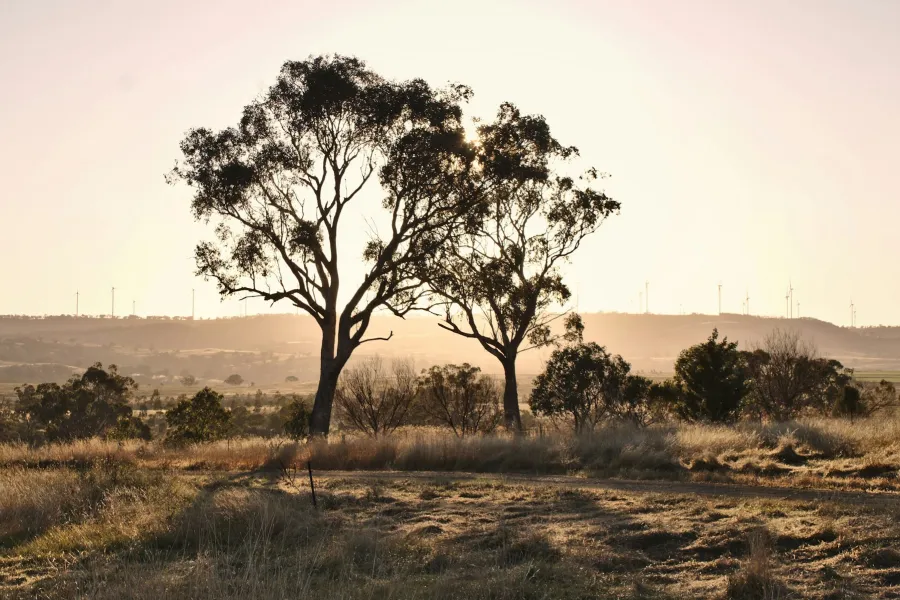
You will hear part of a lecture about eucalyptus trees in Australia and the threats they currently face.
First, you have some time to look at questions 31-40.
Now listen carefully and answer questions 31-40.
Today's subject is the eucalyptus, one of Australia's most familiar trees and also widely known as the gum tree.
I'll begin by explaining its importance before examining several problems that are now affecting it.
Eucalyptus trees matter for many reasons.
They provide shelter for animals such as bats and birds, while numerous species also obtain food from them, especially nectar from their flowers.
They therefore make an important contribution to biodiversity.
The trees are useful to people as well.
Oil taken from eucalyptus leaves is an ingredient in a disinfectant that destroys germs.
These trees grow throughout Australia and may survive for as long as four centuries.
It is therefore worrying that eucalyptus numbers are declining across the country because many trees are dying much earlier than they should.
Disease is one possible explanation.
In the 1970s, trees began to develop a condition known as mandula yellows.
Their leaves slowly became yellow and the trees eventually died.
Researchers did not identify the cause until 2004.
Lime, whose chemical name is calcium hydroxide, had been used to construct roads.
Rain carried it into the surrounding ground, where it affected the roots of nearby eucalyptus trees and prevented them from absorbing the iron necessary for healthy growth.
When iron was injected back into the affected trees, they recovered immediately.
Mandula yellows damaged only a fairly limited number of trees.
By 2000, however, vast areas of eucalyptus along Australia's east coast were being affected by bell miner-associated dieback.
This disease is often found where large populations of bell miner birds live and, again, the leaves suffer the damage.
Insects settle on the foliage and feed on it, destroying the leaves as they move around.
At the same time, they release a sugary substance.
Bell miners are strongly attracted to it and drive away other species that might compete for it.
The birds and insects then multiply at the expense of other wildlife until the leaves are so badly damaged that the tree dies.
Specialists have noticed that eucalyptus trees may appear unhealthy before bell miner-associated dieback becomes visible, so another factor may be involved.
One possibility concerns Australia's extensive bushfires.
More than 40 years ago, ecologist William Jackson proposed that the frequency of fires in a region determines the vegetation that follows.
Very frequent fires encourage grass to take over, whereas moderately frequent fires favor eucalyptus forest.
Why can fairly regular burning support eucalyptus?
First, fire limits competing plants that would otherwise use the water required by the trees.
It also prevents quick-growing bushes and other vegetation from changing the soil and removing its nutrients.
Some bushfires are therefore necessary for eucalyptus survival, provided they do not occur too often.
There is evidence that Indigenous Australians deliberately burned areas of bush at regular intervals for thousands of years before Europeans arrived.
Since European settlement, bushfires have been tightly controlled.
Scientists now think that reducing them to a very low frequency has encouraged the development of what is called dry rainforest.
The name sounds unusual because rainforest is commonly associated with wet conditions.
Unlike a species-rich tropical rainforest, this is a simple ecosystem.
Its vegetation is thick and dense but contains little variety.
The heavy shade creates an ideal habitat for one particular species, the bell-minor bird, which builds its nest in the undergrowth.
That, once again, is harmful to eucalyptus trees.
That is the end of part four.
You now have one minute to check your answers to part four.