You will hear a lecturer talking about the principles of successful tree planting projects.
First, you have some time to look at questions 31 to 40.
Now listen carefully and answer questions 31 to 40.
Tree planting has become a major theme in politics and public debate.
It is regularly promoted as a simple response to the climate emergency and as a means for companies to balance out their carbon emissions.
In reality, however, planting trees is far less straightforward than it may appear.
Putting unsuitable trees in an unsuitable location can cause considerably more harm than benefit without helping either local people or the natural environment.
Reforestation schemes are now being carried out on a vast scale in many countries, so choosing the appropriate trees is essential.
Projects should use a mixture of species characteristic of the natural forest in that area, including rare and threatened varieties, so that a rich ecosystem can develop.
Non-native trees that might become invasive should be excluded.
Invasive species are a major factor in the worldwide biodiversity crisis.
They often enter into competition with native species and can endanger their long-term survival.
Restoring biodiversity in a way that maximizes carbon capture is central to reforestation, but a well-designed project should usually pursue several aims.
Trees might be chosen to support wildlife, provide a sustainable supply of food for nearby communities, and maintain stable soil systems.
A scheme is particularly successful when it achieves several of these aims without damaging local communities, native ecosystems, or vulnerable species.
The survival and resilience of a restored forest also depend on seed selection.
Seeds need a suitable level of genetic diversity, meaning enough variation within a species to help it survive.
Low genetic diversity generally reduces a forest's resilience, leaving it more exposed to disease and less able to adjust to climate change.
Selecting the right site matters just as much as selecting the right trees.
Ideally, planting should take place on land that was once forested but is now in poor condition.
Natural grasslands, savannas, and wetlands should be left alone because these ecosystems already make an important contribution to carbon capture.
A site that can offer further benefits such as recreation may be preferable.
Land currently used for agriculture should not be chosen because doing so often shifts deforestation to another area.
Large reforestation programs require meticulous planning, and sound decisions about where planting should occur depend on reliable information.
Detailed current maps that show the highest priority locations for intervention are therefore indispensable.
Drones can also help specialists identify priorities and monitor damaged forest.
In Brazil, for instance, this technology is being used to locate and measure parts of the Amazon threatened by human activities, particularly the raising of cattle and illegal logging.
Lampang Province in northern Thailand provides a useful example of appropriate tree choice.
A former forest site degraded by mining was restored through cooperation between a cement company and Chiang Mai University.
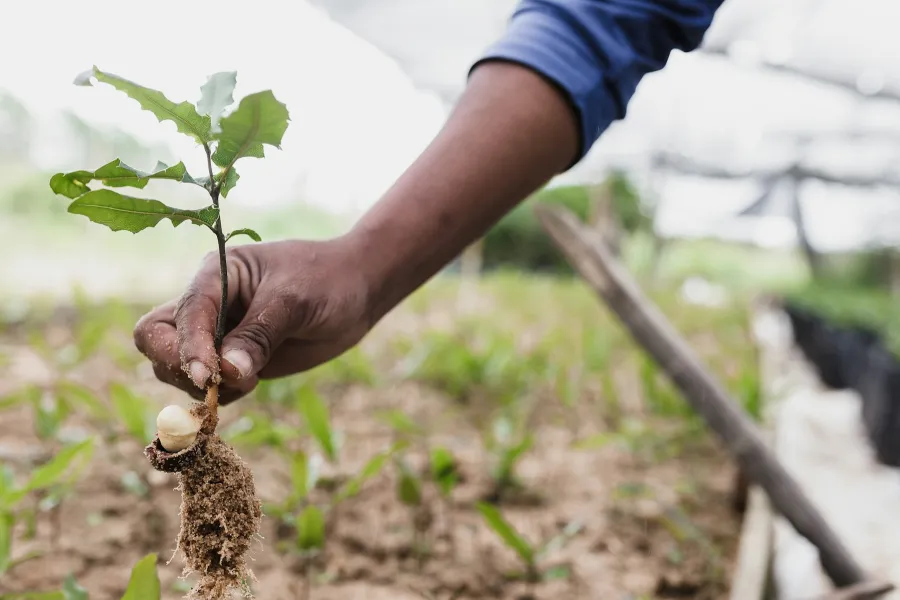
After 60 cm of topsoil had been spread, 14 native tree species were planted, among them several kinds of fig.
Figs are considered a keystone species because they play such an important part in sustaining wildlife populations.
They are especially valuable in tropical reforestation because they increase the speed of recovery by drawing in birds and other animals, which then disperse seeds naturally.
This supports diversity by encouraging the healthy return of many plant species.
Unlike most fruit trees, figs produce fruit throughout the year, so they offer wildlife a dependable food source.
At the Lampang site, monkeys began arriving to eat the figs after only three rainy seasons, and they spread seeds naturally in their droppings.
Every reforestation project should also make a point of consulting local communities and involving them in decisions.
The restoration of Madagascar's mangrove forests shows how a project can bring genuine community benefits.
When the mangroves were destroyed, plant and animal life suffered badly.
The damage also affected fishing, a major source of work for people in coastal settlements.
The restoration program employed local residents to plant and care for new mangroves.
Millions of trees have now been established, allowing a healthy aquatic ecosystem to return.
The mangroves also provide protection against the growing danger of flooding linked to climate change.
In addition, the local economy is more secure, and thousands more families can afford to send their children to school.
One other important point to consider.
That is the end of part four.
You now have one minute to check your answers to part four.