You will hear a student giving a presentation about tardigrades.
First, you have some time to look at questions 31 to 40.
Now listen carefully and answer questions 31 to 40.
For my project on invertebrate animals, I decided to investigate tardigrades.
They are microscopic, or more accurately, almost microscopic, creatures belonging to the phylum tardigrata.
Scientists have identified well over a thousand species.
Most measure between 0.05 and 1 millimeter, although the largest can reach 1.2 millimeters.
Tardigrades are often referred to as water bears.
The word water reflects the environment in which they do best, while bear describes the way they move.
Another common name is moss piglet.
Inspired by their appearance when seen from the front, they were first recorded in Germany in 1773 by Johann Goethe, who later gave the group its scientific name.
Although the species are numerous, they share several basic features.
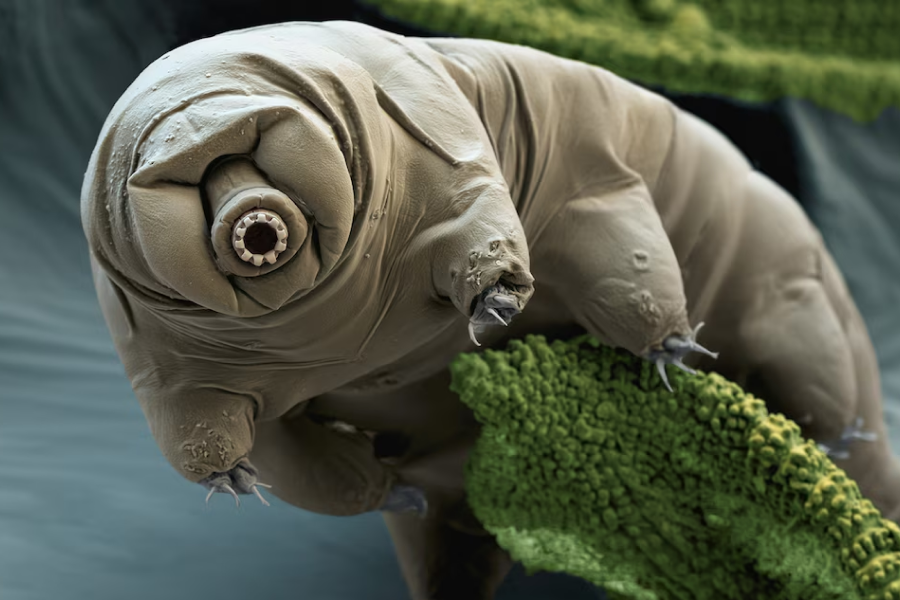
Their body is short and rounded, rather like a small barrel, and is divided into four sections.
Each section normally carries a pair of legs.
Most species have between four and eight pointed claws at the end of each leg.
A few have no claws at all.
Instead, they possess discs that use suction, allowing them to attach themselves to surfaces or hold prey.
Inside the body, there are no lungs or other organs for breathing.
A liquid fills the body cavity and transports both blood and oxygen.
The head can appear flattened, and some websites even call it cute, though that is hardly a scientific description.
Its mouth resembles a tube.
This can extend outwards and expose sharp tooth-like structures called stilets, which pierce plant or animal cells.
Tardigrades occur worldwide in many habitats.
They are frequently found on the bed of a lake, on different kinds of vegetation, or anywhere that stays very damp.
Research has shown how resilient they are.
They can survive radiation and enormous pressure, as well as temperatures below minus 200 degrees Celsius and above 148 degrees.
Some researchers suggest that tardigrades might remain alive even after humans disappeared, perhaps surviving an asteroid strike.
When their surroundings become dangerously dry, they enter cryptobiosis.
They pull in their head and legs and curl into a tiny ball known as a tun.
Their metabolism then falls to under 1% of its normal rate.
They may remain like this for decades, yet after water returns, they can become active again within hours.
During cryptobiosis, a special protein prevents damage to their DNA.
In 2016, scientists revived two specimens that had remained as tons for over 30 years.
A much older claim from 1948 involved a tone said to be 120 years old, but nobody has successfully repeated that result.
Experiments are now being conducted in space to establish how many days tardigrades can survive there.
The confirmed record, as far as I know is 10 days, turning to diet, tardigrades live by taking in liquids.
Despite having tooth-like stilets, they do not chew.
They draw juice from moss and obtain fluid from seaweed.
Certain species also feed on other tardigrades, whether from a different species or their own.
That may be less surprising when we remember that their bodies consist mainly of liquid and have a gel-like coating.
Finally, there is their conservation status.
Tardigrades are thought to have existed for around half a billion years and to have survived five mass extinctions.
The International Union for Conservation of Nature has not formally assessed them, and they do not appear on endangered lists.
In fact, some scientists describe their populations as thriving.
Does anyone have any questions?
That is the end of part 4.