NARRATOR:
You will hear two trainee teachers discussing a video of an origami lesson.
NARRATOR:
First, you have some time.
NARRATOR:
You will hear two trainee teachers discussing a video of an origami lesson.
NARRATOR:
First, you have some time to look at questions 21 to 27.
NARRATOR:
Now listen carefully and answer questions 21 to 27.
TUTOR:
I'd like you to talk about the lesson we've just watched and consider how origami might be used as an educational resource.
TUTOR:
Please discuss it with the person beside you.
SEB:
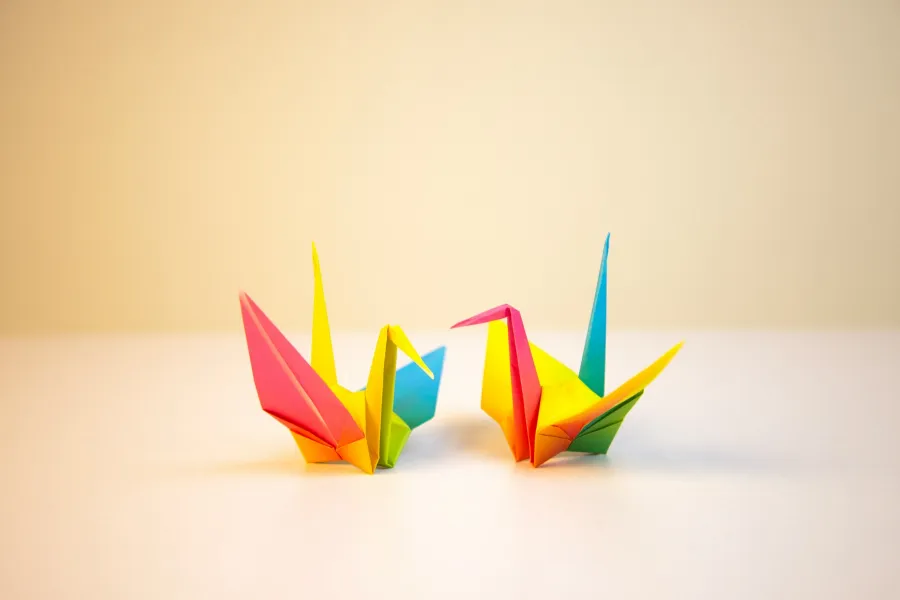
I'd never realized that something as basic as folding a square of paper into a shape, such as a bird, could be such an effective teaching tool.
SEB:
I see origami quite differently now.
LIA:
What interested me was the range of learning skills the children were developing.
LIA:
In the video, they listened very closely so that they could carry out every stage in the correct sequence and finish the bird.
SEB:
They worked on their own in that lesson.
SEB:
But it would be useful to see whether they could figure out a simple model without any guidance.
SEB:
Doing that in groups could also encourage teamwork.
LIA:
Yes, though that would be considerably harder.
LIA:
What struck me most was that they were enjoying themselves at the same time as they were learning something unfamiliar.
SEB:
And that's especially important with children of that age.
SEB:
These pupils handled the folds easily, but with the younger class origami could be used to develop fine control of hand movements.
LIA:
Shall we go through the individual children from the video?
LIA:
I noted all their names and made a few comments.
LIA:
Let's begin with Sid.
SEB:
He was worth watching because he'd been rather unsettled before the origami activity began.
LIA:
Having a practical task for his hands really helped him become calm and focus on what he was doing.
SEB:
Then there was Jack.
SEB:
He seemed determined to solve each difficulty by himself.
LIA:
He kept experimenting with different approaches instead of turning to the teacher.
LIA:
What did you think of Naomi?
SEB:
At one stage, she looked as though her attention was fading.
SEB:
But then she decided her mouse ought to be better than everyone else's.
SEB:
And that made her put in more effort.
LIA:
Even so, she didn't appear pleased with the finished model.
LIA:
She followed the demonstration closely and made an ideal bird with hardly any difficulty.
SEB:
The teacher could probably have given her a more demanding version.
LIA:
I got the impression Zara had never tried origami before.
SEB:
She looked as if she couldn't understand what was happening.
LIA:
She was clearly uncertain about what she needed to do, although her final model was reasonably successful.
SEB:
I'm sure she still learned something useful from it.
NARRATOR:
Before you hear the rest of the discussion, you have some time to look at questions 28 to 30.
NARRATOR:
Now listen and answer questions 28 to 30.
LIA:
I think the activity succeeded partly because the teacher had prepared everything so thoroughly.
SEB:
It must have taken a long time to make a separate example for every stage of folding the bird, but it was worthwhile.
SEB:
The children could see the goal at each point, and being able to pick up the models was much more helpful than simply viewing diagrams.
LIA:
Those real models complemented her spoken directions very effectively.
SEB:
It's surprising that more teachers don't use origami.
SEB:
What do you think puts them off?
LIA:
They may assume it won't attract children who are accustomed to digital activities, particularly boys, even when they recognize its educational value.
SEB:
It's much like any other craft.
SEB:
My guess is that plenty of teachers simply aren't very skillful with their hands, like me.
LIA:
If practical work doesn't come naturally, preparing the activity can seem like too much effort.
SEB:
Anyway, we should use it during our year 3 maths placement.
SEB:
In the video, origami reinforced what the children already knew about geometric shapes.
SEB:
But it could also be a lively way to introduce fractions, which they'll study shortly.
LIA:
Quite a few pupils in that class may find fractions difficult.
LIA:
Origami would help with symmetry too, although I think they covered that last term.
SEB:
Let's collect some ideas and plan the lesson next week.
TUTOR:
Could everyone stop there, please?