You will hear part of a lecture about how the Industrial Revolution changed everyday life in Britain.
First, you have some time to look at questions 31 to 40.
Now listen carefully and answer questions 31 to 40.
Today, I'm going to present the research I carried out into Britain's social history during the Industrial Revolution, with particular attention to the way ordinary people's lives were altered.
This period introduced a new pattern of behavior, consumerism, in which buying and selling products became central to daily life.
During the 19th century, for the first time, the amount and standard of what people owned came to be treated as evidence of Britain's wealth.
Earlier generations had possessed very little, but the Industrial Revolution changed that situation.
Between the middle of the 18th century and the end of the 19th, advances in the manufacture of goods, together with developments in technology, produced enormous social changes that touched almost everyone.
Let's begin with manufacturing.
Steam engines and coal are the images most people associate with the Industrial Revolution, and with good reason.
Without these new sources of power, it could not have occurred.
They replaced the water mills and windmills that had previously supplied most energy.
For much of the 19th century, textiles formed the most advanced industry.
As a result, fashionable cloth, lace, and ribbons became affordable and widely available.
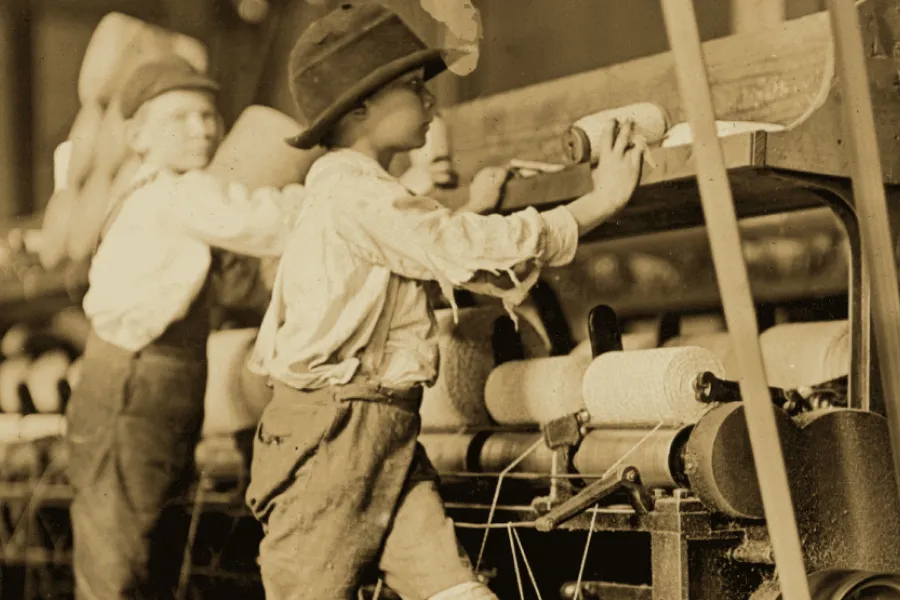
Before industrialization, goods for sale were generally produced in small workshops, often inside people's homes.
Then, extremely large machines were developed that could manufacture items more quickly and in far greater quantities.
Because those machines needed much more room, factories were constructed and gradually took the place of workshops.
Workers now had to travel to their jobs, and large populations moved from rural villages into towns.
Manufacturing was not the only driver of consumerism.
Transport technology also changed dramatically.
The 18th century's slow horse-drawn coaches and carts, which carried only small loads along rough roads, were followed by an extensive canal network that was especially useful for freight.
Canals later declined as the railway system expanded and became the main means of carrying both people and products across the country.
Trains transported coal, iron, and clothing, but also newspapers.
These made thousands of readers better informed about national events and, importantly, about the goods offered in shops, which encouraged further spending.
Faster transport also made distribution much more efficient, allowing products to be sold nationwide rather than only in a local market.
Retailing was the third major area of change.
Shops increased rapidly in both number and quality, and small businesses lost customers to the new department stores that appeared during the 19th century.
Their owners developed new methods of stocking goods and attracting shoppers.
Better lighting inside stores made displays much easier to see.
From the street, plate glass allowed shop windows to be considerably larger than before, so more merchandise was visible.
Promotion changed as well.
Instead of simply announcing that an item was available, advertising increasingly tried to persuade people to shop.
The historian Judith Flanders argues that one of the Industrial Revolution's most important consequences was the creation of choice.
Products that had once been luxuries, such as sugar and cutlery, became ordinary conveniences and then necessities.
Soon, living without them seemed impossible, rather like mobile phones today.
That is the end of part four.
You now have one minute to check your answers to part four.