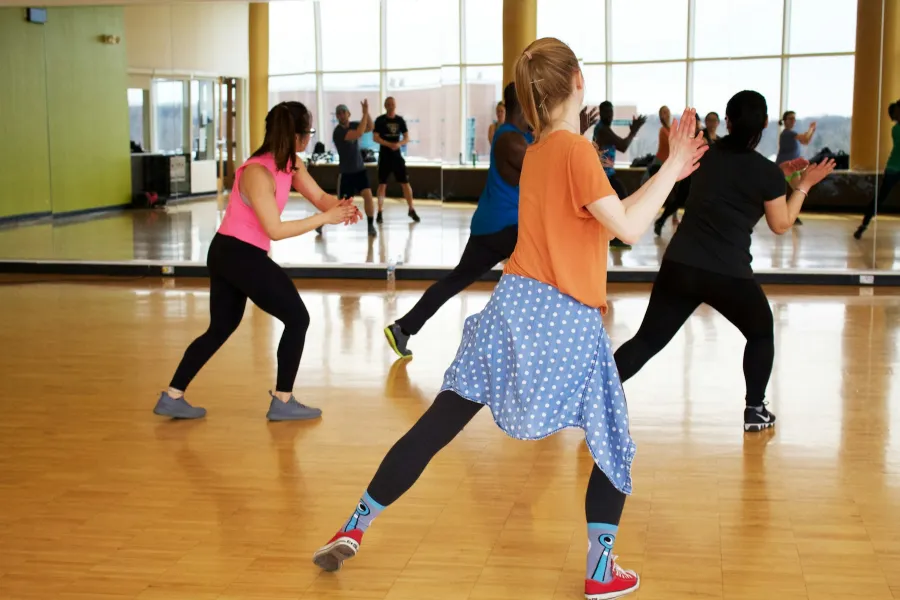
You will hear part of a lecture about the health benefits of dancing.
First, you have some time to look at questions 31 to 40.
Now listen carefully and answer questions 31 to 40.
People everywhere dance when they are celebrating or simply enjoying themselves.
Moving in response to music is found in every culture.
What researchers have only recently begun to recognize, however, is that dance does more than lift our mood.
It can also have substantial benefits for our health.
Like other kinds of physical activity, dancing releases hormones such as dopamine, which help us feel calm and happy.
At the same time, it can lower levels of stress and anxiety.
Dance is usually a social experience as well, and that interaction appears to add to the positive feelings it creates.
One study compared two situations, people dancing alone at home while following a video, and people taking part together in a studio class.
Those who danced with a group said that their mood improved while the participants who danced by themselves reported no comparable change.
Researchers from the universities of York and Sheffield conducted another experiment with students.
Each participant spent five minutes in a laboratory listening to music and chose one of three activities, sitting still, pedaling an exercise bike or dancing.
Everyone completed thinking tasks both before and afterwards.
On the later problem-solving exercises, the dancers demonstrated a much higher level of creativity.
Dr. Lovat at the University of Hertfordshire has suggested another application.
He believes doctors could prescribe dance as therapy for people with mental health difficulties, including depression.
Dance is already known to encourage teenage girls to exercise, but it can be equally valuable for people in their 60s and older.
A major advantage is its accessibility.
Nearly anyone can join in, even when their level of fitness is quite low.
It is particularly useful for older adults who cannot or prefer not to run or complete demanding workouts.
A study published in 2015 found that even gentle dancing supports a healthy heart.
Other evidence shows that it can reduce falls and the resulting injuries, such as a broken hip, because regular practice improves balance.
Some benefits are less obvious.
Dance challenges the mind as well as the body, since participants must concentrate on remembering steps and sequences.
This is valuable in later life because it trains the brain to process information more quickly and retain more of it.
Current studies also indicate that older dancers experience an improved sense of well-being for as long as a week after a class.
They often feel less tired and report greater motivation to remain active through everyday tasks, such as gardening or walking to local shops and parks.
Ballroom and country dancing, which are both popular among older adults, take place in groups, partners cooperate, make physical contact and communicate on the dance floor.
These experiences help people form new relationships and can ease the isolation that affects many older people.
I also examined Zumba, an aerobic workout using Latin American dance movements.
Around 15 million people in 180 countries now attend classes regularly.
Professor John Porcari of the University of Wisconsin studied experienced female participants and found that a 40-minute class burns roughly 370 calories.
That is comparable with fairly demanding activities such as step aerobics and kickboxing.
Research published in the American Journal of Health Behavior followed women with obesity who attended Zumba three times a week for 16 weeks.
On average, they lost 1.2 kilograms and reduced their body fat percentage by one point.
More importantly, they enjoyed the sessions enough to make attendance a habit, continuing to go at least once a week.
That level of commitment is unusual in an aerobic exercise program.
Dance will not produce the same physical gains as a high-intensity workout, but it is likely to become even more popular because it offers such an enjoyable way to stay fit.
That is the end of part four.
You now have one minute to check your answers to part four.