NARRATOR:
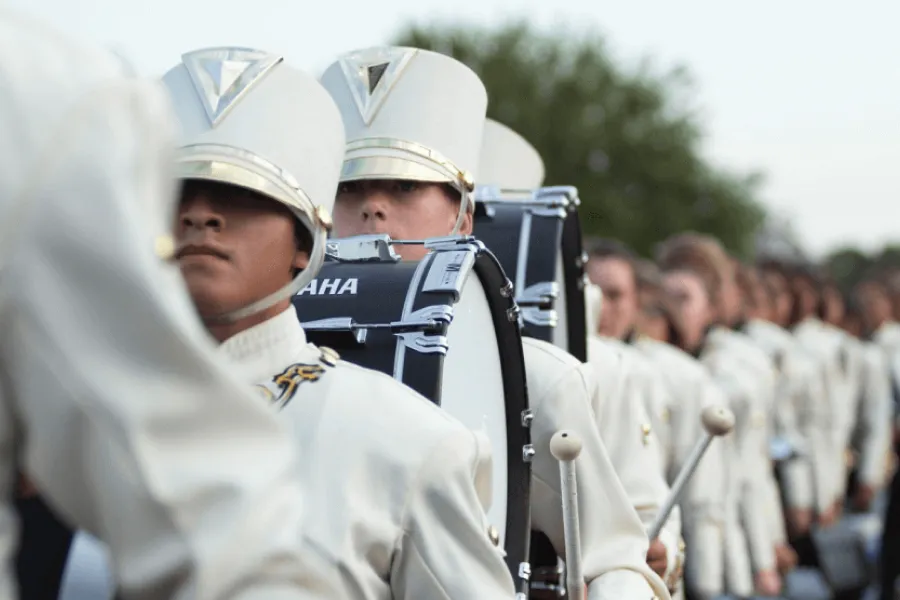
You will hear two trainee, you will hear two trainee teachers discussing Joe's work with a school marching band.
NARRATOR:
First, you have some time to look at questions 21 to 26.
NARRATOR:
Now listen carefully and answer questions 21 to 26.
LIZZIE:
How are things going with your teaching placement at the high school Joe?
JOE:
Well, I've been asked to run the school marching band and it is a considerable responsibility.
JOE:
I'd like to talk it through with you.
LIZZIE:
Of course, perhaps you should begin by giving me some background.
JOE:
The band includes pupils from every year group so their ages range from 11 to 18 and there are roughly 50 members altogether.
JOE:
It is a popular school activity.
JOE:
The largest band I've worked with before had only 20 players so this feels very different.
LIZZIE:
That must be quite a change.
JOE:
They are not yet at the standard needed for national band competitions but they have entered a regional competition later this term.
JOE:
I'm not expecting them to win, but I hope taking part will encourage them to raise their level.
LIZZIE:
Yes, it should give them something to aim for.
JOE:
The town council is also arranging a carnival this summer and the band has been invited to perform there.
JOE:
At the moment I don't think they are ready so I need to get them playing more effectively as one group and I haven't got much time.
LIZZIE:
Have you tried anything apart from rehearsing the pieces?
JOE:
I found a recording of a drummer describing how joining a band had transformed his life.
JOE:
I think it came from an after dinner speech.
JOE:
I found it inspiring because music had kept him away from crime and the pupils appeared interested as well.
LIZZIE:
That sounds encouraging.
JOE:
Next I'm planning to show them the old 1940s film Strike Up the Band and then discuss it with them.
JOE:
Does that seem worthwhile?
LIZZIE:
Because it centers on a school band it may help them see what they could accomplish by cooperating.
JOE:
I'd also like to take some of the band to a parade next month.
JOE:
Two marching bands are due to perform so the atmosphere should be lively.
JOE:
It will depend on whether I can convince the school to pay for one or two coaches.
LIZZIE:
Those all sound like useful ideas.
NARRATOR:
Before you hear the rest of the conversation you have some time to look at questions 27 to 30.
NARRATOR:
Now listen and answer questions 27 to 30.
JOE:
Could I tell you about a few band members I'm finding difficult to manage?
JOE:
I'm sure you can suggest what I might do.
JOE:
One of the flautists insists that she loves being in the band.
JOE:
We rehearse after school twice a week but she is almost never present.
JOE:
She finds me the following day and offers a convincing explanation.
JOE:
Such as needing to help her mother or being unwell but honestly I don't believe her.
LIZZIE:
Are there any other troublesome students?
JOE:
There is a trumpeter who considers herself the strongest musician in the band although she certainly isn't.
JOE:
She is constantly telling the other players what they ought to do which makes leading the group very difficult.
LIZZIE:
She sounds hard to deal with.
JOE:
Then there is a trombonist with an excellent sense of rhythm who could become a very good musician.
JOE:
The problem is that he has a breathing condition and cannot produce enough air for the trombone.
JOE:
Percussion would suit him much better but he refuses to change so he manages only some of the notes.
LIZZIE:
I suppose his determination is admirable.
JOE:
One of the percussionists plays reasonably well but he keeps apart from everyone else and leaves immediately when each rehearsal finishes.
JOE:
There may be difficulties at home.
JOE:
I really don't know.
JOE:
Still it is a concern in a band where everyone needs to feel part of the group.
JOE:
There are a few more but that gives you a sense of the situation.
JOE:
What would you advise me to do Lizzie?
NARRATOR:
That is the end of part three.
NARRATOR:
You now have one minute to check your answers.