IELTS Forcast Reading Test 2025 - Q2 Test 2 with Practice Test, Answers And Explanation
Luyện tập đề IELTS Forcast Reading Test 2025 - Q2 Test 2 được lấy từ cuốn sách Forcast Test 2025 - Q2 với trải nghiệm thi IELTS trên máy và giải thích đáp án chi tiết bằng Linearthinking, kèm answer key và list từ vựng IELTS cần học trong bài đọc.
IELTS Forcast Reading Test 2025 - Q2 Test 2 with Practice Test, Answers And Explanation
Passage
❓ Câu hỏi passage 1
Question 1 - 5
Which paragraph contains the following information?
1
Promising beginnings
2
Definition of a revolutionary technology
3
Repackaging an old idea
4
Dubious attributes
5
The foundation of a new technology
Question 6 - 10
Choose appropriate options A, B, C or D.
6
Nanotechnology
A
has limited value.
B
is not related to science.
C
incites controversy.
D
poses insurmountable safety issues.
7
In the beginning, nanotechnology was
A
overlooked as a science.
B
considered to be irrelevant.
C
highly unpopular.
D
regarded as being revolutionary.
8
Nanoparticles are a product of
A
manufacturing processes alone.
B
natural and manufactured processes.
C
purely biological processes.
D
environmental factors alone.
9
Nanotechnology remained a purely theoretical science until
A
other technologies caught up with it.
B
scientists were better able to understand its practical applications.
C
Taniguchi convinced other scientists of its practical value.
D
a scientist invented a new technology.
10
Safety concerns about nanotechnology are
A
completely unfounded.
B
exaggerated by its detractors.
C
real but manageable.
D
misunderstood.
Question 11 - 13
Complete the sentences.
Choose NO MORE THAN THREE WORDS from the passage for each answer.
A major in the field of nanotechnology came with the discovery of fullerenes and the invention of the Scanning Tunnelling Microscope.
Amongst scientists, nanotechnology has not met with .
The ability of nanoparticles to penetrate is somewhat of a mixed blessing.
Passage
❓ Câu hỏi passage 2
Question 14 - 17
Choose
YES if the statement agrees with the information
NO if the statement contradicts the information
NOT GIVEN if it is impossible to say what the writer thinks about this
14
Many parents indicate that their children struggle to learn a musical instrument.
15
The findings of the recent research into pre-school children's IQs are unreliable.
16
The main reasons people take up an instrument are that they enjoy playing music and being creative.
17
Evidence about the long-term advantages of learning an instrument is increasing.
Question 18 - 22
Choose appropriate options A, B, C or D.
18
The studies mentioned in the first paragraph
A
confirm a link between musical training and intelligence.
B
present misleading information about the value of learning an instrument.
C
suggest that there are undiscovered benefits to
D
studying music cast doubt on a belief about the effects of taking music lessons.
19
According to the second paragraph, there may be many benefits to studying music,
A
even for those who begin learning in adulthood.
B
providing the person learns the correct techniques.
C
especially if the person practices on a regular basis.
D
particularly if the person plays a range of different instruments.
20
The phrase 'this might well be the case' in the fourth paragraph suggests that
A
music lessons and long-term physical well-being may be connected.
B
the ability to learn music may depend on neurological features.
C
learning an instrument may have a lasting impact on brain function.
D
older people's brains may be better suited to studying music than those of children.
21
Which aspect of playing an instrument was included in Hanna-Pladdy's follow-up study but not in her first study?
A
the number of years that the person had played
B
at which age the person began having lessons
C
the length of time since the person last played
D
how the person had practised as a child
22
What do Hanna-Pladdy's studies suggest about people's general education?
A
Studying music compensates for an otherwise limited level of education.
B
Learning to play an instrument improves educational performance.
C
Highly educated people are more likely to benefit from music training.
D
Level of education makes no difference to a person's musical ability.
Question 23 - 27
Complete each sentence with the correct ending, A-F, below.
List of Findings
A
comparing the brains of people who had never played an instrument with those who played for a living
B
activating many different parts of the brain at the same time.
C
teaching a group of older people to play an instrument
D
acquiring the particular set of physical skills needed to play an instrument
E
discovering which group of people become the best musicians.
F
having played an instrument for a considerable length of time.
23
Brenda Hanna-Pladdy believes the cognitive benefits of music lessons are a result of
24
The research undertaken by Gottfried Schlaug focused on
25
According to Alison Balbag, playing an instrument is a unique experience because it involves
26
Nina Kraus believes there is a link between better hearing in later life and the experience of
27
Jennifer Bugos's study involved
Passage
❓ Câu hỏi passage 3
Question 28 - 32
Do the following statements agree with the information given in the Reading Passage?
TRUE if the statement agrees with the information
FALSE if the statement contradicts the information
NOT GIVEN if it is impossible to say what the writer thinks about this
28
The Greeks and Egyptians used polished silver to make mirrors.
29
The first man-made mirrors were made of bronze.
30
Only the wealthy could afford the first mirrors.
31
The first mirrors in America were used for decoration.
32
Spherical mirrors are commonly used in cars.
Question 33 - 36
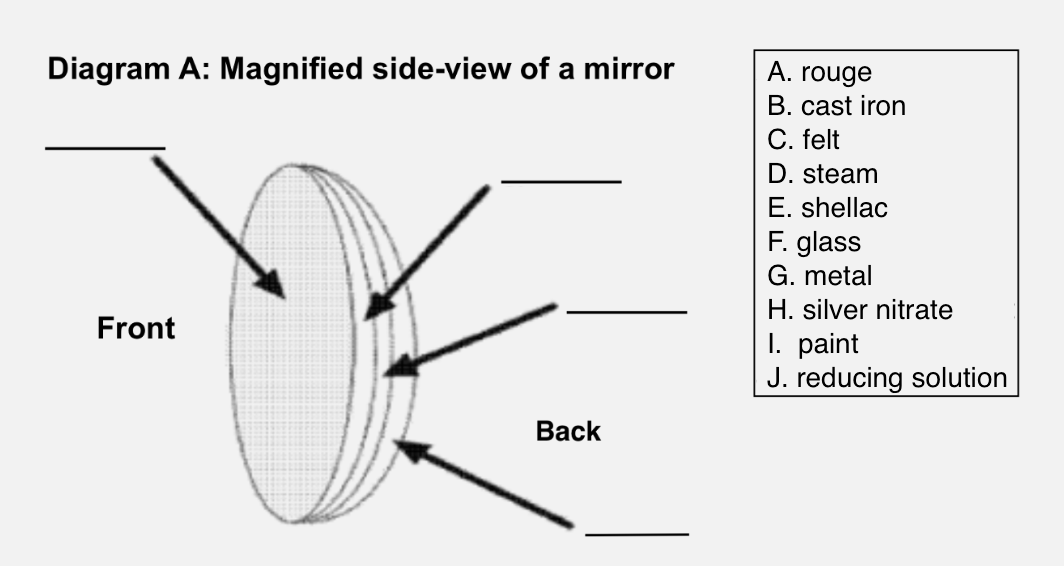
Complete the labels on the diagrams below using the correct letter, A–J.
Question 37 - 40
Choose the correct letter, A, B, C or D.
Write the correct letter in boxes on your answer sheet.
37
The type of mirror used for looking at the stars is
A
paraboloidal
B
spherical
C
cylindrical
D
ellipsoidal
38
17th century craftsmen
A
blended mirror frames well with other household furniture.
B
hung mirrors above fireplaces.
C
used mirror frames as a focus for home decoration.
D
established floral patterns as a standard for mirror frames.
39
18th century craftsmen
A
designed furniture which highlighted the unique properties of mirrors.
B
experimented largely with mirror frames made of ebony and ivory.
C
built spherically-shaped mirrors.
D
experimented with ceiling mirrors around fireplaces.
40
19th century craftsmen
A
used mirrors less than any previous time in history.
B
introduced mirrors as learning tools.
C
used mirrors extensively in bedroom furniture.
D
etched designs into mirrors.
DOL IELTS Đình Lực
05/05/2026
📖 Bài đọc passage 1
Nanotechnology: Its development and uses
A
A. Nanotechnology has been hailed by many as being a twentieth-century miracle of science. Essentially, nanotechnology, a term derived from Greek, translating literally as 'dwarf technology' is, as the origin of its name suggests, engineering at the atomic level. Scientists work with particles of substances known as 'nanoparticles' which may measure no more than 1 nanometre or a billionth of a metre. That's around 40,000 times smaller than the width of the average human hair. Whilst some of these substances derived from carbon compounds are manufactured, others, such as metals, are naturally-occurring or arise as a by-product of another process e.g. volcanic ash or smoke from wood burning. What makes these substances of such scientific interest is that their minute size facilitates medical and technological processes that would otherwise be impossible.
B
It may be something of a revelation for many of us to learn that nanotechnology - or its concept - is far from cutting-edge science. In fact, nanotechnology as an idea was first referred to in an influential lecture by American physicist, Richard Feynman, as far back as 1959. During the lecture, entitled 'There's Plenty of Room at the Bottom', Feynman outlined the basic concept of nanotechnology. Individual atoms and molecules, he claimed, could in the future be created by a physical process. Such a process, he envisaged, would involve the building of a set of precise tools to build and operate another proportionally smaller set. The building of increasingly minute tools at the microscopic level would in turn produce ultra-microscopic materials, later to become known as 'nanoparticles'.
C
Strangely, what should have sparked a scientific revolution was then virtually forgotten about for the next 15 years. In 1974, a Japanese scientist, Norio Taniguchi, of the Tokyo University of Science reintroduced Feynman's theory and put a new name to an old concept, referring to the science as 'nanotechnology'. However, it wasn't until nearly a decade later, in the 1980s, that the way was paved for nanotechnology to leave the realm of theoretical science and become reality. Two major scientific developments within a relatively short period were to enable practical application of nanotechnology. The invention of the Scanning Tunnelling Microscope (STM), combined with the discovery of nano-sized particles termed 'fullerenes', were to prove a turning point in nanotechnology.
D
Fullerenes are derived from carbon molecules and, in common with other nanoparticles, possess chemical and physical properties that are of huge scientific interest. The potential value of fullerenes for medical science was first raised in 2003 and in 2005 when the scientific magazine 'Chemistry and Biology' ran an article describing the use of fullerenes as light-activated antimicrobial agents. Since then, fullerenes have been used for several biomedical applications ranging from X-ray imaging to treating cancer by targeting cancer cells. In addition, these nanoparticles have been used in the manufacture of commercial products, from sunscreen to cosmetics and some food products. Furthermore, nanoparticles of metals, like gold and silver, have been used in environmental clean-ups of oil slicks and other forms of pollution. The remarkable properties of nanoparticles are down to two main factors: their greater surface-to-weight ratio, compared to larger particles which promotes the attachment of substances to their surface, and their minute size which allows them to penetrate cell membranes. These properties are of great benefit, for example in medicine, as drugs to fight cancer or AIDS can be attached to nanoparticles to reach their target cell in the human body.
E
However, despite the amazing properties attributed to nanoparticles such as fullerenes, nanotechnology has yet to win wider universal acceptance in scientific circles. For the very properties that make nanoparticles so valuable to technology and medical science are also the ones that make them potentially so toxic. Such properties are potentially lethal if toxic substances attach themselves to the same nanoparticles, thereby delivering a fatal toxin through the cell membranes into the cells themselves. The toxic effect of these compounds is further increased, since their size permits them to enter the bloodstream and hence the body's major organs. Furthermore, the nanoparticles in themselves are essentially a foreign element being introduced to the body. Unlike foreign elements, such as bacteria, the body has no natural immune system to deaI with these ultramicroscopic particles. Scientists have yet to convince the nanotechnology sceptics that the potential side effects of nanoparticles are more than compensated for by the advantages that they confer. It may be, however, that opposition to this technology is no more than a general distrust of scientific innovation. In fact, Urban Wiesing from the University of Tubingen has been quoted as saying 'Many of the risks associated with nanotechnology have at least been encountered in part in other technologies as well.' He also believes that regulations can be put in place to minimise such risks. This is a view echoed by the Fed eral Environment Agency that proposes that such risks are vastly outweighed by the potential benefits of nanotechnology, in particular for the environment.
🔥 Đáp án & giải thích 1
1
D
Giải thích chi tiết
☺️ Ứng dụng Linearthinking để giải quyết dạng bài Matching Information
📌 Dạng Matching Information chúng ta nên làm cuối cùng, sau khi đã làm các dạng câu hỏi khác nhé DOLBIES, bởi vì lúc này mình đã đọc và hiểu nội dung của bài rồi, cộng thêm nghệ thuật Specify của Linearthinking → sẽ nhanh chóng tìm được vị trí đáp án hơn!!
-------
Step 01: Read the question to predict
Hiểu câu hỏi: Promising beginnings
Specify & Predict: Tìm đoạn văn nói về những bước đầu tiên mang tính tích cực hoặc các tiềm năng được khai mở của công nghệ, ví dụ: các ứng dụng y học đầu tiên, những bài báo ca ngợi tiềm năng...
-------
Step 02: Khoanh vùng đoạn văn
🔍 Từ khóa: “Promising beginnings"
→ Dựa vào các từ khoá trên, có thể khoanh vùng được đoạn D vì có xuất hiện các cụm như:
"potential value of fullerenes for medical science" (giá trị tiềm năng của fullerene đối với khoa học y tế);
"was first raised" (được đề cập lần đầu) ~ tương đương với "beginnings"
"X-ray imaging/ treating cancer/ commercial products..." (cụ thể ứng dụng).
→ Đây là ví dụ cụ thể cho "Promising beginnings" ~ khởi đầu đầy tiềm năng của fullerenes trong y học.
Studies show that learning a musical instrument can being about significant improvements in your brain.
Are music lessons the way to get smarter? That's what a lot of parents and experts believe: studying an instrument gives children an advantage in the development of their intellectual, perceptual, and cognitive skills. This may, however, turn out to be wishful thinking. Two highly convincing trials carried out recently have found no evidence to support this idea; the IQs of pre-school children who attended several weeks of music classes as part of these studies did not differ significantly from the IQs of those who had not.
But that does not mean that the advantages of learning to play music are limited to expressing yourself, impressing friends, or just having fun. A growing number of studies show that learning an instrument in childhood can do something perhaps more valuable for the brain: it can provide benefits as we age, in the form of an added defense against memory loss, cognitive decline, and impaired hearing. Not only that, you may well get those benefits even if you haven't picked up your instrument in years, or decide to take up music for the first time in mid-life or beyond. According to neuropsychologist Brenda Hanna-Pladdy of Emory University in Atlanta, the time spent learning and practicing specific types of motor control and coordination each finger on each hand doing something different, and for wind and brass instruments, also using your mouth and breathing-contributes to the brain boost that shows up later in life.
You can even map the impact of musical training on the brain itself. In one study, Harvard neurologist Gottfried Schlaug found that the brains of adult professional musicians had a larger volume of grey matter than the brains of non-musicians had. Schlaug and colleagues also found that after 15 months of musical training in early childhood, structural brain changes associated with motor and auditory Improvements begin to appear. What's unique about playing an instrument is that it requires a wide array of brain regions and cognitive functions to work together simultaneously, in both right and left hemispheres of the brain,' says Alison Balbag of the University of Southern California. Playing music may be an efficient way to stimulate the brain', she says, 'cutting across a broad swath of its regions and cognitive functions and with ripple effects through the decades."
More research is showing this might well be the case. In her first study on the subject, Hanna-Pladdy divided 70 healthy adults between the ages of 60 and 83 into three groups: musicians who had studied an instrument for at least ten years, those who had played between one and nine years, and a control group who had never learned an instrument. The group who had studied for at least ten years scored the highest when tested in such areas as nonverbal and visuo-spatial memory, naming objects, and taking in and adapting new information. Her follow-up study a year later confirmed those findings and further suggested that starting musical training before the age of nine and keeping at it for ten years or more may yield the greatest benefits. Interestingly, it was the group who had the lowest level of general education which showed the greatest gap in scores between those who had studied an instrument in childhood and those who had not. Hanna-Pladdy suspects that musical training could have made up for the lack of cognitive stimulation these people had.
Neuroscientist Nina Kraus of Northwestern University in Chicago has found still more positive effects of early musical training. She measured the electrical activity in the auditory brainstem of adults, aged 55 to 70, as they responded to the synthesized speech syllable "da." Although none of the subjects had played a musical instrument in 40 years, those who had trained the longest - between four and fourteen years - responded the fastest. "That's significant," says Kraus, "because hearing tends to decline as we age, including the ability to quickly and accurately discern consonants, a skill crucial to understanding and participating in conversation. If your nervous system is not keeping up with the timing necessary for encoding consonants, you will lose out on the flow and meaning of the conversation, and that can potentially create a downward spiral leading to a sense of social isolation," says Kraus. In addition, the fact that musical training appears to enhance auditory working memory might help reinforce in later life the memory capacity that facilitates verbal interaction."
In another study at the University of South Florida, assistant professor of music education Jennifer Bugos studied the impact of elementary piano instruction on adults between the ages of 60 and 85. After six months, those who had received piano lessons showed more robust gains in memory, verbal fluency, the speed at which they processed information, planning ability, and other cognitive functions compared with those who had not received the lessons. Bugos believes that playing an instrument has beneficial effects, regardless of how old the person is when he or she begins. "Musical training contains all the components of a cognitive training program that sometimes are overlooked," she says. "And just as we work out our bodies, we should work out our minds."
🔥 Đáp án & giải thích 2
14
Not Given
Giải thích chi tiết
☺️ Ứng dụng Linearthinking để giải quyết dạng bài Yes / No / Not Given
Step 01: Read the question to understand (main idea + detail)
Simplified: Many parents indicate -> their children struggle to learn a musical instrument
-------
Step 02: Locate relevant information
🔍 Từ khóa: “parents”, “children”, “musical instrument”
=> Dựa vào các từ khoá trên -> Tìm được trích dẫn ở đoạn 1.
-------
Step 03: Read relevant information to understand (main + detail)
📌 Trích dẫn: “Are music lessons the way to get smarter? That’s what a lot of parents and experts believe: studying an instrument gives children an advantage in the development of their intellectual, perceptual, and cognitive skills.”
Simplified: a lot of parents and experts believe studying an instrument gives children an advantage in developing skills
Main idea: Nhiều cha mẹ tin rằng học nhạc cụ giúp con thông minh hơn, phát triển nhận thức và kỹ năng=>không đề cập đến “khó khăn” hay “struggle”.
-------
Step 04: Compare meaning with meaning
Trong bài đọc: Nhiều phụ huynh tin rằng học nhạc giúp con thông minh hơn (nêu lợi ích).
Trong câu hỏi: Nhiều phụ huynh cho rằng con họ gặp khó khăn khi học nhạc cụ.
⇒Bài đọc KHÔNG đề cập đến việc trẻ gặp khó khăn.
✅ Chọn: NOT GIVEN
-------
Lưu ý:
-> Nếu bài nói rõ rằng “parents find it difficult for children to play an instrument”thì mới là YES.
-> Nếu bài nói rõ rằng “parents find it easy” thì mới là NO — nhưng ở đây không có thông tin này.
In all likelihood the first mirrors would have simply been pools of water that reflected the image of the one who looked into it. Nature’s mirror, while cheap and readily accessible, must have also been quite frustrating with the slightest disturbance on the surface of the water making it difficult to see clearly. It is not altogether clear when the first man-made mirrors were produced but mirrors made of brass are mentioned in the Bible, and after that mirrors of bronze were in common use among the ancient Egyptians, Romans and Greeks. In addition to bronze, the Greeks and Romans experimented with polished silver to produce simple mirrors.
Crude forms of glass mirrors were first made in Venice in 1300. Small sheets of glass were cut from disks made by a spinning process. When this glass was backed with a covering of tin or lead, a ‘mirror’ resulted. During the early periods of their development, mirrors were rare and expensive. France had glass factories but only in Venice, Italy was the secret of mirror foiling known. The chemical process of coating a glass surface with metallic silver was discovered by German chemist Justus von Liebig in 1835, and this advance inaugurated the modern techniques of mirror making.
By the end of the 17th century mirrors were made in Britain and the manufacture of mirrors developed subsequently into an important industry in many other European countries. People wore them in their hats, or set them like jewels in their rings. Society glittered and shone like the firmament. A little later on, America was gripped by the mirror craze, only this time they wore interested in larger mirrors. In house after house in residential districts and eastern cities there could be found one long mirror after another placed between two front parlour windows.
In the manufacture of mirrors today, plate glass is cut to size, and all blemishes are removed by polishing with rouge. The glass is scrubbed and flushed with a reducing solution before silver is applied. The glass is then placed on a hollow, cast-iron tabletop, covered with felt, and kept warm by steam. A solution of silver nitrate is poured on the glass and left undisturbed for about 1 hour. The silver nitrate is reduced to a metallic silver and a lustrous deposit of silver gradually forms. The deposit is dried, coated with shellac, and painted. Most present-day mirrors therefore, are made up of these layers. Glass is used on top because it is smooth, clear, and protects the reflective surface. A mirror needs to be very smooth in order for the best reflection to occur.
Mirrors may have plane or curved surfaces. A curved mirror is concave or convex depending on whether the reflecting surface faces toward the centre of the curvature or away from it. Curved mirrors in ordinary usage have surfaces of varying shapes. Perhaps the most common is spherical. Spherical mirrors produce images that are magnified or reduced – exemplified, by mirrors for applying facial makeup and by rear-view mirrors for vehicles. Cylindrical mirrors are another common type of shape. These focus a parallel beam flight to a linear focus. A paraboloidal mirror is one which is often used to focus parallel rays to a sharp focus, as in a telescope mirror, or to produce a parallel beam from a source at its focus, such as a searchlight. A less common but useful shape is the ellipsoidal. Such a mirror will reflect light from one of its two focal points to the other.
While the mirror is the focus of the production, the frame plays an important albeit slightly lesser role as the anchor by which the mirror is affixed to its proper place. From the late 17th century onward, mirrors and their frames played an increasingly important part in the decoration of rooms. Complementing the shiny reflective mirror, the early frames were usually of ivory, silver, ebony, or tortoiseshell or were veneered with walnut, olive, and laburnum. Needlework and bead frames were also to be found. Craftsmen such as Grinling Gibbons often produced elaborately carved mirror frames to match a complete decorative ensemble. The tradition soon became established of incorporating a mirror into the space over the mantelpiece; many of the early versions of these mirrors, usually known as overmantels, were enclosed in glass frames. The architectural structure of which these mirrors formed a part became progressively more elaborate. Focusing heavily on the effect created by mirrors, 18th century designers such as the English brothers Robert and James Adam created fireplace units stretching from the hearth to the ceiling. Oil the whole, mirror frames reflected the general taste of the time and were often changed to accommodate alterations in taste – frames usually being cheaper and hence more easily replaced than the mirror itself.
By the end of the 18th century, painted decoration largely supplanted carving on mirrors, the frames being decorated with floral patterns or classical ornaments. At the same time the French started producing circular mirrors. Usually surrounded by a neoclassical gilt frame that sometimes supported candlesticks, these mirrors enjoyed great popularity well into the 19th. Improved skill in mirror making also made possible die introduction of the cheval glass, a freestanding full-length mirror, supported on a frame with four feet. These were mainly used for dressing purposes, though occasionally they had a decorative function. New, cheaper techniques of mirror production in the 19th century led to a great proliferation in their use. Not only were they regularly incorporated into pieces of furniture – such as wardrobes and sideboards – they were also used in everything from high-powered telescopes to decorative schemes in public places. Their popularity continues today. Through them, infants are able to develop an awareness of their individuality through ‘mirror games’. This type of emotional reflection stimulates babies to move various parts of their body and even promotes verbal utterances.
33
34
35
36
33
34
35
36
🔥 Đáp án & giải thích 3
28
False
Giải thích chi tiết
☺️ Ứng dụng Linearthinking để giải quyết dạng bài True / False / Not Given
Step 01: Read the question to understand (main idea + detail)
Simplified: The Greeks + Egyptians used polished silver to make mirrors
-------
Step 02: Locate relevant information
🔍 Từ khóa: “Greeks”, “Egyptians”, “polished silver”, “make mirrors”.
-> Dựa vào các từ khoá trên, tìm được trích dẫn ở đoạn 1.
-------
Step 03: Read relevant information to understand (main + detail)
📌 Trích dẫn:“In addition to bronze, the Greeks and Romans experimented with polished silver to produce simple mirrors.” (Đoạn 1)
Simplified: The Greeks and Romans experimented with polished silver to produce mirrors
-------
Step 04: Compare meaning with meaning
Trong bài đọc: Người Hy Lạp vàLa Mãsử dụng bạc đánh bóng làm gương.
Trong câu hỏi:Người Hy Lạp và Ai Cập dùng bạc đánh bóng làm gương.
⇒ ✅ Chọn: FALSE
-------
Lưu ý:
Nếu bài đọc nói rằng “Greeks and Egyptians used polished silver” → Đáp án sẽ là TRUE.
Nếu bài đọc không nhắc đến ai sử dụng bạc đánh bóng để làm gương → Đáp án sẽ là NOT GIVEN.
B. It may be something of a revelation for many of us to learn that nanotechnology - or its concept - is far from cutting-edge science. In fact, nanotechnology as an idea was first referred to in an influential lecture by American physicist, Richard Feynman, as far back as 1959. During the lecture, entitled 'There's Plenty of Room at the Bottom', Feynman outlined the basic concept of nanotechnology. Individual atoms and molecules, he claimed, could in the future be created by a physical process. Such a process, he envisaged, would involve the building of a set of precise tools to build and operate another proportionally smaller set. The building of increasingly minute tools at the microscopic level would in turn produce ultra-microscopic materials, later to become known as 'nanoparticles'.
C. Strangely, what should have sparked a scientific revolution was then virtually forgotten about for the next 15 years. In 1974, a Japanese scientist, Norio Taniguchi, of the Tokyo University of Science reintroduced Feynman's theory and put a new name to an old concept, referring to the science as 'nanotechnology'. However, it wasn't until nearly a decade later, in the 1980s, that the way was paved for nanotechnology to leave the realm of theoretical science and become reality. Two major scientific developments within a relatively short period were to enable practical application of nanotechnology. The invention of the Scanning Tunnelling Microscope (STM), combined with the discovery of nano-sized particles termed 'fullerenes', were to prove a turning point in nanotechnology.
D. Fullerenes are derived from carbon molecules and, in common with other nanoparticles, possess chemical and physical properties that are of huge scientific interest. The potential value of fullerenes for medical science was first raised in 2003 and in 2005 when the scientific magazine 'Chemistry and Biology' ran an article describing the use of fullerenes as light-activated antimicrobial agents. Since then, fullerenes have been used for several biomedical applications ranging from X-ray imaging to treating cancer by targeting cancer cells. In addition, these nanoparticles have been used in the manufacture of commercial products, from sunscreen to cosmetics and some food products. Furthermore, nanoparticles of metals, like gold and silver, have been used in environmental clean-ups of oil slicks and other forms of pollution. The remarkable properties of nanoparticles are down to two main factors: their greater surface-to-weight ratio, compared to larger particles which promotes the attachment of substances to their surface, and their minute size which allows them to penetrate cell membranes. These properties are of great benefit, for example in medicine, as drugs to fight cancer or AIDS can be attached to nanoparticles to reach their target cell in the human body.
E. However, despite the amazing properties attributed to nanoparticles such as fullerenes, nanotechnology has yet to win wider universal acceptance in scientific circles. For the very properties that make nanoparticles so valuable to technology and medical science are also the ones that make them potentially so toxic. Such properties are potentially lethal if toxic substances attach themselves to the same nanoparticles, thereby delivering a fatal toxin through the cell membranes into the cells themselves. The toxic effect of these compounds is further increased, since their size permits them to enter the bloodstream and hence the body's major organs. Furthermore, the nanoparticles in themselves are essentially a foreign element being introduced to the body. Unlike foreign elements, such as bacteria, the body has no natural immune system to deaI with these ultramicroscopic particles. Scientists have yet to convince the nanotechnology sceptics that the potential side effects of nanoparticles are more than compensated for by the advantages that they confer. It may be, however, that opposition to this technology is no more than a general distrust of scientific innovation. In fact, Urban Wiesing from the University of Tubingen has been quoted as saying 'Many of the risks associated with nanotechnology have at least been encountered in part in other technologies as well.' He also believes that regulations can be put in place to minimise such risks. This is a view echoed by the Fed eral Environment Agency that proposes that such risks are vastly outweighed by the potential benefits of nanotechnology, in particular for the environment.
Are music lessons the way to get smarter? That's what a lot of parents and experts believe: studying an instrument gives children an advantage in the development of their intellectual, perceptual, and cognitive skills. This may, however, turn out to be wishful thinking. Two highly convincing trials carried out recently have found no evidence to support this idea; the IQs of pre-school children who attended several weeks of music classes as part of these studies did not differ significantly from the IQs of those who had not.
But that does not mean that the advantages of learning to play music are limited to expressing yourself, impressing friends, or just having fun. A growing number of studies show that learning an instrument in childhood can do something perhaps more valuable for the brain: it can provide benefits as we age, in the form of an added defense against memory loss, cognitive decline, and impaired hearing. Not only that, you may well get those benefits even if you haven't picked up your instrument in years, or decide to take up music for the first time in mid-life or beyond. According to neuropsychologist Brenda Hanna-Pladdy of Emory University in Atlanta, the time spent learning and practicing specific types of motor control and coordination each finger on each hand doing something different, and for wind and brass instruments, also using your mouth and breathing-contributes to the brain boost that shows up later in life.
You can even map the impact of musical training on the brain itself. In one study, Harvard neurologist Gottfried Schlaug found that the brains of adult professional musicians had a larger volume of grey matter than the brains of non-musicians had. Schlaug and colleagues also found that after 15 months of musical training in early childhood, structural brain changes associated with motor and auditory Improvements begin to appear. What's unique about playing an instrument is that it requires a wide array of brain regions and cognitive functions to work together simultaneously, in both right and left hemispheres of the brain,' says Alison Balbag of the University of Southern California. Playing music may be an efficient way to stimulate the brain', she says, 'cutting across a broad swath of its regions and cognitive functions and with ripple effects through the decades."
More research is showing this might well be the case. In her first study on the subject, Hanna-Pladdy divided 70 healthy adults between the ages of 60 and 83 into three groups: musicians who had studied an instrument for at least ten years, those who had played between one and nine years, and a control group who had never learned an instrument. The group who had studied for at least ten years scored the highest when tested in such areas as nonverbal and visuo-spatial memory, naming objects, and taking in and adapting new information. Her follow-up study a year later confirmed those findings and further suggested that starting musical training before the age of nine and keeping at it for ten years or more may yield the greatest benefits. Interestingly, it was the group who had the lowest level of general education which showed the greatest gap in scores between those who had studied an instrument in childhood and those who had not. Hanna-Pladdy suspects that musical training could have made up for the lack of cognitive stimulation these people had.
Neuroscientist Nina Kraus of Northwestern University in Chicago has found still more positive effects of early musical training. She measured the electrical activity in the auditory brainstem of adults, aged 55 to 70, as they responded to the synthesized speech syllable "da." Although none of the subjects had played a musical instrument in 40 years, those who had trained the longest - between four and fourteen years - responded the fastest. "That's significant," says Kraus, "because hearing tends to decline as we age, including the ability to quickly and accurately discern consonants, a skill crucial to understanding and participating in conversation. If your nervous system is not keeping up with the timing necessary for encoding consonants, you will lose out on the flow and meaning of the conversation, and that can potentially create a downward spiral leading to a sense of social isolation," says Kraus. In addition, the fact that musical training appears to enhance auditory working memory might help reinforce in later life the memory capacity that facilitates verbal interaction."
In another study at the University of South Florida, assistant professor of music education Jennifer Bugos studied the impact of elementary piano instruction on adults between the ages of 60 and 85. After six months, those who had received piano lessons showed more robust gains in memory, verbal fluency, the speed at which they processed information, planning ability, and other cognitive functions compared with those who had not received the lessons. Bugos believes that playing an instrument has beneficial effects, regardless of how old the person is when he or she begins. "Musical training contains all the components of a cognitive training program that sometimes are overlooked," she says. "And just as we work out our bodies, we should work out our minds."
believe
studying an instrument gives children an advantage in developing skills
Main idea: Nhiều cha mẹ tin rằng học nhạc cụ giúp con thông minh hơn, phát triển nhận thức và kỹ năng=>không đề cập đến “khó khăn” hay “struggle”.
In all likelihood the first mirrors would have simply been pools of water that reflected the image of the one who looked into it. Nature’s mirror, while cheap and readily accessible, must have also been quite frustrating with the slightest disturbance on the surface of the water making it difficult to see clearly. It is not altogether clear when the first man-made mirrors were produced but mirrors made of brass are mentioned in the Bible, and after that mirrors of bronze were in common use among the ancient Egyptians, Romans and Greeks. In addition to bronze, the Greeks and Romans experimented with polished silver to produce simple mirrors.
Crude forms of glass mirrors were first made in Venice in 1300. Small sheets of glass were cut from disks made by a spinning process. When this glass was backed with a covering of tin or lead, a ‘mirror’ resulted. During the early periods of their development, mirrors were rare and expensive. France had glass factories but only in Venice, Italy was the secret of mirror foiling known. The chemical process of coating a glass surface with metallic silver was discovered by German chemist Justus von Liebig in 1835, and this advance inaugurated the modern techniques of mirror making.
By the end of the 17th century mirrors were made in Britain and the manufacture of mirrors developed subsequently into an important industry in many other European countries. People wore them in their hats, or set them like jewels in their rings. Society glittered and shone like the firmament. A little later on, America was gripped by the mirror craze, only this time they wore interested in larger mirrors. In house after house in residential districts and eastern cities there could be found one long mirror after another placed between two front parlour windows.
In the manufacture of mirrors today, plate glass is cut to size, and all blemishes are removed by polishing with rouge. The glass is scrubbed and flushed with a reducing solution before silver is applied. The glass is then placed on a hollow, cast-iron tabletop, covered with felt, and kept warm by steam. A solution of silver nitrate is poured on the glass and left undisturbed for about 1 hour. The silver nitrate is reduced to a metallic silver and a lustrous deposit of silver gradually forms. The deposit is dried, coated with shellac, and painted. Most present-day mirrors therefore, are made up of these layers. Glass is used on top because it is smooth, clear, and protects the reflective surface. A mirror needs to be very smooth in order for the best reflection to occur.
Mirrors may have plane or curved surfaces. A curved mirror is concave or convex depending on whether the reflecting surface faces toward the centre of the curvature or away from it. Curved mirrors in ordinary usage have surfaces of varying shapes. Perhaps the most common is spherical. Spherical mirrors produce images that are magnified or reduced – exemplified, by mirrors for applying facial makeup and by rear-view mirrors for vehicles. Cylindrical mirrors are another common type of shape. These focus a parallel beam flight to a linear focus. A paraboloidal mirror is one which is often used to focus parallel rays to a sharp focus, as in a telescope mirror, or to produce a parallel beam from a source at its focus, such as a searchlight. A less common but useful shape is the ellipsoidal. Such a mirror will reflect light from one of its two focal points to the other.
While the mirror is the focus of the production, the frame plays an important albeit slightly lesser role as the anchor by which the mirror is affixed to its proper place. From the late 17th century onward, mirrors and their frames played an increasingly important part in the decoration of rooms. Complementing the shiny reflective mirror, the early frames were usually of ivory, silver, ebony, or tortoiseshell or were veneered with walnut, olive, and laburnum. Needlework and bead frames were also to be found. Craftsmen such as Grinling Gibbons often produced elaborately carved mirror frames to match a complete decorative ensemble. The tradition soon became established of incorporating a mirror into the space over the mantelpiece; many of the early versions of these mirrors, usually known as overmantels, were enclosed in glass frames. The architectural structure of which these mirrors formed a part became progressively more elaborate. Focusing heavily on the effect created by mirrors, 18th century designers such as the English brothers Robert and James Adam created fireplace units stretching from the hearth to the ceiling. Oil the whole, mirror frames reflected the general taste of the time and were often changed to accommodate alterations in taste – frames usually being cheaper and hence more easily replaced than the mirror itself.
By the end of the 18th century, painted decoration largely supplanted carving on mirrors, the frames being decorated with floral patterns or classical ornaments. At the same time the French started producing circular mirrors. Usually surrounded by a neoclassical gilt frame that sometimes supported candlesticks, these mirrors enjoyed great popularity well into the 19th. Improved skill in mirror making also made possible die introduction of the cheval glass, a freestanding full-length mirror, supported on a frame with four feet. These were mainly used for dressing purposes, though occasionally they had a decorative function. New, cheaper techniques of mirror production in the 19th century led to a great proliferation in their use. Not only were they regularly incorporated into pieces of furniture – such as wardrobes and sideboards – they were also used in everything from high-powered telescopes to decorative schemes in public places. Their popularity continues today. Through them, infants are able to develop an awareness of their individuality through ‘mirror games’. This type of emotional reflection stimulates babies to move various parts of their body and even promotes verbal utterances.
Trong bài đọc: Người Hy Lạp vàLa Mãsử dụng bạc đánh bóng làm gương.
In all likelihood the first mirrors would have simply been pools of water that reflected the image of the one who looked into it. Nature’s mirror, while cheap and readily accessible, must have also been quite frustrating with the slightest disturbance on the surface of the water making it difficult to see clearly. It is not altogether clear when the first man-made mirrors were produced but mirrors made of brass are mentioned in the Bible, and after that mirrors of bronze were in common use among the ancient Egyptians, Romans and Greeks. In addition to bronze, the Greeks and Romans experimented with polished silver to produce simple mirrors.
Crude forms of glass mirrors were first made in Venice in 1300. Small sheets of glass were cut from disks made by a spinning process. When this glass was backed with a covering of tin or lead, a ‘mirror’ resulted. During the early periods of their development, mirrors were rare and expensive. France had glass factories but only in Venice, Italy was the secret of mirror foiling known. The chemical process of coating a glass surface with metallic silver was discovered by German chemist Justus von Liebig in 1835, and this advance inaugurated the modern techniques of mirror making.
By the end of the 17th century mirrors were made in Britain and the manufacture of mirrors developed subsequently into an important industry in many other European countries. People wore them in their hats, or set them like jewels in their rings. Society glittered and shone like the firmament. A little later on, America was gripped by the mirror craze, only this time they wore interested in larger mirrors. In house after house in residential districts and eastern cities there could be found one long mirror after another placed between two front parlour windows.
In the manufacture of mirrors today, plate glass is cut to size, and all blemishes are removed by polishing with rouge. The glass is scrubbed and flushed with a reducing solution before silver is applied. The glass is then placed on a hollow, cast-iron tabletop, covered with felt, and kept warm by steam. A solution of silver nitrate is poured on the glass and left undisturbed for about 1 hour. The silver nitrate is reduced to a metallic silver and a lustrous deposit of silver gradually forms. The deposit is dried, coated with shellac, and painted. Most present-day mirrors therefore, are made up of these layers. Glass is used on top because it is smooth, clear, and protects the reflective surface. A mirror needs to be very smooth in order for the best reflection to occur.
Mirrors may have plane or curved surfaces. A curved mirror is concave or convex depending on whether the reflecting surface faces toward the centre of the curvature or away from it. Curved mirrors in ordinary usage have surfaces of varying shapes. Perhaps the most common is spherical. Spherical mirrors produce images that are magnified or reduced – exemplified, by mirrors for applying facial makeup and by rear-view mirrors for vehicles. Cylindrical mirrors are another common type of shape. These focus a parallel beam flight to a linear focus. A paraboloidal mirror is one which is often used to focus parallel rays to a sharp focus, as in a telescope mirror, or to produce a parallel beam from a source at its focus, such as a searchlight. A less common but useful shape is the ellipsoidal. Such a mirror will reflect light from one of its two focal points to the other.
While the mirror is the focus of the production, the frame plays an important albeit slightly lesser role as the anchor by which the mirror is affixed to its proper place. From the late 17th century onward, mirrors and their frames played an increasingly important part in the decoration of rooms. Complementing the shiny reflective mirror, the early frames were usually of ivory, silver, ebony, or tortoiseshell or were veneered with walnut, olive, and laburnum. Needlework and bead frames were also to be found. Craftsmen such as Grinling Gibbons often produced elaborately carved mirror frames to match a complete decorative ensemble. The tradition soon became established of incorporating a mirror into the space over the mantelpiece; many of the early versions of these mirrors, usually known as overmantels, were enclosed in glass frames. The architectural structure of which these mirrors formed a part became progressively more elaborate. Focusing heavily on the effect created by mirrors, 18th century designers such as the English brothers Robert and James Adam created fireplace units stretching from the hearth to the ceiling. Oil the whole, mirror frames reflected the general taste of the time and were often changed to accommodate alterations in taste – frames usually being cheaper and hence more easily replaced than the mirror itself.
By the end of the 18th century, painted decoration largely supplanted carving on mirrors, the frames being decorated with floral patterns or classical ornaments. At the same time the French started producing circular mirrors. Usually surrounded by a neoclassical gilt frame that sometimes supported candlesticks, these mirrors enjoyed great popularity well into the 19th. Improved skill in mirror making also made possible die introduction of the cheval glass, a freestanding full-length mirror, supported on a frame with four feet. These were mainly used for dressing purposes, though occasionally they had a decorative function. New, cheaper techniques of mirror production in the 19th century led to a great proliferation in their use. Not only were they regularly incorporated into pieces of furniture – such as wardrobes and sideboards – they were also used in everything from high-powered telescopes to decorative schemes in public places. Their popularity continues today. Through them, infants are able to develop an awareness of their individuality through ‘mirror games’. This type of emotional reflection stimulates babies to move various parts of their body and even promotes verbal utterances.