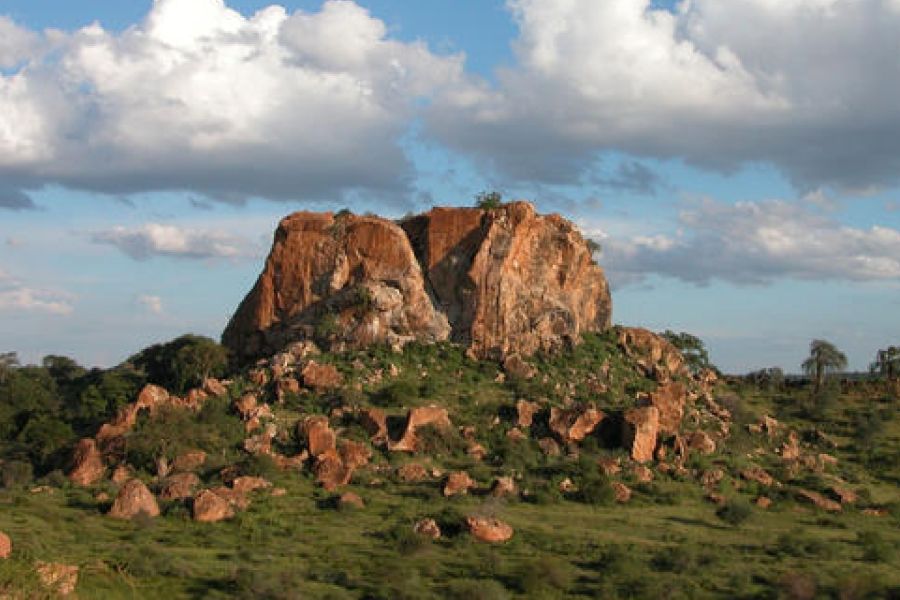
Mapungubwe
Rising on an inland plateau beside the upper reaches of the Nzembe River, the kingdom of Mapungubwe rose to prominence between the 11th and 14th centuries CE.
A
A. Among the earliest states to emerge in the region, Mapungubwe was established by Tsivara-speaking peoples who lived chiefly by farming. At the core of the territory its rulers governed lay a broad sandstone plateau whose sheer inaccessibility made it simple to defend. Food was plentiful here, as in neighbouring kingdoms, for herding cattle and growing crops yielded not only enough to eat but a surplus that could be exchanged for whatever the people lacked. Thick deposits of bone and dung point to sizeable cattle herds from the 8th century CE onward, and in this part of the world large herds had long been the customary basis of a ruler's power. By the 9th century domesticated cattle had grown markedly more numerous, while plentiful spindle whorls reveal that cotton was by then being grown and woven.
B
B. At its height, most likely in the early 13th century, Mapungubwe may have been home to some 4,000 inhabitants. Its chief, whom people called the king, is thought to have been the richest of all, holding more cattle and valuables than any of his subjects. He and his counsellors occupied a walled compound of stone dwellings set on the very highest ground the kingdom possessed: a natural sandstone hill rising roughly 25 metres and stretching about 120 metres from one end to the other. People had lived on this hill since the 10th century, and postholes cut into the rock reveal that a wooden palisade once ringed the entire compound. Everyone else was housed in mud and thatch dwellings on the flat land below, where a single stone building also stood. That lower settlement, called Tshiluvi, spreads across some 6 hectares (14.8 acres) and is older than anything raised on the hilltop.
C
C. Whereas ordinary people were laid to rest down in the valley encircling the site, the kings themselves were buried apart, within a marked-off zone at the hill's summit. A wooden staircase joined the two burial levels, and the holes that once held its steps can still be made out in the sandstone cliff face. Scattered around the edge of Tshiluvi stood a number of unusually large houses, generally taken to have been the homes of the king's male kin. Across the plateau lie many further sites, more modest than the central hill yet impressive in their own right, some as near as 20 and others as far as 90 kilometres away. Built of stone walls and dwellings, these most probably belonged to minor chiefs who served the king.
D
D. Bones of large predators and slivers of ivory turn up in great quantity on the plateau, a hint that the hides of such beasts, along with elephant tusks, were being stockpiled, probably to be carried down the Nzembe to the coast. Glass beads found at the site, which can only have come from the ports of Adhrima, show that the kingdom traded in some fashion with coastal states, and those states in turn dealt with merchants who arrived by sea. Copper from nearby sources added to its wealth, as did the gold that travelled down from Marovanya, a kingdom to the north (itself prominent from the 12th to the 15th century), on its way to the coastal city of Selora. Command over such profitable long-distance dealings very likely tightened the grip of Mapungubwe's rulers, who had every reason to control, and if possible monopolise, them.
E
E. The sheer quantity of expertly made pottery unearthed at the site is taken as further proof of the wealth Mapungubwe society had attained, since such output implies that potting had become a full-time profession. Among the finds are round-bodied, short-necked jars, along with beakers and bowls, a great many stamped with decorative motifs. Ceramic discs and rattles have likewise come to light, as have figurines of cattle, sheep and goats and small, highly stylised human figures given elongated necks and stunted arms. What part these human figures played remains uncertain, though they may have served as offerings to the gods during ceremonies. Small ornaments worked from copper of local origin round out the discoveries.
F
F. Finely worked objects of gold have likewise been recovered from Mapungubwe. One decorative technique, unknown anywhere else but at Marovanya, called for gold to be beaten into little rectangular plates into which geometric designs were then incised. Using tiny gold tacks, craftsmen fixed these plates over objects of wood, none of which has lasted to the present day. A sceptre may be among the items treated in this way; further signs of gold-working on the spot include a rhinoceros modelled from small beaten plates and many thousands of tiny gold beads. Every one of these pieces came from the royal graves and belongs to about the year 1210. They stand as the earliest evidence anywhere in the region that gold was prized in its own right, rather than merely as a form of money.
G
G. By the opening years of the 14th century Mapungubwe had already begun to fade. The likeliest cause was that too large a population had come to press too heavily on local resources, a strain a run of droughts may well have driven to breaking point. The trade routes, too, may have shifted northward; at any rate it was the northern territories, Marovanya chief among them, that now prospered.