
Mapungubwe IELTS Reading Answers with Explanation

Luyện tập đề IELTS Reading Practice với passage Mapungubwe được lấy từ cuốn sách IELTS CAM IELTS Practice Test 21 - Test 2 - Passage 2 với trải nghiệm thi IELTS trên máy và giải thích đáp án chi tiết bằng Linearthinking, kèm list từ vựng IELTS cần học trong bài đọc.

Mapungubwe IELTS Reading Answers with Explanation

📖 Bài đọc (reading passage)

Mapungubwe
Located in southern Africa just below the Limpopo River, the kingdom of Mapungubwe, flourished between the 11th and 13th century CE
A
A. Mapungubwe, which was one of the first states in southern Africa, was formed by Bantu-speaking peoples who were farmers. The area controlled by the rulers of Mapungubwe had at its heart a large sandstone plateau, which was easily defended due to its inaccessibility. As with other kingdoms in the region of southern Africa, cattle herding and other types of farming brought plenty of food and a surplus that could be traded for needed goods. Archaeology has revealed extensive layers of bones and manure, which indicate that from the 9th century CE there were large cattle herds, the traditional source of political power in southern African communities. The archaeological record for the 10th century shows a marked increase in the number of domesticated cattle in the area as well as cotton cultivation and weaving, as indicated by abundant finds of spindle whorls.
B
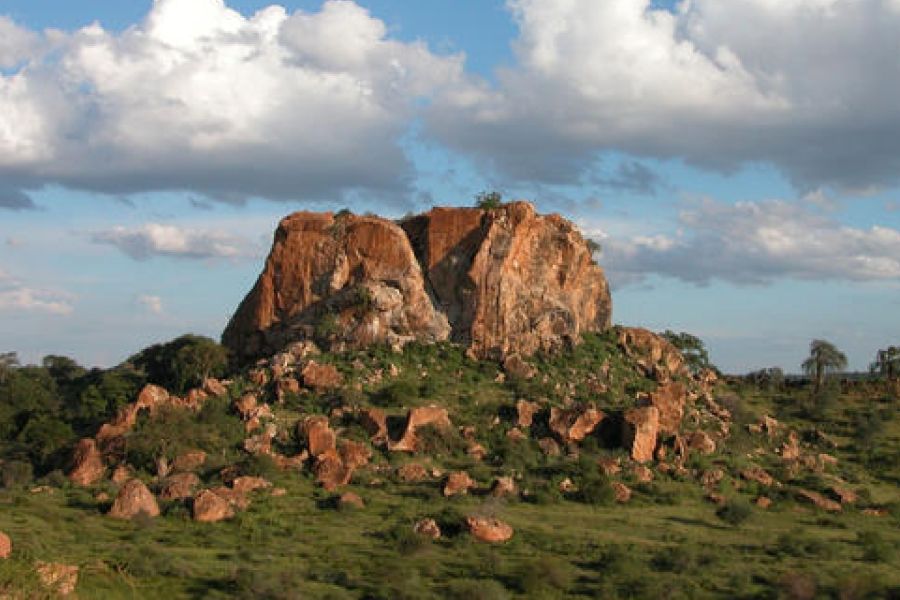
B. The total population of Mapungubwe at its peak in the mid-13th century was around 5,000 people. The chief or king of Mapungubwe was likely the wealthiest individual in the society, and would have owned more cattle and precious materials than anyone else. The king and his advisers dwelt in a stone enclosure composed of stone walls and housing built on the highest level of the community's territory, a natural sandstone hill which is some 30 metres high and 100 metres in length. Occupation on the hill dates from the 11 th century and the entire complex was surrounded by a wooden palisade*, as indicated by postholes made in the rock. The rest of the community lived in mud and thatch housing spread out below the hill, although there is one stone structure here. This settlement, known as Babandyanalo, covers around 5 hectares (12.3 acres) and predates the hilltop structures.
C
C. The kings of Mapungubwe were buried at the top of the hill site in a demarcated area away from the dwellings, while other members of the community were buried at the surrounding valley level. A wooden staircase connected the two levels, the sockets for the steps being clearly visible in the sandstone cliff face. There were some grander residences dotted around the outskirts of Babandyanalo, and these probably belonged to male relatives of the king. There are many other smaller but still impressive sites across the Mapungubwe plateau, which are located anywhere from 15 to 100 kilometres from the major hill site. Containing stone residences and walls, they likely belonged to local chiefs who acted as servants to the king. *palisade: typically a row of closely placed, high vertical wooden or iron posts used as a means of defence
D
D. The Mapungubwe plateau has a very high number of carnivore animal remains and ivory splinters, suggesting that the skins of these large animals and ivory elephant tusks were accumulated, probably for trade with coastal areas reached by the Limpopo River. The presence of glass beads, almost certainly from India, indicate there was trade of some sort with other states on the coast who, in turn, traded with merchants travelling from India by sea. Mapungubwe also benefitted from locally-sourced copper and the gold trade as it passed from the kingdom of Great Zimbabwe (12-15th century), situated to the north of Mapungubwe, to the coastal city of Kosala. It is likely that trade links led to a strengthening of political authority in order to control and even monopolise these lucrative interregional connections.
E
E. Archaeological discoveries reveal that pottery was produced on a scale large enough to suggest the presence of professional potters, and is another indicator of the prosperity of Mapungubwe society. Archaeological finds include spherical vessels with short necks, beakers, and bowls, many of which have decorative stamps. There are also ceramic discs, and whistles. In addition, cattle, sheep, and goat figurines, and small figures of highly stylised humans with elongated bodies and short limbs have been found. The figures may have been used in ceremonies as offerings to ancestors, but their precise function is not known. Other discoveries include small jewellery items made from locally sourced copper.
F
F. Beautifully decorated artefacts made of gold have also been found at Mapungubwe. A type of decoration, found nowhere else except Great Zimbabwe, involved the crafting of gold into small rectangular sheets and carving geometrical patterns into it. These sheets were then used to cover wooden objects (which have not survived) using small tacks, also made of gold. One such object that has been discovered may have been a sceptre, while additional evidence of local gold-working is a rhinoceros figurine made from small hammered sheets, and thousands of small gold beads. These objects were all found at the royal burial site and date to c. 1150. They are the first known indicators that gold had an intrinsic value of its own (as opposed to that of a currency) in southern Africa.
G
G. The kingdom of Mapungubwe was already in decline by the late 13th century, probably because overpopulation placed too much stress on local resources, a situation that may have been brought to a crisis point by a series of droughts. Trade routes may also have shifted northwards. Certainly, the areas that now prospered were to the north, such as Great Zimbabwe.

❓ Câu hỏi (questions)

Question 1 - 6
Reading Passage 2 has seven paragraphs, A-G. Which paragraph contains the following information? Write the correct letter, A-G.
1
a mention of the uncertainty regarding the purpose of certain objects
2
the likelihood that a climatic factor increased the problems Mapungubwe faced
3
a mention of the location where members of the king's family are thought to have lived
4
a reference to people who brought goods by ship
5
an estimate of the size to which the Mapungubwe community grew
6
a mention of agricultural produce being exchanged for other items
Question 7 - 8
Choose TWO letters, A-E.
The archaeological record reveals information about gold and the kingdom of Mapungubwe. Which TWO pieces of information are mentioned by the writer?
A
Not everyone in Mapungubwe used gold as a form of payment.
B
Items of gold were placed close to where Mapungubwe kings were buried.
C
The most valuable item discovered in Mapungubwe was a sceptre made of gold.
D
The way gold was decorated in Mapungubwe was also practised in another kingdom.
E
Working with gold was a respected occupation in the Mapungubwe community.
Question 9 - 13
Complete the summary below. Choose ONE WORD ONLY from the passage for each answer.
Archaeological discoveries

The Mapungubwe community's  is indicated by the amount of professionally made pottery discovered at the site. Many of these objects, such as beakers and bowls, are highly decorated and have been marked with stamps. Other finds include round ceramic objects,  and figures of various animals, as well as models of people with stretched . It is possible that these had a role in ceremonies to honour . In addition, pieces of  made from a local metal have been found at the site.

🔥 Answer key (đáp án và giải thích)

1
E

Giải thích chi tiết

✅ Step 1: Phân tích câu hỏi (Matching Information)

a mention of the uncertainty regarding the purpose of certain objects .

=> Đề đang hỏi đoạn nào có nhắc đến việc người ta không biết chắc một số vật đó dùng để làm gì.

Dự đoán thông tin cần tìm (SPECIFY):

Đoạn đúng phải có đủ 2 mảnh:

  • Có nhắc đến objects / artefacts / figures / items

  • Có ý không chắc chức năng / chưa rõ mục đích / không biết chính xác dùng để làm gì

-------

✅ Step 2: Locate bằng chứng

Đoạn E là đoạn khớp rõ nhất.

Câu bằng chứng trong đoạn E:

The figures (cattle, sheep, and goat figurines...) may have been used in ceremonies as offerings to ancestors , but their precise function is not known .

Ở đây ta thấy rất rõ:

  • certain objects = the figures (cattle, sheep, and goat figurines... - ở câu trước)

  • uncertainty regarding purpose = their precise function is not known

=> Vì vậy, đáp án là paragraph E.

-------

✅ Step 3: Đối chiếu paraphrasing

  • a mention ⇔ đoạn E có nhắc đến

  • uncertainty ⇔ may have been used / is not known

  • the purpose ⇔ precise function - offerings to ancestors

  • certain objects ⇔ the figures

=> Match rất khớp:

  • uncertainty được paraphrase bằng may have been + not known

  • purpose được paraphrase bằng function

  • certain objects được cụ thể hoá thành figurines / figures

-------

❌ Những đáp án “bẫy” hay dính

Nếu skim/scan vội, học sinh có thể chọn nhầm paragraph F vì đoạn này cũng nói về nhiều objects như:

  • sceptre

  • rhinoceros figurine

  • gold beads

Nhưng F không đúng vì đoạn đó chủ yếu nói về:

  • cách chế tác đồ vàng

  • nơi tìm thấy chúng

  • ý nghĩa của vàng trong xã hội Mapungubwe

Dù có câu “may have been a sceptre”, đoạn F không tập trung vào ý không rõ chức năng của một số objects rõ bằng đoạn E.

Ngoài ra, cũng có thể chọn nhầm paragraph B nếu chỉ thấy đoạn này có nhiều mô tả về cộng đồng và nơi ở. Nhưng B nói về population, king, housing, hoàn toàn không có ý uncertainty about purpose of objects.

Xem full giải thích