CAM IELTS 21 - Listening Test 2 with Practice Test, Answers And Explanation

Luyện tập đề IELTS Online Test CAM IELTS 21 - Listening Test 2 được lấy từ cuốn sách Cambridge IELTS 21 với trải nghiệm thi IELTS trên máy và giải thích đáp án chi tiết bằng Linearthinking, kèm answer key và list từ vựng IELTS cần học trong bài đọc.


CAM IELTS 21 - Listening Test 2 with Practice Test, Answers And Explanation

Section

👂️ Bài nghe section 1

Question 1 - 10
Complete the table below. Write ONE WORD AND/OR A NUMBER for each answer.
One-day classes at Steynford College

❓ Tapescript section 1

One-day classes at Steynford College
MAN:
Hello, Stainford College External Course Registration, can I help you?
WOMAN:
Yeah, I'm ringing to find out about one-day classes next year.
WOMAN:
I got a leaflet about them in the post, but I lost it
WOMAN:
and I understand some of the classes are filling up fast, so
WOMAN:
I might need to book quite soon if I want to go ahead.
MAN:
Sure.
MAN:
Can you remember which one you were considering?
WOMAN:
There were a few, actually.
WOMAN:
I remember there was one on how to make Vietnamese food that
WOMAN:
sounded good.
WOMAN:
I think that was on the 13th of January.
WOMAN:
It cost about £60.
MAN:
Yes, you're right about the date, but it's £59, actually.
MAN:
It's a very popular class, and among other things, the teacher explains
MAN:
how Vietnamese food includes lots of different herbs.
MAN:
I'm afraid that all the places are taken at present, but I
MAN:
can put you on the waiting list if you want?
WOMAN:
No, that's okay.
WOMAN:
I'm quite interested in the bread-making class.
WOMAN:
That's in March sometime, isn't it?
MAN:
Yeah, the 20th of March.
MAN:
Would you like to register for that?
WOMAN:
I'm not sure.
WOMAN:
How much is it?
MAN:
The actual cost is £48, but then there's an extra charge as
MAN:
well as that for the ingredients.
MAN:
I'm not sure how much that is,
MAN:
no more than twenty pounds, I think.
WOMAN:
So what sorts of things do they make in the class?
MAN:
Oh, various types of bread.
MAN:
I think they make white bread, and then they make sourdough.
MAN:
That seems to be very fashionable at present,
MAN:
and they learn how to make pizza, which is apparently really good.
WOMAN:
Well, I'd definitely be interested in that, but there were also a
WOMAN:
few other classes that sounded interesting.
WOMAN:
I think there was one on face massage.
WOMAN:
I'd love to learn how to do that.
MAN:
Yeah, that's on the 23rd of February, and it costs just £35
MAN:
for the day.
MAN:
The teacher's great.
MAN:
The type of massage done is a traditional technique used in India,
MAN:
and she actually did her training there.
MAN:
The massage is meant to relax you and get rid of lines and wrinkles.
MAN:
You practice it on yourself, so you have to take a mirror
MAN:
to the class so you can see what you're doing.
WOMAN:
OK.
WOMAN:
And I think there was a class in candle making?
MAN:
Yes, that's sometime in April, I think.
MAN:
Let me check.
MAN:
Yes, it's on the 6th.
MAN:
It was on the 23rd of January, but they had to change the date.
MAN:
It's just £52.
MAN:
That's a popular course, too.
MAN:
I think one reason why people like it is because the candles
MAN:
are all made out of natural products.
MAN:
It's filling up fast, but there's still a few places left.
WOMAN:
Yes, one of my friends did that class.
WOMAN:
She said the candles make really good presents.
WOMAN:
In fact, she gave me one.
MAN:
Ah, by the way, have you heard about the class on silk painting?
MAN:
That's being held on the 18th of May.
MAN:
You learn how to create designs on silk fabric and colour them
MAN:
using special dyes.
MAN:
Apparently, people can produce beautiful artworks that way, either to put on
MAN:
the wall as a picture or to use for something like a scarf.
MAN:
It's £67.50, which is really good value, I think.
MAN:
There's a similar class I've seen that was £110.
WOMAN:
That sounds interesting.
WOMAN:
Would I need to bring the silk?
MAN:
No.
MAN:
The only thing is, everyone has to bring something to protect their
MAN:
clothing, like an apron if you've got one, or a shirt that
MAN:
you don't use anymore, because the dye can really stain your clothes.
WOMAN:
Right.
WOMAN:
Then the last class I was considering was a bit different.
WOMAN:
That was on DIY for beginners.
WOMAN:
I'd like to learn how to do household repairs.
WOMAN:
Are there any places left on that?
MAN:
That's on the 24th of February.
MAN:
Yes, there are a few places.
MAN:
It's a bit more expensive.
MAN:
It's £125, but it's a very popular class.
MAN:
You learn how to use an electric drill and a saw.
WOMAN:
Yeah, that would be really useful.
WOMAN:
And I even need to learn how to use a hammer, because
WOMAN:
I always end up hitting my fingers.
MAN:
Yes, you'll do that too.
MAN:
And when you've learned how to use the basic tools, you do
MAN:
a practical job, which is fixing a shelf to a wall.
WOMAN:
Great, just what I need to know.
WOMAN:
Right, well, I'd like to enrol for that, and also for the...

🔥 Đáp án & giải thích section 1

1
13 January / 13th January / 13.01 / 13.1

Giải thích chi tiết

Câu hỏi: Vietnamese food – Date: ___

🎯 Xác định loại từ cần điền:

  • Chỗ trống nằm ở cột Date nên cần điền một ngày/tháng.

  • Dòng thông tin đang nói về khóa học Vietnamese food, vì vậy cần nghe đúng ngày diễn ra lớp học này.

Đáp án đúng: 13 January

▶️ Bắt đầu nghe ở: câu người phụ nữ nhắc đến khóa học how to make Vietnamese food.

☺️ Giải thích đáp án:

  • Trước khi nghe, xác định từ khóa chính là Vietnamese foodDate.

  • Khi nghe, người phụ nữ nói: “I remember there was one on how to make Vietnamese food…” → đây là đúng dòng thông tin cần theo dõi.

  • Ngay sau đó, cô ấy nói: “I think that was on the 13th of January.”

  • Người đàn ông xác nhận lại: “Yes, you’re right about the date...” → điều này cho thấy ngày 13 tháng 1 là thông tin chính xác.

  • Vì vậy, đáp án cần điền là 13 January.

Xem full giải thích

Section

👂️ Bài nghe section 2

Question 11 - 12
Choose TWO letters, A-E.
Which TWO pieces of advice are given about the Marsden Coastal Walk?
A
Stop for lunch in an ancient town.
B
Don't miss the ruins of a certain building.
C
Catch a boat to the start of this walk.
D
Be careful of the steep and rocky paths.
E
Don't worry about getting lost.
Question 13 - 14
Choose TWO letters, A-E.
Which TWO things are said about the Melby Heritage Walk?
A
This walk is mostly downhill.
B
The paths can get busy during the day.
C
This is a circular walk.
D
A tower stands on the site of an older structure.
E
There are far-reaching views the whole way.
Question 15 - 20
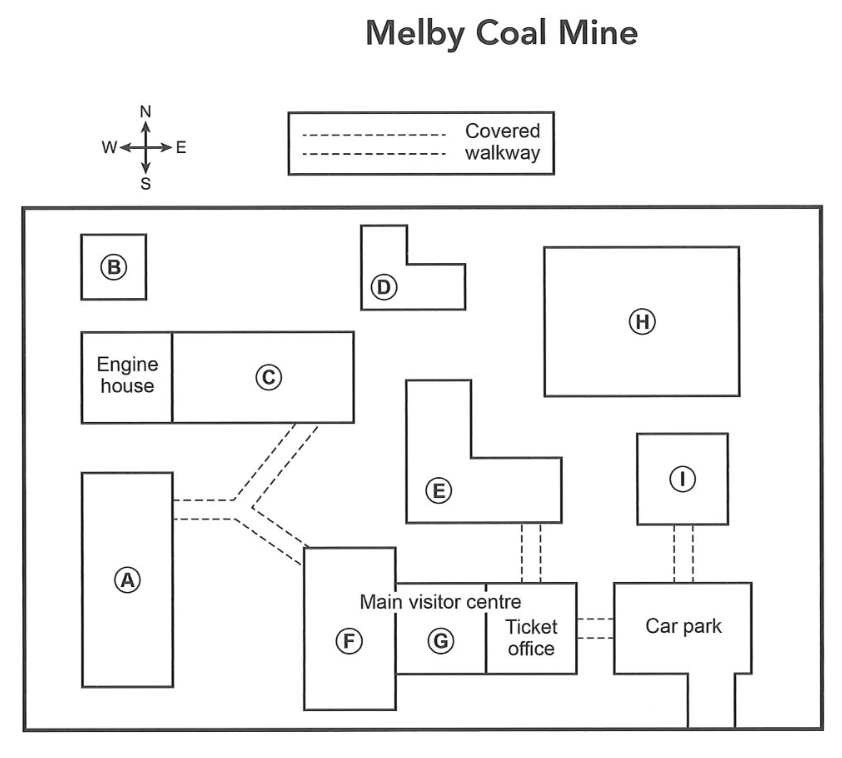
Label the map below. Drag your answers in the option list into the boxes.
1ZRKUyeq8Vd4UtgPncmAiQHXnHxSDi7Tw
A
B
C
D
E
F
G
H
I
Exhibition
15
Baths
16
Tools
17
Vehicles
18
Ponies
19
Education centre
20

❓ Tapescript section 2

Melby Coal Mine
Here is some information about history and nature walks in the region.
They can be completed in less than a day and also be
combined with a visit to Melby, a former coal mine now open
to the public.
The Marsden Coastal Walk is suitable for all the family as there
are no strenuous climbs.
The route begins at Marsden Harbour where there are hourly ferries to
and from the beautiful Hooker Island, a great place for fishing.
The walk covers part of the Coastal Path Trail.
As there are clear signposts all along the way, you don't even
need to take a map with you.
At one point, the route goes inland slightly and passes a castle
built in the 1400s, near to a now vanished market town.
The castle's now just a pile of stones, but it's a great
place to take photos and fascinating information boards show what it once
looked like.
If you set off early, you can be back in time for midday.
The Melby Heritage Walk is a great place to take photos, especially
of the night sky.
At certain times of the year, people come here from far and wide.
They climb to the top of the valley and take pictures of
the stars.
In the daytime, it's completely different.
As you hike through the dense woods in the valley bottom, the
only things you'll hear are the sound of your own footsteps.
At the highest point, you can stop to take in the views,
and those with lots of energy can climb the tower that's situated
where there was once a 17th century hunting lodge.
The route continues along the tops of the hills and brings you
back down to the starting point, the car park at Melby Coalmine.
Melby Coalmine has been open to the public for 20 years and
has won awards for its visitor experience.
Many of the buildings around the mine are still standing and have
been converted into display areas.
Firstly, there's an exhibition showing the history of the mine, with many
original black and white photos.
To see that, you go from the car park via a covered
walkway to the main visitor centre.
Go through the ticket office to an area where there are lockers
to leave heavy bags in, and where you can borrow raincoats.
Beyond that room is the exhibition.
There's a small bath house where miners used to wash after their
shift underground.
You can see that in the building directly to the north of
the engine house.
The boiler has gone from there now, but there are lines of
tin baths on the stone floor.
There's a display of early mining tools from the days before mechanisation.
You can find that in a small L-shaped building in the
middle of the northern boundary of the site.
It's incredible to think how miners were able to use hand implements
to cut through rock.
The vehicle shed, where you can find wagons of different sizes, along
with some of the high-tech cutting machines that were in use
until the mine closed, is in the southwest corner of the site
and can be accessed via a covered walkway.
There is a field with ponies, which are always popular with children,
on the north-eastern boundary of the site, not approached via a
covered walkway.
The other building to mention is the education centre.
This is where school groups go when they visit the mine, but
it's also accessible to the public, as it contains a library and
small gift shop.
The centre is connected to the ticket office via a short section
of covered walkway.

🔥 Đáp án & giải thích section 2

11
B

Giải thích chi tiết

Câu hỏi: Which TWO pieces of advice are given about the Marsden Coastal Walk?

Đáp án đúng: B. Don't miss the ruins of a certain building. E. Don't worry about getting lost.

▶️ Bắt đầu nghe ở: Đoạn người nói bắt đầu mô tả Marsden Coastal Walk, thường có tín hiệu như “The Marsden Coastal Walk…”. Sau đó, hãy chú ý những câu nói về đường đi, biển chỉ dẫn, và địa điểm nổi bật trên tuyến đường.

☺️ Giải thích đáp án:

  • Trước khi nghe, xác định từ khóa chính trong câu hỏi là pieces of advice, Marsden Coastal Walk. Nghĩa là ta cần nghe xem người nói đang khuyên người đi bộ nên làm gì / không cần lo điều gì.

  • Với đáp án E, người nói nói rõ: “there are clear signposts all along the way”“you don't even need to take a map with you”.

  • Cụm này cho thấy tuyến đường có biển chỉ dẫn rõ ràng, nên người đi không cần lo bị lạc. Vì vậy chọn E. Don't worry about getting lost.

  • Với đáp án B, người nói tiếp tục nhắc đến một điểm đáng chú ý trên đường: tuyến đi passes a castle built in the 1400s.

  • Sau đó, người nói mô tả thêm rằng lâu đài giờ chỉ còn là “a pile of stones”, tức là tàn tích / phế tích của một công trình cổ.

  • Đồng thời, đây được nhấn mạnh là “a great place to take photos”, cho thấy đây là một điểm đáng ghé xem, không nên bỏ lỡ. Vì vậy chọn B. Don't miss the ruins of a certain building.

🧐 Lưu ý: ❌ A. Stop for lunch in an ancient town. => Dễ nhầm vì có nhắc đến a now vanished market town, nhưng thị trấn này đã biến mất, không phải nơi để dừng ăn trưa. ❌ C. Catch a boat to the start of this walk. => Audio nói tuyến đường begins at Marsden Harbour và ở đó có ferries ra đảo, nhưng đi thuyền không phải cách để tới điểm bắt đầu của walk. ❌ D. Be careful of the steep and rocky paths. => Trái ngược với thông tin nghe được: người nói nói rõ “no strenuous climbs”, nên đây không phải lời khuyên đúng.

Xem full giải thích

Section

👂️ Bài nghe section 3

Question 21 - 22
Choose TWO letters, A-E.
Which TWO facts in the sessions on food safety were new information for Nadia and Fergus?
A
the amount of plastic in the ocean
B
the number of diseases caused by contaminated food
C
the amount of food that is wasted
D
the number of people who are obese
E
the result of treating animals with antibiotics
Question 23 - 24
Choose TWO letters, A-E.
Which TWO features of a project aiming to prevent food fraud impressed Fergus?
A
the new technology it used
B
the publicity it received
C
the use of multiple tests on food items
D
the variety of dietary requirements included
E
the way information was made widely accessible
Question 25 - 26
Choose TWO letters, A-E.
Which TWO topics do both students recommend should be included in the course?
A
sustainable fishing
B
targeted nutrition
C
global differences in consumption
D
sustainable agriculture
E
digital technology and food
Question 27 - 30
Complete the flow-chart below. Choose FOUR answers from the box and write the correct letter, A-F.

List Of Options

This was challenging but enjoyable.

This led to some disagreement.

This was easy to decide on.

This was helped by the guidelines provided.

This seemed like an unnecessary stage.

This involved selecting a new ingredient.

Student project: developing a new food product
STEP 01

Initial aim: 

STEP 02

Literature review: 

STEP 03

Product development: 

STEP 04

Product production: 

❓ Tapescript section 3

Sessions on food safety
TUTOR:
Thanks for coming along Nadia and Fergus.
TUTOR:
So this is a chance for you to give us some feedback
TUTOR:
about different aspects of your course.
TUTOR:
What would you like to begin with?
NADIA:
I've enjoyed the sessions on food safety.
NADIA:
There was some information there that I found really surprising, although some
NADIA:
were stuff I knew already, like the rise in rates of obesity.
FERGUS:
Yeah, that's been in the news a lot.
FERGUS:
But I hadn't realised that unsafe food causes more than 200 different diseases.
NADIA:
No, I'd no idea it was that many.
NADIA:
And speaking of diseases, I knew resistance to antibiotics is on the
NADIA:
increase, but I didn't know why.
FERGUS:
That it's partly because when animals are treated with antibiotics then
FERGUS:
consumed by humans, the antibiotics get into the food chain.
FERGUS:
I had no idea about that either.
NADIA:
Then the sessions provided a lot of information about plastic pollution from
NADIA:
food packaging in the ocean,
NADIA:
but I think that most of us were already aware of that.
FERGUS:
Yeah, but I thought we could have done more on how much
FERGUS:
food is thrown away unnecessarily through fear of it being out of date,
FERGUS:
that was only mentioned in passing.
TUTOR:
OK, I'll bear that in mind.
TUTOR:
What did you think about the sessions from visiting lecturers, Fergus?
FERGUS:
For me, the most interesting one was about that project to prevent
FERGUS:
companies giving incorrect information to consumers about food.
TUTOR:
Ah, food fraud, yes.
FERGUS:
I thought it was really good to address a problem that's faced
FERGUS:
by so many different groups.
FERGUS:
People with special religious rules, as well as vegetarians and vegans.
NADIA:
And those with allergies.
FERGUS:
Yeah.
FERGUS:
And another thing, we've had effective ways of analysing DNA for some
FERGUS:
time now, and these can easily be applied to analysing food.
FERGUS:
But what the researchers succeeded in doing was to ensure that these
FERGUS:
tests were carried out at different stages in the food's journey, from
FERGUS:
the producer to the consumer.
NADIA:
So they knew that the food actually came from the place it
NADIA:
was supposed to, and had the ingredients it was meant to.
FERGUS:
Exactly.
FERGUS:
So customers can be confident about what they buy.
NADIA:
And the researchers had a good system for publicising their findings too.
FERGUS:
Well, I thought there were some problems with that actually.
TUTOR:
Okay.
TUTOR:
And do you have any recommendations for new topics that we could
TUTOR:
include in the course?
NADIA:
Well, I'm interested in how crop yields can be increased without damaging
NADIA:
the environment.
FERGUS:
But we've already done quite a bit on that.
FERGUS:
But not so much on the seafood industry, where stocks are in
FERGUS:
danger of being overexploited as a food source, unless we can find
FERGUS:
ways of keeping stocks up.
NADIA:
Yes, that'd be a good topic.
NADIA:
And I'm interested in the idea of a personalised approach to diet,
NADIA:
now we have the technology to analyse exactly what individuals need.
FERGUS:
That sounds more like a medical topic than food science.
NADIA:
Okay.
NADIA:
What about sessions on the variety of food and eating habits around
NADIA:
the world?
NADIA:
That's very relevant nowadays.
FERGUS:
Yes.
FERGUS:
I think the whole class would be interested in that.
NADIA:
Then there's technological stuff, things like 3D printing of food and smart packaging.
FERGUS:
Maybe too specialist.
TUTOR:
Now, I'm particularly interested in your project, the one where you developed
TUTOR:
a new food product.
TUTOR:
So talk me through the stages.
TUTOR:
First, you had to decide on your initial aim.
FERGUS:
We decided we wanted to create something people could eat on the
FERGUS:
go rather than in a restaurant.
NADIA:
Yeah.
NADIA:
So we chose falafel, which was originally a Middle Eastern snack.
FERGUS:
We made up our minds about that pretty quickly.
FERGUS:
I know some students found this a lot harder to choose and
FERGUS:
wasted a lot of time.
NADIA:
Then we had to do the literature review.
NADIA:
We hadn't done one of these before, so the handout with advice
NADIA:
for the project was very useful here.
FERGUS:
Yes, especially the advice on how to present the information.
FERGUS:
Then product development, actually deciding what we'd use to make the falafel,
FERGUS:
and for me, the interesting thing about that was that we wanted
FERGUS:
it to be something a bit different from an ordinary falafel.
NADIA:
We really made the right choice when we finally decided to use
NADIA:
jackfruit, even though it wasn't something that either of us had ever
NADIA:
tasted before.
FERGUS:
Yeah, like the name tells you, it's a fruit, but actually it's
FERGUS:
really good in savoury dishes.
FERGUS:
The product production, working out how to make the falafel, was harder
FERGUS:
than I expected because I'd never made them before.
NADIA:
It was mostly trial and error.
NADIA:
We started off with the basic recipe, and then experimented, and when
NADIA:
it went wrong…
FERGUS:
… which it did a lot of the time …
NADIA:
We just moved on and kept adapting it.
NADIA:
And in the end, it turned out fine and we had a lot of fun.
FERGUS:
We did.
TUTOR:
Thank you.
TUTOR:
Well, your project was a very good…

🔥 Đáp án & giải thích section 3

21
B

Giải thích chi tiết

Câu hỏi: Which TWO facts in the sessions on food safety were new information for Nadia and Fergus?

Đáp án đúng: B. the number of diseases caused by contaminated food E. the result of treating animals with antibiotics

▶️ Bắt đầu nghe ở: Đoạn Nadia và Fergus bắt đầu nói về những thông tin họ thấy bất ngờ / chưa biết trước đó trong phần học về food safety, thường có tín hiệu như “I found really surprising…”, “I hadn’t realised…” hoặc “I had no idea…”.

☺️ Giải thích đáp án:

  • Trước khi nghe, cần gạch chân từ khóa new information, Nadia and Fergus, và food safety sessions.

  • Vì câu hỏi hỏi về facts ... were new information, ta cần nghe những cách diễn đạt như I hadn’t realised, I had no idea, I didn’t know.

  • Fergus nói: “I hadn't realised that unsafe food causes more than 200 different diseases.”

  • Câu này cho thấy thông tin mới với Fergus là số lượng bệnh do thực phẩm không an toàn gây ra.

  • Nadia đáp lại: “I'd no idea it was that many.” → Nadia cũng không biết con số đó trước đó.

  • Vì vậy, B. the number of diseases caused by contaminated food là đáp án đúng.

  • Sau đó Nadia nói: “I knew resistance to antibiotics is on the increase, but I didn't know why.”

  • Nghĩa là Nadia đã biết hiện tượng kháng kháng sinh tăng lên, nhưng không biết nguyên nhân.

  • Fergus giải thích rằng khi animals are treated with antibiotics rồi bị con người ăn, the antibiotics get into the food chain.

  • Fergus tiếp tục nói: “I had no idea about that either.”

  • Điều này xác nhận cả hai đều thấy mới ở thông tin về kết quả của việc điều trị kháng sinh cho động vật.

  • Vì vậy, E. the result of treating animals with antibiotics là đáp án đúng.

🧐 Lưu ý: ❌ A. the amount of plastic in the ocean => Nadia nói rằng phần về plastic pollution from food packaging in the ocean thì most of us were already aware of that, nên đây không phải thông tin mới. ❌ C. the amount of food that is wasted => Fergus chỉ nói họ nên học nhiều hơn về vấn đề này, không nói đây là điều mới với cả hai. ❌ D. the number of people who are obese => Nadia nói rõ đây là điều cô ấy knew already, nên không thể chọn.

Xem full giải thích

Section

👂️ Bài nghe section 4

Question 31 - 40
Complete the notes below Write ONE WORD ONLY for each answer.
Challenges facing the cruise ship industry

Problems with overtourism

31.

is one of the worst problems. • A tourist
32.

is being introduced in some cities to reduce numbers, e.g. Barcelona. • Bruges: action was taken to limit day trips from the nearby port because the city was becoming a ‘theme park’ (e.g. many shops were only stocking
33.

and souvenirs). • Dubrovnik: limits the number of tourists by managing the
34.

of cruise ship arrivals.

Problems of perception • Cruises are generally associated with the elderly. • There is an assumption about the

35.

of cruises. • People think there may be too many
36.

.

Solutions Cruise lines are attracting younger customers by: • becoming more sustainable e.g. using hybrid engines. • having a wide range of activities e.g. boxing,

37.

and well-being programmes. • offering a diverse selection of food including
38.

options. • providing reliable
39.

. • improving marketing on social media with high quality
40.

.

❓ Tapescript section 4

Challenges facing the cruise ship industry
For my presentation today, I'm going to talk about some of the
issues facing the cruise ship industry, and then some ways these can
be addressed.
The cruise ship industry has partly been responsible for the effects of
overtourism in recent decades.
Overtourism occurs in places where excessive numbers of tourists cause
significant problems.
Pollution, for example, is among the greatest threats to many popular tourist destinations.
Of course, for many places, it's a difficult balance to achieve.
They want to promote their city or island as a desirable tourist
destination, but at the same time are unable to cope with thousands
of cruise ship passengers on a daily basis.
The trouble is, excessive tourism is destroying the beauty spots and places
of interest that people come to visit.
Several cities, such as Barcelona, have responded by imposing a tax, which
all visitors to the city from cruise ships have to pay.
But as it's only a couple of euros, many green campaigners think
it won't deter enough people to make any difference.
Bruges is another city which became impossible to navigate at times because
of the huge numbers of cruise passengers arriving on day trips from
the port of Zeebrugge.
The city was becoming like a theme park, with shops only catering
for tourists selling chocolate, which Belgium is famous for, and other souvenirs.
The local council took action to limit cruise passengers to a more
manageable level.
Dubrovnik had to limit the numbers of cruise ships after it became
extremely popular as a cruise ship destination when it featured in a
hugely successful TV series.
What it does now is control the timing of all cruise ship
entries to the city's port.
However, many people feel this measure does not go far enough.
Cruise ships may be unpopular in some of their destinations, but they
also have an image problem.
They've always been perceived as a safe holiday for the elderly, with
not much on offer for families or young couples.
A recent survey showed that cost is also a major factor in
putting younger groups off going on a cruise.
But what they don't realize is that compared to other types of
package holidays, cruises can actually be good value, as all activities and
drinks are often included.
And another perception is that cruises have lots of rules about what
to wear and how to behave.
But these days, most cruises are no longer very formal and behind
the times.
So what solutions are there for cruise lines to overcome some of
these problems?
How can they appeal to younger customers?
Well, one selling point is that cruise ships are becoming more sustainable.
New ships are built with hybrid engines with large batteries, which means
ships do not have to keep their engines running while docked.
Cruise lines are also designing ships specially for those in the age
range of 21 to 45.
The decor in these feels contemporary, and there are a range of
activities on board that you wouldn't find on a more traditional cruise.
There's even a boxing ring on one ship, and most offer diving expeditions.
But there's also a huge focus on well-being, with a variety
of sessions of different kinds.
Food is always a very important part of any cruise, and cruise
ships have had to radically update their menus to suit the tastes
of their younger customers.
Vegan dishes are standard, for example.
The restaurants on board have also gone paperless, with menus available on screen.
Unlike older generations who went on cruises largely to get away from
everything, younger people expect to be able to keep in touch with
friends and family.
Many people going on longer cruises also spend time working, so companies
have to guarantee Wi-Fi that can be relied upon at all
times.
My grandparents used to love looking through cruise brochures, even when they
weren't planning on going on a cruise.
Until very recently, TV ads for cruises always felt dated and aimed
at retirees.
Cruise lines have been slowed to adopt the power of social media,
but that's all changing.
Leading cruise lines now employ top agencies to produce first-rate videos
for social media channels.
It will be interesting to see whether the cruise...

🔥 Đáp án & giải thích section 4

31
Pollution

Giải thích chi tiết

Câu hỏi: ________ is one of the worst problems.

🎯 Xác định loại từ cần điền:

  • Chỗ trống đứng ở vị trí chủ ngữ của câu, nên cần một danh từ.

  • Cụm phía sau là “is one of the worst problems” nên từ cần điền phải là một vấn đề/nguy cơ lớn đối với các điểm du lịch nổi tiếng.

  • Dựa vào tiêu đề Challenges facing the cruise ship industry, ta dự đoán đáp án sẽ là một thách thức về môi trường hoặc du lịch quá tải.

Đáp án đúng: Pollution

▶️ Bắt đầu nghe ở: câu người nói giải thích về overtourism và nhắc đến significant problems ở các điểm du lịch.

☺️ Giải thích đáp án:

  • Trước khi nghe, xác định từ khóa quan trọng là worst problems.

  • Ngay sau khi giải thích về overtourism, người nói đưa ra một ví dụ cụ thể: Pollution, for example, is among the greatest threats to many popular tourist destinations.”

  • worst problems = greatest threats, nên đáp án nghe được là Pollution.

Xem full giải thích