You will hear a podcast produced by the Tourism Authority at Larswater, a lake in England.
First you have some time to look at questions 11 to 14.
Now listen carefully and answer questions 11 to 14.
One of the most beautiful lakes in England has to be Larswater.
It's a glorious lake, surrounded by wooded hills, which in the old days were famed for their hunting.
But things have changed since the 19th century, the days when poet William Stanklin called the area home.
Stanklin is still associated with the area and visitors can still visit the house he lived in, which is open to the public throughout the year.
Larswater gained fame in 1953, when a man called Ricky Shorting set a national water speed record with his speedboat, reaching 325 kilometres per hour.
These days, safety rules have slowed the pace of life on the lake, although the Yacht Club still does host an annual weekend of racing, which takes place at the start of July.
And if you're sporty and you fancy something even more energetic, well, each June there's also the Lake Challenge, in which swimmers cover the whole 9 kilometres from end to end.
These days, many visitors come here for the hiking.
One popular route is the Larswater Way, a 22 kilometre circular trail around the lake.
Now, while that might sound like quite a distance, let me reassure you, the great thing is that the route itself doesn't involve any steep climbs or big hills, it's actually pretty gentle going all the way.
And if you don't want to walk quite so far, you have the option of taking the bus some of the way round, or buying a ticket to use the ferry network, the Larswater Steamer, to get where you want to be on the walking route and save your legs.
If you want further details, you can register with the Friends of the Larswater Way website and receive more information and updates about this lovely route.
Before you hear the rest of the podcast, you have some time to look at questions 15 to 20.
Now listen carefully and answer questions 15 to 20.
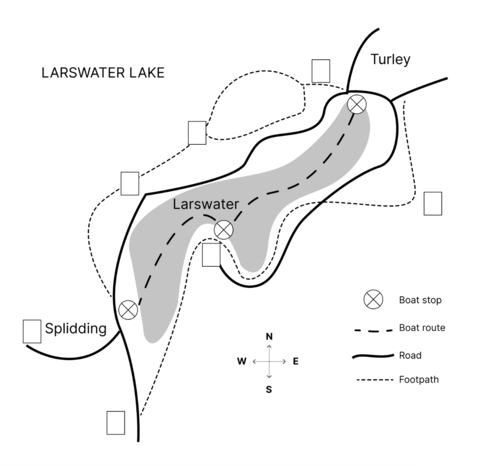
Right, let's look at the map and explore the geography of the area in a bit more detail.
Some visitors find themselves staying in the little village of Goughton.
Now, if you look at the map, you'll see the dashed line going across the lake, representing the ferry route from Splidding to Turley.
But on its way, you'll see it makes one stop, just short of half way.
It's handy for visitors to know whereabouts to park, and one such place is at Coyne Car Park.
Now, you'll see the main road out of Splidding travels north for a bit, and then takes a sharp right turn before going east.
Well, just at that corner, that's Coyne Car Park, but it does fill up quickly, so you'll need to get there early.
Oh yes, there's an ancient stone circle put there about 4,000 years ago.
To get there, well, if you see where the village of Turley is, and then there's a footpath from Turley going directly south, heading away from the lake.
Then, as far away from the lake as it gets, it comes to a turning and heads back towards the lake.
Well, the stone circle is at that bend.
Now, especially if you do go all the way around the lake, you're likely to go through Paterdale at some point.
That's the village just after the lake ends at the south-west, just beyond Splidding.
And it's where the road meets up with a footpath that follows along the south side of the lake.
Another prehistoric settlement is Maiden Castle, at least the remains of it.
To get to that, as you head west away from Turley on the footpath, that's the dotted line on your map, you come to a point where there's a loop, so you've got a choice of two possible paths.
But just before that split is Maiden Castle.
And if you're feeling really energetic, or you want to get away from Larswater and explore another valley, there's always Grisedale.
That's a valley just west of Splidding, which you can get to on the road, heading away from Larswater.
Also well worth exploring.
That is the end of part two.
You now have some time to check your answers.