Juliette:
Great to have you here today, Hamish.
Juliette:
I've been a fan of yours for ages.
Juliet:
The very first rock concert I went to when I was 13, your band was playing.
Hamish:
I'd like to thank this station too, Juliet.
Hamish:
If I remember rightly, Ray Rogers' interest in Soundhole's second album put us on the map.
Juliette:
Alas, who could forget when Soundhole broke up and Ray wept live on his show?
Hamish:
But to set the record straight, Soundhole isn't getting back together, despite rumours on social networks.
Hamish:
My performing days are over.
Hamish:
Frankly, solo gigs were a nightmare.
Hamish:
I was so anxious every time I went out onto a stage.
Hamish:
Live audiences seriously scare me.
Juliette:
Yet you've got such a rapport with them.
Juliette:
You look so relaxed in those clips on YouTube.
Hamish:
One thing the social networks did get right is the reason I quit performing.
Hamish:
I was manic when I was on the road with the band.
Hamish:
I'd stay up days on end.
Hamish:
Back home, I was horribly depressed.
Hamish:
I'd sleep for a week.
Hamish:
My life was a mess.
Hamish:
My first wife left me, and my second wife left me.
Hamish:
I've got three children I hardly know.
Hamish:
My son sent me a card just before Soundhole split up, in which he'd written he'd seen more of me on TV than in the flesh.
Juliette:
So how long have you been making acoustic guitars, Hamish?
Hamish:
Full-time for about three years.
Hamish:
My sister and I work together.
Hamish:
She sources the materials and does the books.
Hamish:
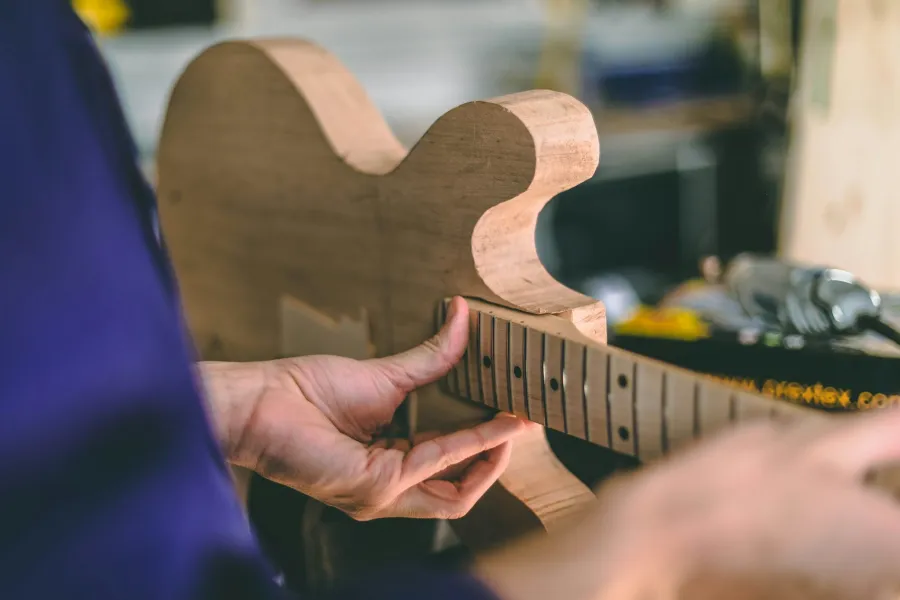
I build the instruments.
Juliette:
I checked on the internet last night, and it's a long process to make a guitar.
Hamish:
There's at least 15 steps.
Hamish:
I won't go into them all now, but sourcing the wood, the first step, is crucial.
Hamish:
Cheap guitars use softer wood, which equates with poorer sound quality.
Hamish:
But harder wood is scarce these days.
Hamish:
For instance, the back of a great guitar, historically, was made from Brazilian rosewood, but the supply is minuscule now.
Hamish:
I use East Indian rosewood, which will also disappear soon.
Hamish:
Likewise, spruce was once preferred for the top of a guitar, but I use cedar, which is more plentiful.
Juliette:
I thought guitars were mainly mahogany?
Hamish:
Cheap guitars, yes, but only the necks of good ones.
Hamish:
The neck must resist distortion when pulled by the strings, and it mustn't swell or contract with changes in temperature and humidity.
Hamish:
Mahogany's perfect for the neck.
Juliette:
I like that wavy pattern you get on the tops and backs of guitars.
Juliette:
How's that done?
Hamish:
That pattern is called book matching.
Hamish:
A thickish block of wood, about half the size of the body, is sliced horizontally.
Hamish:
The two pieces are laid together, with the grain continuous, before they're glued.
Hamish:
The next two steps are to saw the top of the guitar into that sensual shape, and cut out the sound hole.
Juliette:
What's inside the guitar to control its vibration and improve its tone?
Hamish:
Narrow little bits of wood, glued in an X pattern.
Hamish:
The process is known as strutting.
Hamish:
The back also has strutting to reflect sound waves.
Juliette:
How's the neck made?
Hamish:
It's carved from a single piece of mahogany, and a metal rod is driven up into it for reinforcement.
Juliette:
How do you get those lovely curved sides?
Hamish:
Strips are cut, sanded and soaked in water.
Hamish:
They're moulded until they're set in that shape.
Hamish:
When everything's been glued together, the back, the sides, the top and the neck, the guitar is put into clamps for several days.
Hamish:
There are some other reinforcements too, like end blocks and bindings.
Juliette:
I guess precision is the key to much of this work.
Hamish:
In fact, guitar making has improved my mental health, because everything's nice and slow and precise.
Hamish:
I'm alone in my workshop, dealing with wood.
Hamish:
It has a calming effect.
Juliette:
It seems as though you sound hole again.
Hamish:
No more silly puns on the name of our band.
Hamish:
I spent 14 years explaining that hole was spelt with a W.