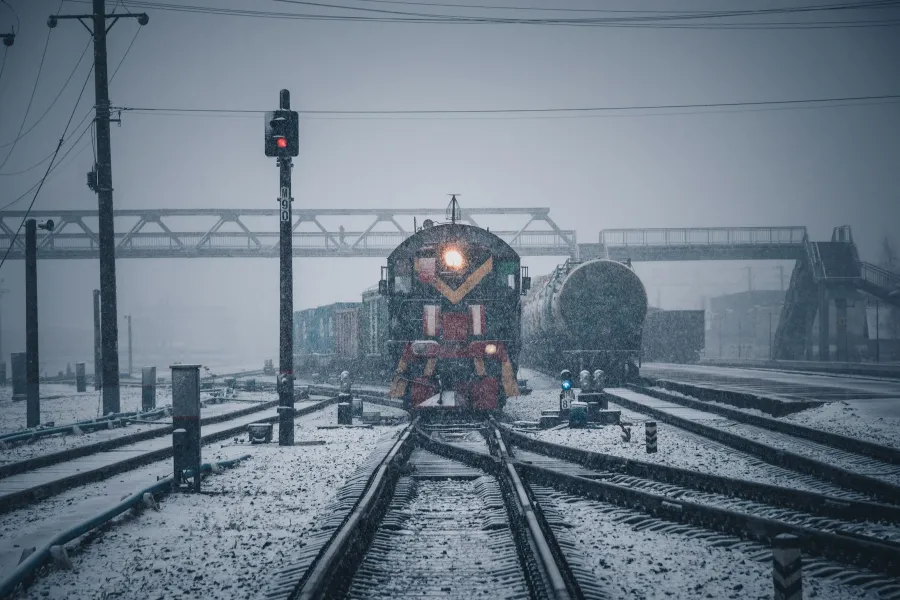
Last time, I briefly introduced our next topic, which is the development of locomotives and their effect on history.
We looked at the invention of the first locomotive by Richard Trevithick in 1804 in Wales, and I explained the basic concepts and designs of the first locomotives.
Today, I'd like to move ahead and discuss the development of trains and railway systems thereafter.
Trevithick's locomotive was not a financial success, unfortunately, but there was modest development of small rail systems in Great Britain after that.
However, it wasn't until the early 1830s that large-scale railway construction began, and this was mainly due to industrialization sweeping across Great Britain, which increased demand for faster and cheaper transport.
Centers of industry which contained new factories needed connections to port cities, where manufactured products could be shipped abroad.
Likewise, raw materials needed to be sent to manufacturing plants.
And it wasn't just in the UK that railways were being built, but all around the world, and this caused international trade to grow at a rapid rate.
The mid-1800s saw an explosion of railway construction on large landmasses.
Continental Europe was also seeing an explosion of train rails because of the demand of industrialization.
Rail transport spread around the globe quickly, notably in North America.
In the US, some rail projects began in the early 1800s, but it was not until the Baltimore and Ohio Railroad in 1828 that a railroad fully connected cities in an entire region.
It was also the first railway to be totally open to the public rather than for a limited clientele.
Canada also joined in and began building railways extensively in the 1850s.
The discovery of gold in the western part of North America offered an additional incentive, and by the end of the century, the US and Canada each had built transcontinental railways connecting the east and west coasts.
In the 20th century, there were several historic occasions that affected railway construction.
Most early trains ran by coal-powered steam engines, but in 1912 the first diesel-fuelled engine was introduced, which allowed for larger weights to be transported at faster speeds than ever.
Long-distance land trips, which had previously taken weeks or even months, could now be accomplished in just a matter of days.
Railway construction continued at a fast rate, as demand was growing for both commercial transport and passenger transit.
The occurrence of World War I and World War II slowed down the growth of railway systems a bit, as often they were military targets and required reconstruction after being destroyed or damaged during battles.
But another period of rapid growth occurred in the 1950s, as Europe and other parts of the world rebuilt following the aftermath of World War II.
Following that, trains were the most popular method of land transportation until usage of automobiles and aircrafts became more widespread and popular.
So, why did train transport experience such rapid growth and success within such a relatively short period of time?
Before locomotives, land transport was primarily limited to wagons pulled by animals.
Travel times were incredibly long, making trade rather expensive and difficult.
So, world trade, even trade within the United Kingdom, was limited.
Industrialisation drove the development of railways as the period demanded larger quantities of materials and a better way to transport products.
Manufacturers insisted on having a way to transport their goods more rapidly and cheaply to consumers or centres of commerce.
And because of that, consumers started seeing a drop in the cost of manufactured products.
Another reason rail systems grew so quickly, for Europeans and the British in particular, is that they allowed countries to have greater control of their colonies around the world.
Soldiers and military equipment could easily and quickly be moved to wherever they were needed.
Needed supplies were easily transported across great distances to more remote areas.
Were it not for rail systems, control of foreign territories would have been impossible.
And these days, the popularity of passenger trains continues to grow, and they have become even more innovative and cost-efficient.
Cleaner fuels are being used, and with the development of electric trains, railway systems are more environmentally friendly.
These days, we have very sleek and modern trains in many countries that travel at speeds of up to 430 kilometres per hour.
And now we are seeing the further construction of electromagnetic train systems, which run on perfectly clean energy.
Rapid development of advanced railway systems in East Asia and continental Europe have made trains the most popular method of travel in those regions.
Many believe that trains will become the most popular form of transport in the future, as they are fast, efficient and affordable.
Now, before I talk about some of the positive and negative historical consequences of railway development, I would like to briefly...