From princes to paupers: how Goya's portraits tell the story of Spain
❓ Câu hỏi (questions)
Question 1 - 5
Reading Passage has seven paragraphs A-G
Which paragraph contains the following information?
Write the correct letter, A-G
NB You may use any letter more than once
1
a weakness in some of Goya's paintings
2
a reason that might explain why some artists did not enjoy painting portraits
3
a genre Goya did not paint
4
description of a reaction to a promotion
5
a summary of the historical significance of Goya's works
Question 6 - 7
Choose TWO letters, A-E.
Which TWO statements are true about Goya's tapestry cartoons?
A
They featured lively civilians and labourers that he observed.
B
Individuals were portrayed without faces.
C
They were used to develop techniques for his future works.
D
People's social standings were a secondary focus.
E
He avoided painting political controversies.
Question 8 - 9
Choose TWO letters, A-E.
Which TWO statements are true about Goya's portraits?
A
His depiction of royalty was typical of the time.
B
He was meticulous about the details when painting clothes.
C
He generally avoided using the same pose.
D
He paid very close attention to the background in his paintings.
E
He did not believe in using the works of other artists as inspiration.
Question 10 - 13
Choose ONE WORD ONLY from the passage for each answer.
Goya's Artistic Duality
Francisco Goya, in embracing the simplicity and truth in his art, masterfully navigated the delicate balance between idealism and reality. Among the many royal portraits of his career, his most significant was from Charles IV, in which he abandoned conventional majesty to faithfully reveal the monarch, whose depiction was later likened to a . His subsequent royal paintings, including the 1815 unflattering portrait of Ferdinand VII, show that he was able to depict truth without jeopardizing his position.
However, Goya's private portraiture revealed a different narrative, as exemplified by his 1820 double portrait with Dr. Arrieta, in which an ailing Goya is seen in the care of the good . It serves as a testament to Goya's pinnacle ability to portray humanity in both its finest and darkest moments, all while refraining from passing judgment; in the latter scenario, individuals may have to be dependent on the of their fellow men.
DOL IELTS Đình Lực
📖 Bài đọc (reading passage)
From princes to paupers: how Goya's portraits tell the story of Spain
A
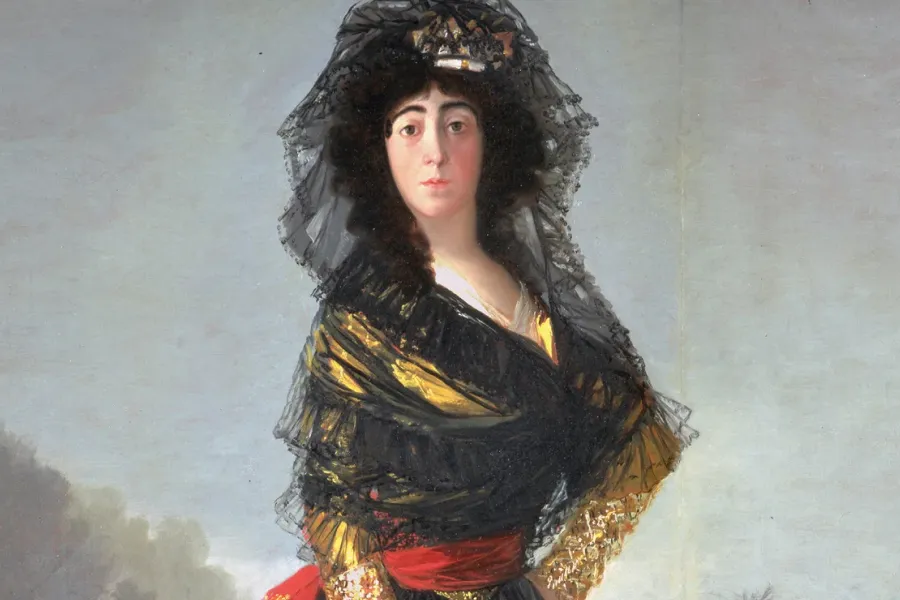
A. There are, according to current scholarship, 160 existing portraits by Francisco de Goya - about a third of his painted output. The real number, though, is much greater since there are no pure landscapes in Goya's work, in that everything he ever painted deals with people. In the work of no other great portraitist are a nation's people, history, traumas, folk traditions, and superstitions so comprehensively and relentlessly captured. His subject was a good one since Goya lived in interesting times: his lifetime was a period that saw Spain pass through the effects of the French Revolution, the Napoleonic wars, and the restoration of the monarchy; it was ruled by a succession of authoritarian and liberal governments; and was simultaneously marked by the Enlightenment. Put his work together – the public and private paintings, the personal drawings and sketches, and the unsettling and sinister etching series – and what you have is a portrait in the round of Spain itself.
B
His work as a portraitist has its origins in the 45 tapestry cartoons he painted after he moved to Madrid in 1775. Although his designs don't show portraits, they do show types – the majos and majas who gave Madrid its street swagger, peasants and rich men, courting couples, singers, hunters, children, and young men and women playing blind man's buff or tossing a mannequin into the air. The pictures have a light, rococo palette and the faces are individualised without being those of individuals. But in them, Goya practised poses and groupings and a way of handling light on and around figures that was to be invaluable.
C
The tapestry designs also show social roles rather than the people inhabiting them, but when it came to painting portraits proper, Goya would turn this on its head. His greatest strength as a portraitist is that regardless of the status of the sitter, be they a king and queen, the Duke of Wellington, or a doctor or writer, it was the person he showed first and their position second. It was this trait, most apparent in his royal portraiture, that has led him to be seen as satirising the Bourbon monarchy rather than as a painter who depicted what he saw without showing obeisance to the usual flattering conventions. In Robert Hughes's phrase, he did not 'pay reflexive homage to authority' but instead walked a fine line between respect and truth.
D
Goya's success was rapid; in 1785 he was made deputy director of painting at the Royal Academy (his main message to his students was subversive – 'there are no rules in painting') and in 1786 became pintor de cámara, required to paint 'works required for royal service'. Не immediately spent some of his 15,000-reales salary on a two-wheeled gig (one of only three in Madrid) which he promptly crashed on his first outing. His amour propre untouched, he wrote to his childhood friend Martín Zapater: 'I have now established an enviable way of living: I do not wait on anyone in antechambers, and if anyone wants anything from me they must come to me; I have made myself more in demand and unless it is a person of rank or at the request of a friend I would do nothing for anyone...'
E
Part of the reason for his success was that, unlike Gainsborough, for example, he did not resent portraiture as an economically necessary chore that ate away at the time he could devote to higher art. Portraiture fascinated him; it was, after all, part of that 'sacred science which requires so much study' and his portraits reveal a fully engaged artist. There is hardly any repetition in his poses (to help, he drew on prints of English portraits as well as classical statuary), he worked hard to give his sitters in repose a sense of latent movement, and he defined them by the careful depiction of the space around them. When it came to clothing he allowed himself extraordinary freedom, the frogging on uniforms or lace on a dress sketched in thick impasto rather than being laboriously defined. From close up such three-dimensional scumblings look out of focus but from a distance, they coalesce into silks, braiding, and gauze. Such varieties of technique within a painting keep the eye entertained and moving.
F
'My work is very simple. My art reveals idealism and truth,' Goya claimed. The truth though is always more apparent than the idealism. In the most important commission of his career, for example, the portrait of Charles IV and the royal family of 1800, he eschewed entirely the grandeur of majesty to portray the assembled Bourbons as they appeared - a motley grouping (a French visitor had likened Charles and his queen Maria Luisa to a butcher and his wife) in fancy clothes. Goya may have been a political liberal but he wouldn't have jeopardised his hard-won new position as first court painter – the first Spaniard since Velázquez to hold the role - in order to score political points at the expense of his patrons. That his sitters didn't regard the portrait as unflattering was evidenced by succeeding royal commissions, not least his 1815 portrait of Ferdinand VII. Ferdinand himself was physically unprepossessing, tyrannical, vicious, and small-minded and that is exactly how Goya shows him. The king, however, looking in Goya's particular mirror, saw no such characteristics staring back at him.
G
The private side of Goya's portraiture was a world away from the public. The contrast between the Ferdinand portrait and the remarkable 1820 double portrait, showing Goya with Dr Arrieta, represents a moral version of the three ages of man – the 73-year-old painter in the throes of a debilitating illness being tended by his doctor. If Ferdinand represents human malignity and Goya its frailty, then Arrieta stands for man's innate kindness. While not all his portraits are successful (some have a doll-like stiffness), this is what Goya at his best could do: in the guise of representing individuals he showed, without judging, man as a universal being.
🔥 Answer key (đáp án và giải thích)
1
G
Giải thích chi tiết
☺️ Ứng dụng Linearthinking để giải quyết dạng bài Matching Information
📌 Dạng Matching Information chúng ta nên làm cuối cùng, sau khi đã làm các dạng câu hỏi khác nhé DOLBIES, bởi vì lúc này mình đã đọc và hiểu nội dung của bài rồi, cộng thêm nghệ thuật Specify của Linearthinking → sẽ nhanh chóng tìm được vị trí đáp án hơn!!
-------
Step 01: Read the question to predict
Hiểu câu hỏi: a weakness in some of Goya's paintings
Specify & Predict: Câu hỏi yêu cầu tìm một hạn chế / điểm chưa thành công trong tranh của Goya,
ví dụ: tranh thiếu tự nhiên, chưa đạt hiệu quả như mong đợi.
-------
Step 02: Khoanh vùng đoạn văn
🔍 Từ khóa: “weakness”, “some/not all”, “paintings/portraits”
→ Dựa vào các từ khoá trên, có thể khoanh vùng được đoạn G vì có xuất hiện cụm: “not all his portraits are successful” (không phải tất cả tranh chân dung đều thành công) và “doll-like stiffness”(sự cứng đơ như búp bê) → một điểm yếu cụ thể trong tranh.
B. His work as a portraitist has its origins in the 45 tapestry cartoons he painted after he moved to Madrid in 1775. Although his designs don't show portraits, they do show types – the majos and majas who gave Madrid its street swagger, peasants and rich men, courting couples, singers, hunters, children, and young men and women playing blind man's buff or tossing a mannequin into the air. The pictures have a light, rococo palette and the faces are individualised without being those of individuals. But in them, Goya practised poses and groupings and a way of handling light on and around figures that was to be invaluable.
C. The tapestry designs also show social roles rather than the people inhabiting them, but when it came to painting portraits proper, Goya would turn this on its head. His greatest strength as a portraitist is that regardless of the status of the sitter, be they a king and queen, the Duke of Wellington, or a doctor or writer, it was the person he showed first and their position second. It was this trait, most apparent in his royal portraiture, that has led him to be seen as satirising the Bourbon monarchy rather than as a painter who depicted what he saw without showing obeisance to the usual flattering conventions. In Robert Hughes's phrase, he did not 'pay reflexive homage to authority' but instead walked a fine line between respect and truth.
D. Goya's success was rapid; in 1785 he was made deputy director of painting at the Royal Academy (his main message to his students was subversive – 'there are no rules in painting') and in 1786 became pintor de cámara, required to paint 'works required for royal service'. Не immediately spent some of his 15,000-reales salary on a two-wheeled gig (one of only three in Madrid) which he promptly crashed on his first outing. His amour propre untouched, he wrote to his childhood friend Martín Zapater: 'I have now established an enviable way of living: I do not wait on anyone in antechambers, and if anyone wants anything from me they must come to me; I have made myself more in demand and unless it is a person of rank or at the request of a friend I would do nothing for anyone...'
E. Part of the reason for his success was that, unlike Gainsborough, for example, he did not resent portraiture as an economically necessary chore that ate away at the time he could devote to higher art. Portraiture fascinated him; it was, after all, part of that 'sacred science which requires so much study' and his portraits reveal a fully engaged artist. There is hardly any repetition in his poses (to help, he drew on prints of English portraits as well as classical statuary), he worked hard to give his sitters in repose a sense of latent movement, and he defined them by the careful depiction of the space around them. When it came to clothing he allowed himself extraordinary freedom, the frogging on uniforms or lace on a dress sketched in thick impasto rather than being laboriously defined. From close up such three-dimensional scumblings look out of focus but from a distance, they coalesce into silks, braiding, and gauze. Such varieties of technique within a painting keep the eye entertained and moving.
F. 'My work is very simple. My art reveals idealism and truth,' Goya claimed. The truth though is always more apparent than the idealism. In the most important commission of his career, for example, the portrait of Charles IV and the royal family of 1800, he eschewed entirely the grandeur of majesty to portray the assembled Bourbons as they appeared - a motley grouping (a French visitor had likened Charles and his queen Maria Luisa to a butcher and his wife) in fancy clothes. Goya may have been a political liberal but he wouldn't have jeopardised his hard-won new position as first court painter – the first Spaniard since Velázquez to hold the role - in order to score political points at the expense of his patrons. That his sitters didn't regard the portrait as unflattering was evidenced by succeeding royal commissions, not least his 1815 portrait of Ferdinand VII. Ferdinand himself was physically unprepossessing, tyrannical, vicious, and small-minded and that is exactly how Goya shows him. The king, however, looking in Goya's particular mirror, saw no such characteristics staring back at him.
G. The private side of Goya's portraiture was a world away from the public. The contrast between the Ferdinand portrait and the remarkable 1820 double portrait, showing Goya with Dr Arrieta, represents a moral version of the three ages of man – the 73-year-old painter in the throes of a debilitating illness being tended by his doctor. If Ferdinand represents human malignity and Goya its frailty, then Arrieta stands for man's innate kindness. While not all his portraits are successful (some have a doll-like stiffness), this is what Goya at his best could do: in the guise of representing individuals he showed, without judging, man as a universal being.