Welcome back to this series of lectures on the development of photography.
Last week we looked at a type of photography called daguerreotype, the first commercially successful photographic process.
Today we're going to look at how this was gradually replaced by a technique called calotype.
Daguerreotype was a major breakthrough but there were problems with it.
In particular because the image was produced on a copper sheet it was expensive to create each photograph.
As a result during the 1840s a man named William Talbot began looking for an alternative approach.
Talbot eventually became an influential figure but he always said he was not a professional photographer.
In fact he trained as an artist.
His greatest interest was painting and he only became involved with photography as a secondary interest.
Talbot spent many years trying to solve the problems associated with daguerreotype photography.
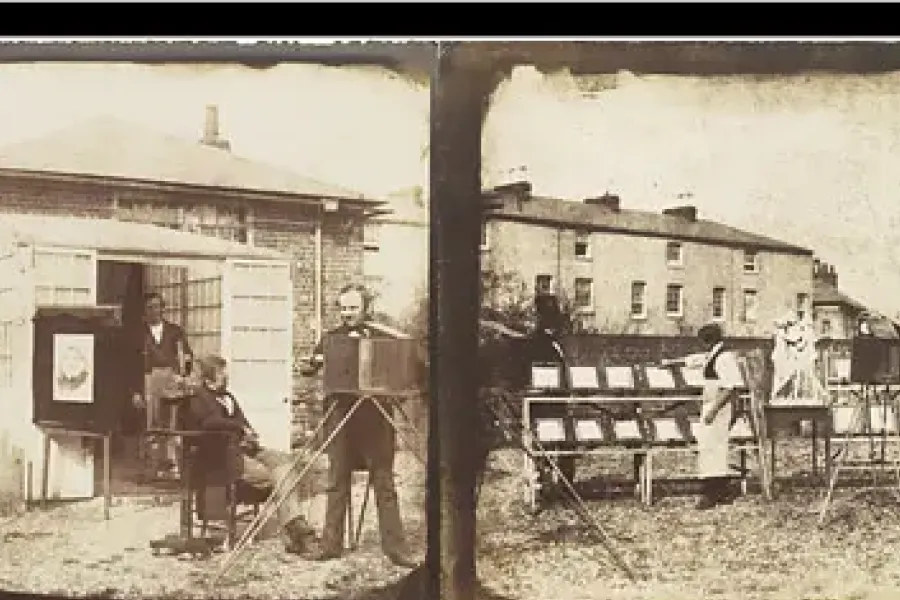
He tried a number of different approaches and it took some time to find a successful alternative but in the end what he did was instead of producing each photograph on a sheet of copper he produced them on paper and at the time this was a great advance.
Talbot's technique which he called calotype photography had other advantages as well.
Maybe the most important was that the pictures themselves weren't as sharp as the ones produced before.
The sharpness had been a problem because it distorted everything but this new calotype process produced images that were realistic compared to all earlier photographs.
Calotype photography was invented in Britain but it was also popular with French photographers.
The 1850s were a time of rapid development in France and photography was used to record these changes.
One example of how important photography had become occurred in 1851 when the French government established a society to promote the interests of photographers, something that hadn't happened before.
To begin with there were five members and maybe the most important was a man called Gustave Le Gray.
Le Gray became increasingly fascinated by the calotype process most of all he wanted to produce different types of image so began a series of experiments to see how this might be done.
His greatest success was when he designed the first camera that was able to create enlargements, an important step forward.
Another of Le Gray's innovations was his work on the size of the equipment necessary to take photographs.
Originally it was very heavy and difficult to move about but Le Gray made it lighter and smaller.
This meant he could take photographs outdoors more easily rather than being limited to the studio which had sometimes been the case until then.
Le Gray produced numerous photographs during this period and was highly regarded among fellow photographers but his work also became famous among the general public because he wrote a very popular series of books describing the calotype process and giving examples of his work.
The simple fact was that people liked photography.
They thought it was reliable especially compared to drawing where the human hand might alter or exaggerate things.
This had various consequences one of which was that photography was now often used to record the huge program of renovation work of historical buildings in France during the 1850s.
The camera doesn't lie so people said.
As a result the calotype process was admired not only by photographers but increasingly by the government and by mainstream society.
However debate still remained about whether photography could truly be called an art form like sculpture or drawing.
Certainly although the public liked it in the opinion of critics photography could not be compared to other established forms of art.
So in summary what can we say about calotype photography during this period?
One thing to re-emphasise is that the 1850s were a period of great development in Britain and France.
The culture in both countries admired all new technological advances and photography represented these ideas because it was considered to be a science by most people.
However photographers didn't stop experimenting with new materials to improve the quality of their work.
Most of all they were searching for ways to make images more permanent because calotype photographs tended to fade over time and in the end they found that if the image was produced on glass it lasted much longer.
So calotype photography was slowly replaced by other techniques.