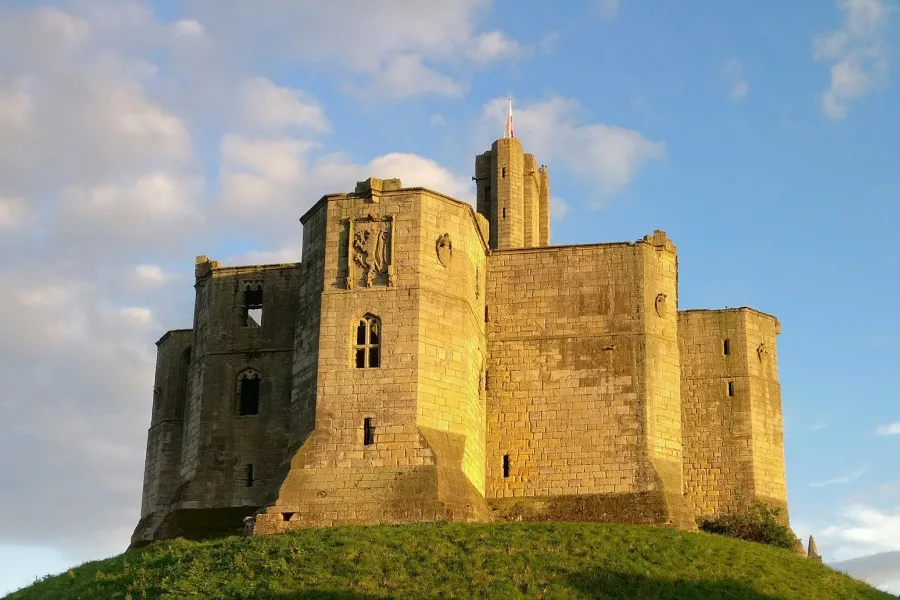
Guedelon is no ordinary building site. There is no rumble of diggers or shriek of circular saws. All is peaceful and quiet, save for the continual tapping of the small army of stonemasons, the quacking of the ducks or the occasional crow of the cockerel. Slowly but surely, a brand new medieval castle is rising from the woods of Guedelon, Yonne, home to the Burgundy vineyards in the heart of France. The year is 1229, that is, for the purposes of this project: to build a prince’s ‘chateau fort’ using only the techniques and tools of the 13th century.
'The project has four main aims,' explains Macyline Martin, managing director for Guedelon. The first is experimental archaeology - to try and verify all the theories, based on documents of the time. There’s also a social aim, because this region is very poor, with high unemployment: so it provides jobs. Then there’s tourism: 'the project couldn’t work without visitors because a lot of money is needed to pay people working here and to run the site. And finally, we want to open experimental archaeology to everybody - because in France, history and architecture are still very much oriented to academics.’
The idea for the project emerged about five years ago. It was the brainchild of Michel Guyot, who bought and renovated the nearby castle of Saint-Fargeau, which was built and rebuild between the 10th and 18th centuries. Beneath his castle were the original foundations of the 13th century building. Guyot thought it would be fun to construct a chateau to the same plans, but this proved too big to attempt. So Jacques Moulin, managing director for the local historical monuments, drew up plans for a smaller castle that would still be ambitious, but realistic. Five months later, having managed to get together 600,000 Euros in funding, they began looking for a site that would provide all the materials they needed: stone, water, sand, wood, iron and clay. They found it at Guedelon.
The only major cheat so far was early on when a mechanical earthmover was brought in to raise the castle floor. Archaeologists know how it was done in the 13th century: by backbreaking, tedious work. 'To do it by hand would have added ten years to the project,’ says Franck, one of the site’s guides. It’s still a long, painstaking task. Next to the beginnings of the east wall is the quarry, where masons extract the ferruginous limestone to build the thick castle walls. They bore lines of holes into the rocks and then they hammer metal wedges into them until the rock splits along the line. It is then hewn into bricks, and cemented together with a mortar of chalk, sand and quicklime.
Quicklime is made by heating limestone to 800°C - done off-site because of the poisonous gases that come from the process. Little wonder that 13th-century lime-burners had a life expectancy of only 25-30 years. ‘The bricks are laid horizontally for the first metre of the wall, and vertically thereafter,’ says Franck, ‘because if there was a shock from, say, a catapult, and the stones were all laid in the same way, the shockwave would shatter the wall.’
The scientists and craftspeople alike are learning on the job, as they don’t know exactly why or how things were done as the historical evidence suggests. One such discovery was the significance of the marks that masons carved into each finished stone. It was thought that these probably had superstitious meaning, but experience and archaeological research reveals three very practical uses: to establish how much each mason should be paid; to keep track of who made what, in case of any problems; and to specify where the stone should be placed in the castle reconstruction.
Guedelon has a scientific committee of archaeologists that discusses ideas and problems as they emerge, and will approve works and practices only when its members are sure that they are true to the 13th century. Reaching unanimity is not always easy. ‘All the big plans for the castle itself are all done but the details aren’t settled,’ says Martin. ‘So, during the winter, the site manager and I visit other castles in the region. When we see something we want to do here, we draw a sketch, make plans and show this to the committee.’
The castle will take at least a decade longer to build than it would have in the 13th century. ‘With the same number of workers it would have taken 15 years then,’ says Franck. ‘But we could do this too if we had only professional workers, if the site wasn't open to the public and if we worked harder - today it’s illegal to work more than 8 hours a day, as they did at the time.’
Workers come and go but at any one time about 40 people are working on the site. Some are students, others have ‘downshifted’ from other careers, others are local unemployed people learning skills they might use elsewhere - say, in chateau restorations around France. They are trained on the site as the need arises, and in the winter they may be trained in modern techniques as part of Guedelon’s social remit.
So, indeed, what will happen when Guedelon’s magical-looking castle is complete? They might build houses around it; perhaps villages may develop, testing out 13th-century agricultural techniques. If they can build this castle, anything seems possible.