Hello everyone, today you've come to the open day at Sunnyside Farm.
To start with, I'd like to tell you a little about our history and what we do here.
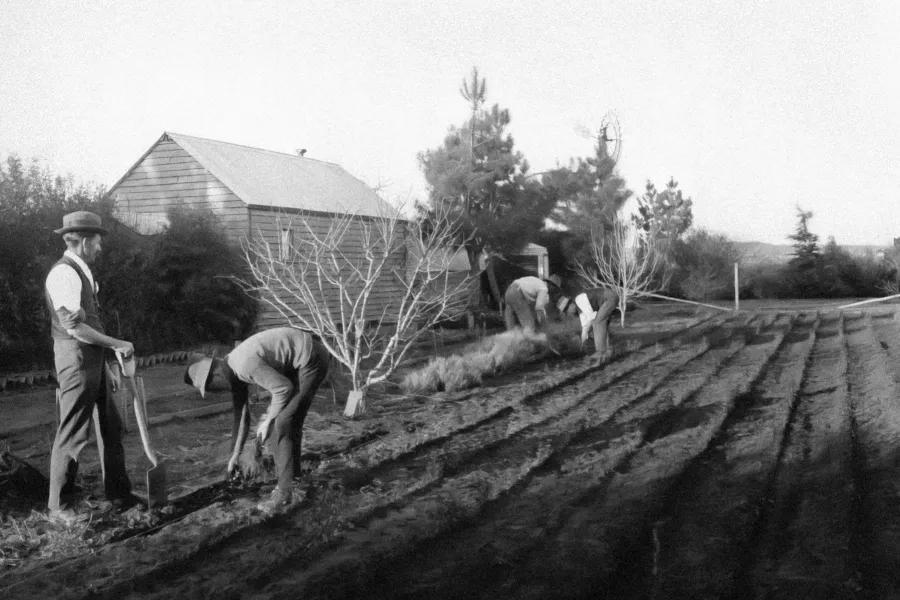
The Wilson family have been farming here at Sunnyside since the start of the last century.
To start with, it was mainly an arable farm, which means that there were no animals.
To start with, Sunnyside specialized in growing vegetables.
The produce would then be sold in local markets around the area.
At that time, the farm became a major source of work for the local population, especially in summertime in the harvest period.
After the First World War, the farm turned towards meat production.
The farm had a herd of cows for producing beef and also several hundred sheep to produce lamb every spring.
Rather uncommon for a British farm, the meat produced was sold for export.
This carried on for around 50 years, with the interruption of course of the Second World War.
At the time of the war, the farm actually closed down for a while, as most labourers and the farmer himself were away in the army.
The farm started up again when peace returned.
In the early 70s, the farmer at that time saw that he would earn better margins producing milk.
He bought a herd of dairy cattle and sold the other animals.
This was a major change and quite a big commercial risk, as the farmer also had to equip his dairy to get the milk from the cows, and this was quite expensive.
However, the gamble paid off, and Sunnyside became a successful producer of milk for the whole area.
Around 10 years ago, milk became less and less profitable.
This was because some big companies created increased competition after they bought up some of the surrounding farms and started producing cheap milk.
The farmers at Sunnyside at that time are the same ones as Mr. and Mrs. Wilson.
They had been interested in farm tourism for some time, as they had seen it work quite well up in Scotland, where they had gone on a holiday.
They saw how popular this was, and after some research, they saw that no one else in the area was doing anything like this.
After a year of planning, they took the plunge and bought a wide variety of different farm animals that people could come and see and interact with.
Naturally, this project is predominantly targeted at children, though you'd be surprised how many adults come by themselves for the experience.
So, let me now tell you about some of the things that we do here.
We have a number of different animals for people to interact with, and other things to do as well.
To start with, people can visit the old dairy, which is where the cows used to be milked.
Here, there is a small museum on dairy farming.
A short film is played here every half an hour.
If you actually want to try milking some cows yourself, go to the West Stable.
This takes place twice a day at 9.30am and 4.30pm. Another area of farming that we cover is the lamb industry.
In the East Barn, you can see the sheep close up, and in season, you can see and feed the lambs.
There is also an exhibition on the history of the sheepdog, which of course has always been a vital companion of the sheep farmer.
Every afternoon at 2pm, you can see an exhibition of sheepdog skills in the South Field.
This goes on for around 25 minutes.
In the North Field, we have a favourite for all ages.
There you can find our donkeys and horses.
These can be fed or ridden on.
It's important to have adults with children if they want to try the riding out.
If the children are very young or nervous, it's best to try a donkey.
All our donkeys are very placid and good-natured.
In three months, the horses and donkeys will move to the West Field, as we are planning a campsite in the North Field.
People will be then able to stay overnight at the farm in tents or caravans.
I've mentioned quite a few locations so far.
Don't worry, just outside this building is a map of all the activities and where to find them.